
Key West watersports comparison
Key West Parasailing: Fury vs. Sunset Watersports Reviews
Compare Fury and Sunset Watersports parasailing by departure point, flight time, safety questions, photo packages, weather, and real booking tradeoffs.
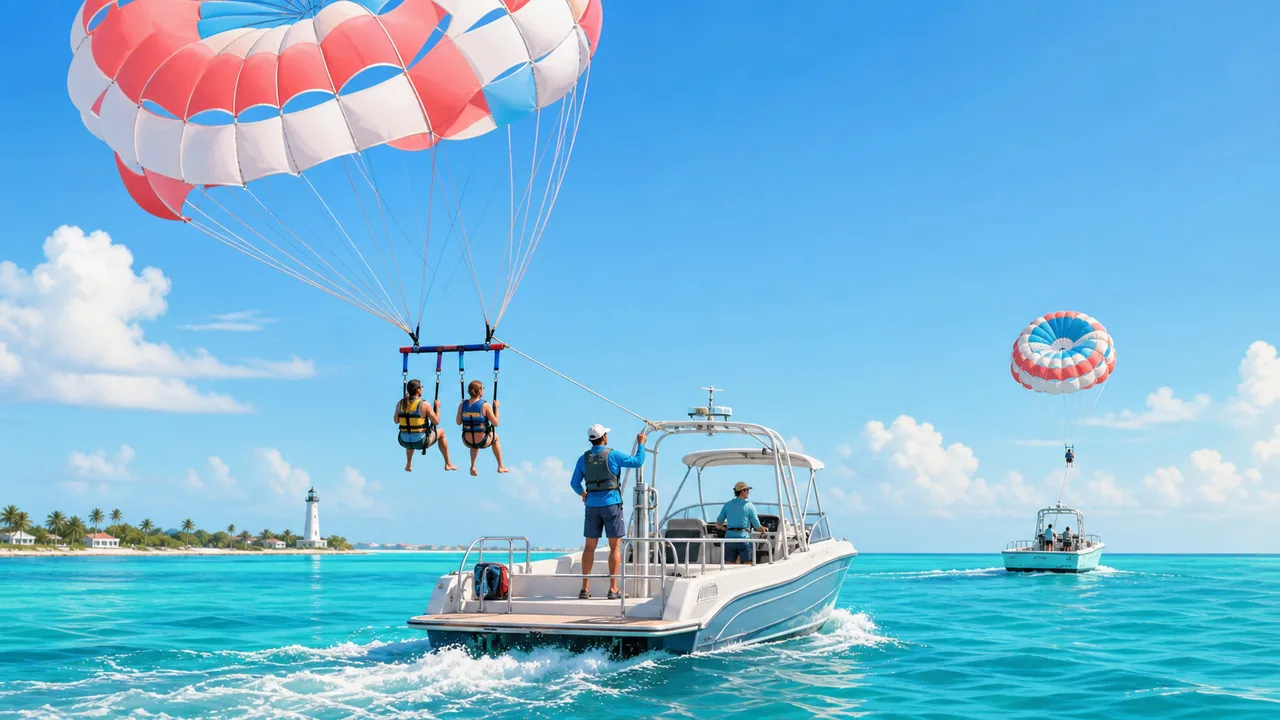
Parasailing operators sell the view, but the booking differences are mostly on the boat: departure location, check-in, time aloft, passenger rotation, photo pricing, age and weight rules, and how weather decisions are handled.
Fury and Sunset Watersports dominate the Key West comparison. Public feedback for both is strong, which makes convenience and transparent policies more useful than trying to crown a universal winner.
Avoid a vague watersports booking
Check the departure, riders, and date together
Group ages and rider combinations affect eligibility, so include them in the first availability request.
The view is similar; the logistics are not
Downtown departure can save a cab from Old Town. Smathers Beach may be easier for a hotel on South Roosevelt Boulevard. A small price difference disappears quickly when parking, a ride, and a missed check-in are included.
Ask whether the advertised duration is total boat time or flight time. Riders rotate, so a one-hour outing does not mean an hour in the air. Also confirm whether observers can ride, whether tandem or triple flights are decided by combined weight and conditions, and whether tips or media packages are extra.
Fury: broad inventory and combination options
Fury advertises dry takeoffs and landings and sells parasailing alone and inside multi-activity products. The broader fleet is useful for travelers who want one checkout for jet skis, snorkeling, a waterpark, and parasailing.
Combination value comes with less time in each activity. Fury's current FAQ describes six to eight minutes of parasailing and fifteen to twenty minutes of jet-ski time per couple on the Ultimate Adventure. Buy it as a sampler, not as four full excursions.
Sunset Watersports: choose the desk before the brand
Sunset lists trips from its downtown operation and from Smathers Beach. For an Old Town stay, downtown can eliminate a cross-island ride; for a hotel along South Roosevelt Boulevard, Smathers may be the shorter move. The reservation needs the actual street address because the familiar Sunset Watersports name appears at more than one starting point.
Treat a review as evidence about the dock and product it names. A report about parking, desk staff, boarding delay, or a particular crew does not automatically describe the other departure. Put the product name, boarding point, arrival cutoff, scheduled boat duration, and current airborne estimate in the same confirmation.
Florida's no-fly rules use numbers, not a vague disclaimer
Section 327.375 names the conditions that close commercial parasailing: sustained wind above 20 mph; gusts at least 15 mph above the sustained wind; any gust above 25 mph; visibility under half a mile in rain or heavy fog; or a known lightning storm within seven miles.
Before carrying passengers, the operator must look at observed and forecast conditions and enter them in a weather log. The same law requires at least $1 million per occurrence and $2 million aggregate liability coverage, an appropriate Coast Guard passenger-for-hire license, VHF radio, and separate electronic access to National Weather Service information. A captain may stop earlier; the numbers are outside limits, not an order to launch.
A phone from an observer's seat is not the same photo product
Put the photo-set charge into the total before choosing the cheaper ticket. The useful details are plain: current price, approximate image count, delivery method, whether the set can be viewed first, and how long the files remain available. An observer may be seated below the flight path with spray and other passengers in the frame, so “we will take our own” is a plan only after the boat's camera rules and seating are known.
Compare direct-booking cancellation terms with marketplace terms. A cheaper reseller price is not better if the weather credit is less flexible.
Our verdict
For a standalone flight, choose by location, policy clarity, and final price. For a family that wants several activities, Fury's bundle is easy to understand once the short per-activity times are accepted. For a hotel near Smathers Beach, Sunset's beach departure can beat a downtown transfer. The operator that answers the eligibility questions clearly is the safer booking than the one with a marginally higher star average.
Six minutes aloft can sit inside a much longer boat trip
Fury publishes roughly six to eight minutes aloft for the parasailing segment of its Ultimate Adventure. That is a useful scale, but not a guarantee for every standalone departure. Briefing, the run from the dock, and each group's turn make up the rest of the reservation, so compare airborne time with dock-to-dock time instead of treating them as the same number.
Picture a boat carrying four flying pairs. Each pair receives its own launch, tow, and landing while the other six guests remain aboard; a second boat with two pairs can sell the same airborne minutes inside a shorter outing. Wind and combined weight can also turn the requested triple into a tandem plus one solo rider. The crew controls that arrangement on the day.
Mobility question: can this guest board this boat?
That is the wording I would use with the desk. Give the specific limitation—wet steps, a recent operation, pregnancy, serious back or neck trouble, or difficulty moving across a deck—and ask how boarding works at the named departure. “No experience required” describes parasailing skill; it says nothing about getting from the dock into position.
Fear needs a different call. Have the crew describe the deck launch and landing, the gradual tow, communication aloft, and any water dip. Then settle the money question: if the guest rides out but will not enter the harness, is the unused flight still charged?
The booking can end four different ways
Operator cancellation before departure. Boat ride with no flight. Some flyers completed before a weather stop. Customer backed out. I would copy those four lines into the reservation email and put the promised remedy beside each one; a single “weather permitting” sentence does not price them.
The other number is the actual total. Start with fare and add tax, web fee, observer seat, transportation or parking, photos, and the expected tip. Note the personal-camera rule beside the photo line, because the post-flight offer may be gone after the group leaves the desk.
A review becomes useful when it identifies which of the four outcomes occurred and what the company did next. Dock, product, briefing, boarding, time aloft, and the written remedy can be checked. A perfect view cannot.
What the desk should be able to prove
Ask to see the liability-insurance details that Florida law makes available at the place of business: carrier, address, and policy number. The captain's Coast Guard passenger-for-hire license has to match the vessel and passenger count and travel aboard. The required VHF radio and separate weather device are boat equipment, so the desk should be able to identify the vessel being used.
Keep that vessel name with the boarding map pin, desk or dock, check-in cutoff, passenger maximum, and observer rule. If the boat departs and the captain then cancels flight, the company's terms should decide whether the sale became a boat ride, a shortened service, a new departure, or a refund. Those facts matter more than a height claim.
One confirmation email should settle the moving pieces
A workable confirmation reads like this: two adults and one child; requested tandem plus solo; pairing subject to the captain; usual minutes aloft; estimated dock-to-dock time; passenger count; named dock; check-in cutoff; observer seat; photos; final total. If the seller cannot fill in a line, the customer knows exactly what remains uncertain.
The same record should settle boat takeoff and landing, any water dip, photo pricing, gratuity, transportation, lockers, cancellation protection, and the result when a guest changes their mind after departure. A total with those lines filled in is comparable; two headline fares are not.
How to read “they cancelled even though it was sunny”
The Florida rule is based on conditions in the operating area, including wind, gust spread, visibility, and nearby lightning—not the patch of sky visible from a hotel. The Key West National Weather Service page adds marine-zone forecasts, observations, warnings, and coastal products. A sunny-shore complaint therefore needs the operator's stated reason and the time of the decision before it proves poor service.
The service question comes next: Were passengers told promptly? Had the boat boarded? Did anyone fly? Did the company apply the refund or rebooking term it sold? A conservative no-fly call can be correct. Poor communication or a broken written remedy is a separate and reviewable failure.
Resolve medical and child fit before the refund clock starts
Pregnancy, a recent operation, serious back or neck trouble, limited mobility, or another relevant condition should be raised while the reservation is still refundable. Give the operator the facts and get a description of the boarding route and restrictions. A guest may also need advice from a qualified clinician; a booking agent cannot decide medical fitness.
A child's reservation turns on the age rule, harness fit, adult requirement, ability to follow the briefing, and the captain's pairing decision. Give the correct age and weight when asked. If the family will not accept a different pairing or a no-fly call, this is the wrong activity to book on a nonrefundable ticket.
A useful reservation record fits on one screen
Save the names and ages, number flying, observers, requested pairings, disclosed boarding concern, exact desk or dock, map pin, arrival cutoff, ID rule, waiver link, and weather contact together. That is enough for another member of the party to reach the right place and explain the booking without reconstructing a phone call.
Below it, keep four cancellation labels: operator cancellation; boat departed but no flight; weather change after partial completion; customer declined. Copy the remedy beside each label. A single sentence about “weather permitting” does not resolve those different bills.
After the trip, compare the record with what happened. Was the airborne estimate close? Did the photo offer, briefing, boarding, and location match? If several recent reviewers describe the same gap, cite the written term when asking the company about it. That produces a useful complaint instead of another unexplained low rating.
Sources and verification
For this page, Florida Statutes § 327.375 supplies the mandatory insurance, captain-license, radio, weather-access, and no-fly rules. The National Weather Service Key West page supplies marine forecasts and warnings. Fury and Sunset Watersports pages establish their current product descriptions and locations; the linked RealReviews profiles keep business-specific evidence attached to the correct operator. None of those sources can promise a future departure, price, crew, or passenger pairing, so those details remain items for the dated reservation record.
Frequently asked questions
How long are you in the air?
Plan on about 6 to 8 minutes airborne, not the full boat-trip duration. Fury publishes that range for the parasailing segment of its Ultimate Adventure; standalone rotations can differ with the boat load and conditions. Ask for the current airborne estimate and total dock-to-dock time so a 60- to 90-minute reservation is not mistaken for an hour in the parachute.