
Key West wedding venue comparison
Best Key West Wedding Venues: Compare Beaches, Gardens, Historic Homes, and Resorts
Compare Key West wedding venues by setting, guest count, weather backup, vendor rules, lodging, transportation, and total planning complexity.
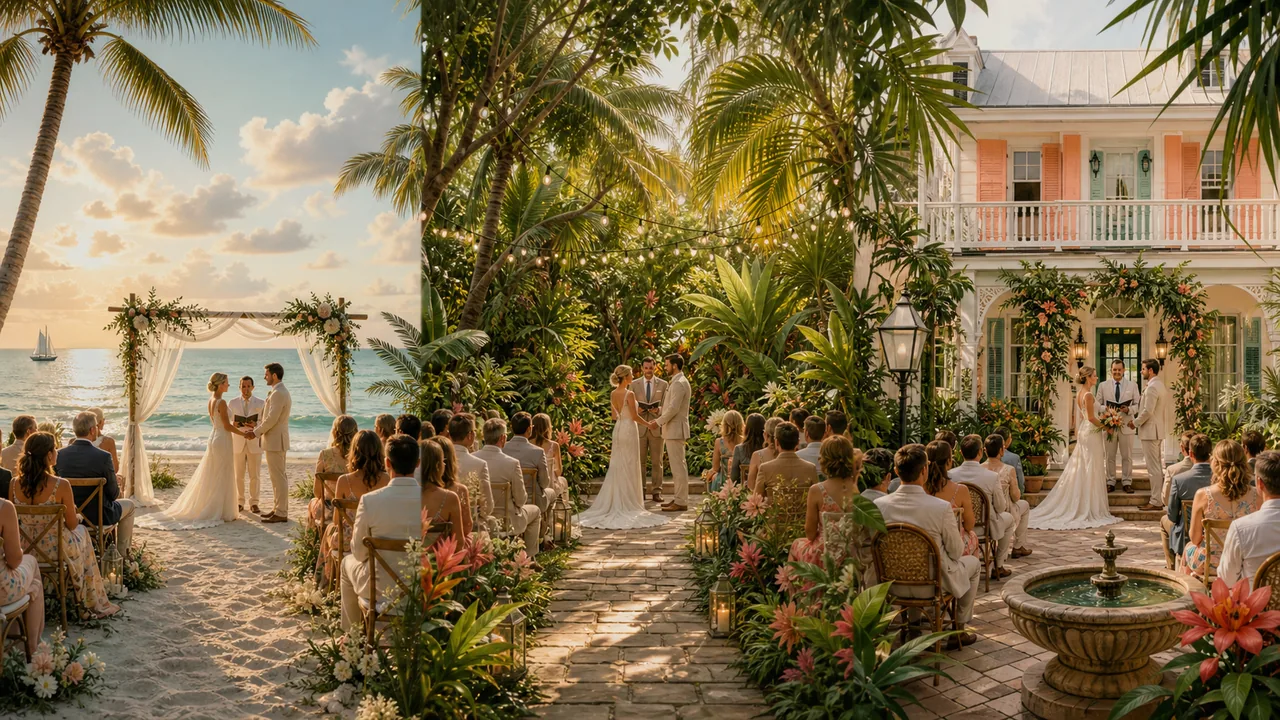
The best Key West wedding venue is not one universal address. It is the place that can handle your guest count, weather plan, reception, vendors, transportation, and lodging without forcing the celebration into a format you never wanted. A beach ceremony, a historic garden, and a waterfront resort may share the same sunset, but they create very different contracts and planning jobs.
A usable venue proposal must state the ceremony and reception spaces, guest limits, rain plan, hours, catering and bar rules, rentals, vendor access, sound limits, transportation, lodging obligations, taxes, service charges, and cancellation terms. Compare those terms for the actual date and event rather than treating an outside star average as a substitute for the contract.
Check real venue fit
Send your date, guest count, budget, and non-negotiables
Choose up to three Key West venues and send one structured inquiry. The venues must confirm availability, pricing, restrictions, and any booking.
The short list by wedding format
For an outdoor garden wedding, the Key West Garden Club at West Martello offers the most literal combination of tropical planting, historic masonry, and ocean edge. Its official rental information says events may accommodate up to 100 guests. Events with more than ten people occur after normal public hours, while very small events may be held during the day without exclusive use of the public garden. That distinction affects photography, privacy, timing, and setup.
For a beach ceremony, Fort Zachary Taylor provides a state-park setting, rocky shoreline, sunset orientation, and a Civil War-era fort. The current wedding agreement says groups of seven or more must reserve a specific site and that the reserved ceremony window is limited to two hours including setup and breakdown. This is a strong ceremony choice, not automatically an all-in-one reception venue.
For historic Old Town privacy, the Truman Little White House rents three lawns around the presidential residence. The venue's current event information describes evening garden rentals from 6 p.m. to 10 p.m. and makes clear that the rental is for the location; catering, equipment, music, and other vendors are contracted separately. It is close to Duval Street while feeling buffered inside Truman Annex.
For a hotel-centered destination weekend, Oceans Edge Resort & Marina on Stock Island combines event spaces, on-site catering, room blocks, resort amenities, and marina surroundings. That can reduce vendor and lodging coordination, but guests need a transportation plan for Old Town. Southernmost House offers a more intimate mansion-and-oceanfront identity at the south end of Duval Street, better suited to couples who want character and proximity rather than a large convention-style resort.
- Garden and historic fort: Key West Garden Club at West Martello.
- Beach ceremony with park rules: Fort Zachary Taylor.
- Private historic lawns near Old Town: Truman Little White House.
- Rooms, catering, pools, and marina weekend: Oceans Edge Resort & Marina.
- Oceanfront historic-house atmosphere: Southernmost House.
Venue comparison: what each option really commits you to
A venue fee is not a wedding total. Site-only rentals transfer more decisions to the couple or planner: tables, chairs, tenting, lighting, power, catering, bar service, cleanup, transportation, insurance, and weather backup may all sit outside the base agreement. Hotel venues may bundle several of those pieces, but the convenience can come with food-and-beverage minimums, service charges, resort pricing, preferred-vendor rules, and room-block terms.
The Key West Garden Club's published policies require licensed and insured alcohol service and describe insurance requirements. The garden remains public during normal daytime hours, so couples seeking exclusivity need an after-hours plan. At the Truman Little White House, a professional caterer is required, the site must be broken down professionally, and separate rental vendors are commonly needed. Those are not defects; they are the operating model.
Fort Zachary Taylor is similarly specific. The wedding agreement treats setup, ceremony, and breakdown as part of the reserved window. A couple picturing a long cocktail period on the same beach should verify what is permitted rather than assuming a ceremony reservation includes a reception. State-park access, public visitors, parking, entry fees, sound, décor, and an indoor-fort weather alternative all deserve written answers.
Oceans Edge presents the opposite planning model. Its wedding page offers on-site catering, professional planning support, preferred vendors, guest rooms, and resort amenities. That can simplify handoffs, especially when many guests fly in. It also makes the resort's proposal and room-block agreement more important: compare the complete event total and guest obligations, not merely the ceremony-space price.
Guest count changes more than the number of chairs
A destination wedding with 30 guests and one with 100 guests are different logistical products. Larger groups need more than physical capacity. They need enough restrooms, power, covered space, transportation seats, catering staging, service staff, and realistic transition time between ceremony and reception. A venue that technically holds the group may still create a poor flow.
West Martello publishes a 100-guest maximum, making it useful as a hard early filter. The Truman Little White House spreads activity across three lawns, but couples should request a sample layout for their actual seated dinner, dance floor, bars, catering path, and tent rather than interpreting a broad claim about event sizes as a floor plan. Fort Zachary's agreement separates smaller and larger parties and requires reservations for seven or more.
Hotel and marina venues can usually support more complex food, beverage, and room needs, but capacity still depends on the chosen event space and setup. Ask for seated, cocktail, and rain-plan capacities separately. A ballroom number does not establish the comfortable limit for dinner, dancing, staging, and a band.
Count vendors and required personnel when evaluating flow even if the venue's formal guest limit excludes them. Photographers, musicians, planners, officiants, catering staff, rental crews, and transportation drivers consume access, parking, meals, and setup time. Children, wheelchairs, strollers, and older relatives change the useful capacity of narrow paths and uneven historic surfaces.
Weather backup is part of the venue—not an optional add-on
Key West's appeal is outdoors, and that means the backup plan should be evaluated with the primary setting. Ask what happens for rain, wind, heat, lightning, flooding, or a named storm. The answer must identify an actual covered location, its capacity, the decision deadline, who makes the call, and what extra rentals or labor it triggers.
A tent is not a complete hurricane-season plan. It may not be usable in high wind, can require permits or approved vendors, and needs installation time. The Truman Little White House lists local tent vendors but still requires the couple to contract those services separately. West Martello's historic garden and Fort Zachary's shoreline make vendor access and weather timing particularly important.
For a resort such as Oceans Edge, request the indoor backup space in the contract rather than relying on a salesperson's general assurance. Verify whether another event could hold that room, whether moving indoors changes the food or rental minimum, and when the venue requires the decision. At a small historic property, the rain capacity may be much lower than the fair-weather capacity.
Heat is a separate planning constraint. Shade, water stations, guest arrival time, ceremony length, attire, and accessible transportation can matter even on a clear day. Sunset photographs may be the visual goal, but guests should not wait outside for an hour to achieve them. Ask the photographer and venue to build a timeline around the actual sunset and travel time for the date.
Old Town, Stock Island, and the transportation decision
A central venue can reduce organized transportation when guests stay nearby, but Key West walkability is conditional. Heat, rain, formal clothing, mobility, uneven sidewalks, and late-night safety can turn a short map distance into a ride. The Truman Little White House sits inside Truman Annex near Old Town hotels and attractions. Southernmost House is at the opposite end of Duval Street, close to lodging but farther from the Historic Seaport.
Fort Zachary Taylor is reached through the state-park entrance and should not be treated like a curbside Old Town address. West Martello sits beside Higgs Beach on Atlantic Boulevard. Oceans Edge is on Stock Island, removed from the Old Town core. None is inherently inconvenient; each needs a different shuttle, parking, or lodging strategy.
Request the precise guest-entry point rather than using the property's mailing address. Confirm bus access, loading time, parking fees, rideshare pickup, bicycle or scooter safety, and whether vehicles can remain after the event. If ceremony and reception are at different places, calculate the door-to-door transfer with loading and late passengers—not only driving time.
A room block can simplify the shuttle plan, but it can also create financial obligations. Ask whether rooms are courtesy-held or guaranteed, the release date, attrition terms, resort and parking fees, minimum stay, cancellation policy, accessible room inventory, and how guests obtain the group rate. Oceans Edge currently advertises room blocks without a minimum room requirement, but the actual proposal controls.
How to compare proposals without losing the total cost
Send the same event brief to every finalist. Include preferred and alternate dates, ceremony and reception needs, estimated adults and children, desired meal style, alcohol plan, music, accessibility, transportation, room-block estimate, and rain expectations. A vague request produces proposals that cannot be compared.
Separate fixed venue fees from per-person charges and conditional costs. Then add service charges, tax, catering minimums, bar minimums, rentals, tenting, power, lighting, security, cleaning, insurance, permits, delivery, setup, overtime, cake cutting, vendor meals, transportation, and planner requirements. Ask which figures may change with final count and which are locked at signing.
Do not compare a site-only historic garden with a catered resort package by headline price. Normalize both to the same wedding: the same number of chairs, tables, meals, service hours, bars, rain coverage, transportation, and cleanup. Site-only can provide more creative control. A resort can reduce coordination and uncertainty. Either can cost more after all pieces are included.
Review the payment schedule and cancellation language before falling in love with a date. Ask about deposit refundability, force majeure, named-storm procedures, rescheduling, vendor cancellation, insurance, damage deposits, and the last date to reduce guest count. If the sales discussion promises something important, require it in the contract or attached event order.
- Site rental and exact hours, including setup and breakdown.
- Food, beverage, service charge, tax, and minimums.
- Tables, chairs, linens, tent, lighting, power, and restrooms.
- Rain room or alternate site with real capacity.
- Security, cleanup, insurance, permits, and overtime.
- Transportation, parking, room blocks, and accessibility.
- Deposit, cancellation, rescheduling, and storm language.
Marriage-license planning for destination couples
The Monroe County Clerk is the authoritative source for the license process. Its current guidance says applicants need valid photo identification, the license must be used within 60 days of its effective date, and there is no Florida residence or citizenship requirement. If both applicants live outside Florida, the clerk lists no waiting period. Florida residents can face a three-day waiting period unless the applicable premarital-course requirements are met.
The clerk currently lists an $86 license fee, reduced to $61 when both Florida-resident applicants provide qualifying premarital-course proof. Fees and procedures can change, so use the clerk's current page and appointment system rather than relying on an old wedding blog. The person performing the ceremony must return the completed license to be recorded.
Confirm who will officiate, whether that person is authorized under Florida rules, who physically holds the license, and who returns it. The clerk identifies ordained clergy, judiciary, Florida notaries, clerks, and deputy clerks among those able to solemnize a marriage. This is an administrative checklist, not individualized legal advice.
Destination schedules should leave room for travel disruption. Do not place the only feasible license appointment immediately before the ceremony. Bring the exact identification and prior-marriage information the clerk requests, and verify current office location and appointment instructions shortly before traveling.
Where a planner earns the fee
A planner is most valuable when the venue is not providing full coordination or when multiple locations and vendors must move on island time. Site-only gardens and historic properties require someone to own rentals, delivery windows, catering access, ceremony timing, weather decisions, guest transportation, and breakdown. A venue contact protects the property; that role is not automatically the couple's independent planner.
Ask whether the planner provides full planning, partial planning, or event-day coordination, and define when event-day work actually begins. Review the number of meetings, budget management, vendor sourcing, contract review, timeline, rehearsal, staffing, emergency kit, weather call, setup supervision, and cleanup handoff. Determine whether the planner receives referral fees or has exclusive vendor relationships.
RealReviews currently lists Key West planners including Aaron's Key West Weddings, Little Miss Planner, Big Day in Key West, WCO Events, and others. Their outside ratings remain attributed on their profiles. A strong public average is a useful discovery signal, not proof that a particular planning scope, communication style, or budget is right for your wedding.
Interview planners using the venue finalists. Ask what routinely goes wrong at each property, which rain plan they have actually executed, what rental and transportation assumptions couples miss, and how they document decisions. Specific answers are more informative than a gallery of beautiful completed events.
A practical venue-selection sequence
First, set the maximum guest count you can afford rather than the number you hope will decline. Second, identify the ceremony and reception format: beach plus restaurant, garden plus tented dinner, historic grounds plus external caterer, or resort package. Third, establish the lodging and transportation model. Only then request proposals.
Reduce the market to three venues with genuinely different strengths. Visit in person when possible, or request a live video walk-through that shows guest entrance, restrooms, catering path, power, rain space, sunset orientation, nearby noise, parking, and the exact boundaries of the rental. Ask to see the contract before paying a hold.
Score each finalist on fit, not fame: capacity with layout, weather resilience, complete cost, vendor freedom, accessibility, transportation, lodging, contract risk, and the amount of coordination transferred to you. A famous venue that forces unacceptable compromises is not the best venue.
Finally, verify the date and every volatile term directly. The venue controls availability, pricing, contract terms, and booking; a RealReviews inquiry records interest and requirements but does not create a reservation.
Sources and verification
Rules and public requirements link to the responsible agency. Business-specific service claims are checked against privately retained official material, while public ratings remain attributed to their original source. RealReviews does not turn outside reviews into invented testimonials, blend unrelated platforms into a house score, or sell placement in these comparisons. Recheck licenses, availability, scope, and price before hiring.
Frequently asked questions
What is the best Key West wedding venue for 100 guests?
The Key West Garden Club is the clearest exact-size starting point because it publishes a 100-guest maximum. For a resort event with rooms and broader infrastructure, compare an Oceans Edge space configured for the same seated count. Do not accept a generic capacity: require separate numbers for seated dinner, ceremony, cocktail layout, dance floor, and the rain backup.
Can you get married on the beach at Fort Zachary Taylor?
Yes, through the park's wedding reservation process. Current rules distinguish parties of six or fewer from groups of seven or more and limit reserved ceremonies to a defined window that includes setup and breakdown.
Do out-of-state couples have a Florida marriage-license waiting period?
No. Florida's three-day waiting period applies to Florida residents who have not completed an approved premarital course; non-Florida residents are not subject to that waiting period. Both applicants still must meet the Monroe County Clerk's identification and application requirements, so schedule the license around office access rather than relying on the ceremony day.
Does a Key West venue fee include catering and rentals?
Usually no. Treat the site fee as access to the space unless the proposal expressly includes food, beverage, tables, chairs, linens, service staff, setup, breakdown, power, lighting, restrooms, security, permits, and tax. Require an inclusion schedule beside the venue price so a low site fee is not mistaken for a low event total.
Do we need a wedding planner for a Key West destination wedding?
Yes for a multi-vendor destination wedding unless the venue provides genuine full-service coordination. Key West events can involve remote planning, weather backup, guest transportation, rentals, access windows, and vendor handoffs that require one accountable operator. A day-of coordinator is enough only after contracts, layout, rentals, timeline, and contingency plans are already complete.
When should we request a venue proposal?
Start 12 to 18 months before a peak-season Saturday or a 75-plus-guest destination wedding; use 6 to 12 months as a practical range for a smaller event with flexible dates. Request proposals only after setting guest-count range, ceremony and reception needs, budget, preferred month, rain-plan standard, and lodging strategy so venues quote the same problem.