
What our Reading.com reviews analysis found
Reading.com scores 7.2/10 in this review. The app gives a parent a coherent route from early sounds to decodable books, and its Apple and Google ratings are strongly positive. The catch is the research record: the published Tier IV paper is a rationale for the program, not a trial showing Reading.com caused better outcomes. This is a credible choice for an adult willing to teach each lesson and check whether skills appear in books away from the screen.
Why 7.2 rather than 9? The lesson order, parent prompts and decodable practice are tangible strengths, and favorable store feedback is both large and consistent. The missing piece is direct product testing. Reading.com's commissioned paper describes a logic model, cites related literacy research and names a controlled study as future work. We read store reviews for recurring pleasures and problems; we did not turn their star totals into a learning-success rate or treat them as an independent assessment.
Verdict evidence record sources
Is Reading.com worth it?
Reading.com can be worth it when a child needs an engaging, sequential introduction to phonics and an adult wants a ready-to-read teaching script. It is poor value if the goal is independent screen time, broad K-2 language arts, or a proven intervention for a diagnosed difficulty. Use the seven-day trial for several real 15-20-minute sessions, test the child's tolerance for the book portions, and compare the recurring price with free or print-based alternatives before renewal.
Seven-day fit test
- During the trial, do enough ordinary lessons to encounter both a short activity and one of the longer books. Then close the app and ask the child to read a few new words that use the same sound pattern. Note how often you had to prompt, whether the book needed splitting across two days, and whether that adult workload fits your week. Check the renewal price in the actual storefront and put the conversion date on your calendar before deciding.
Seven-day fit test sources
Is Reading.com legit?
Reading.com is a real education app with current Apple and Google listings, more than one million Google Play downloads, identified operators, published legal policies, and active support. That makes it legitimate, not automatically effective for every child. Apple identifies TTW Innovations LLC as seller and Teaching.com as developer; Google identifies Reading.com LLC in developer details. Buyers should still separate company identity, curriculum quality, individual fit, and direct evidence of learning outcomes.
The identity record is provider-scoped because the public surfaces use several related names. The official domain, Apple app ID, Google package, seller field, developer details, terms, privacy policies, and support center all point to the same reviewed service more reliably than a shortened brand label alone. Those records establish that buyers are dealing with an operating education product with identifiable policies and support routes. They do not establish that every marketing claim is independently verified or that the curriculum fits a particular learner.
Provider identity record sources
How does Reading.com work?
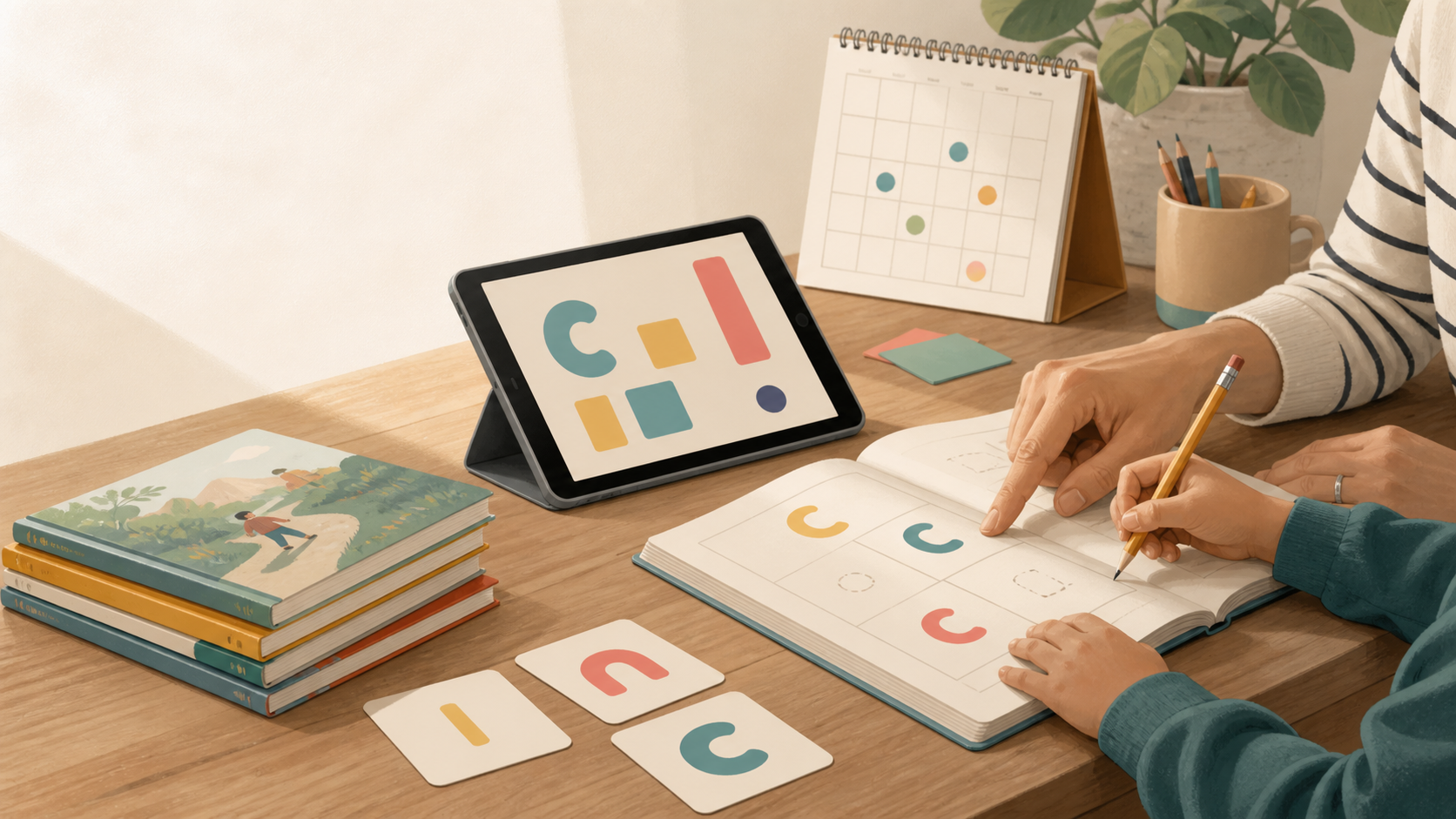
Reading.com is a guided parent-and-child program, not a tutor that takes over when you hand over the tablet. The app orders the sounds, blending work, games and decodable books; the adult delivers its prompts and responds to mistakes. Reading.com describes most lessons as roughly 15-20 minutes and generally recommends one per day. Some games can be played alone, while a placement option lets a child with prior skills begin farther along.
In an ordinary lesson, the screen may model a sound or supply an example, but the grownup still has to hear what the child actually says. That can mean repeating a blend, pausing on a shaky word or carrying a longer book into the next sitting. Store reviewers often liked having the script ready; others found the shared time heavier than expected. The useful progress check happens afterward: can the child read a new word with the same pattern on paper?
A lesson in practice sources
What age is Reading.com for?
Reading.com positions its family program mainly for children ages 3-8, and Apple lists it for ages 4+. Those labels are rough: the starting skills and the child's tolerance for a 15-20-minute, adult-led lesson matter more. The sequence starts with letters and builds toward approximately late-first- to early-second-grade reading. Older beginners can still fit; children who already decode comfortably may need placement ahead or a broader program.
Use behavior and transfer as the guardrails. Reconsider the fit if the child keeps guessing from pictures, cannot blend after repeated teaching, dreads the routine or reads well inside the app but not on paper. An older beginner deserves age-respectful placement, while an advanced decoder may simply be beyond the material. Persistent or puzzling difficulty calls for a qualified reading specialist; an app cannot determine whether language, attention, hearing, vision or a reading disability is involved.
Age and fit boundary sources
Is Reading.com a full reading curriculum?
Reading.com can serve as a structured beginning-reading sequence, but it is not a complete language-arts curriculum. It covers phonemic awareness, letter-sound links, blending, decoding, sight words, connected text, and some comprehension. Families still need rich read-alouds, conversation, vocabulary, writing and spelling practice, independent books, and progress checks. The current app advertises 120 lessons, expanded from the older 99-lesson version, and targets roughly late first-grade or early second-grade reading rather than every K-2 literacy objective.
Included versus still needed
| Factor | What the evidence indicates | What the buyer should verify |
|---|---|---|
| Decision point 1 | Current Apple and public-site descriptions list 120 lessons and 84 books, while older support material and the March 2024 report describe a 99-lesson, 60-book version. We treat that as dated product expansion rather than silently blending the counts. In scope, the app overlaps with important foundational-reading practices, especially sound-letter work, decoding, and connected text. A complete literacy plan still has to supply oral language, broad knowledge, vocabulary, handwriting, spelling, sustained read-alouds, independent reading, and checks that are not controlled by the app. | Confirm the exact fit, current terms and outcome with the controlling source before purchasing. |
Included versus still needed sources
Does Reading.com actually work?
Reading.com uses several practices that broader reading research supports, but no cited study yet shows that this particular app caused children to read better. Its commissioned Tier IV report lays out the program's logic and supporting literature; it describes a controlled evaluation as future work. Parent reviews provide encouraging observations, not causal proof. Look outside the app for change in unfamiliar-word decoding, oral accuracy, connected-text fluency, comprehension and reading from print.
The distinction is visible in the underlying documents. The Institute of Education Sciences guide addresses foundational reading practices in general. Reading.com's paper, prepared by a contracted firm and reviewed with the company, connects those ideas to the app without measuring its effect against a comparison group. That makes the report useful for understanding the design, but not for assigning the app an outcome rate. Store reviews can reveal where families noticed progress or frustration; their authors were not independently selected or assessed.
Evidence-strength record sources
How much does Reading.com cost?
Reading.com begins with a seven-day trial and then renews on a monthly or annual plan. Recent outside price checks put those plans near $14.99 a month and $89.99 a year, although the amount shown by your website or app-store checkout is the one that matters. A developer response confirms a lifetime option, but we could not verify a current public price for it. Promotions, taxes and renewal pricing may differ by purchase channel.
Price at the point of purchase
- The website did not show us a final offer until after personalization questions and an email prompt, which is why we would not print one price as permanent. Read the last checkout screen rather than the headline promotion. It should tell you who will bill the account, when the trial converts and what that first charge will be. For an annual plan, the real comparison is not only its monthly equivalent; it is whether this child is likely to keep using the lessons long enough to justify paying up front.
Price at the point of purchase sources
How do you cancel Reading.com?
Cancel Reading.com wherever the subscription was purchased. An iPhone or iPad purchase is managed in Apple subscriptions, an Android purchase in Google Play, and a website purchase in Reading.com's linked Stripe portal. The app's Grownup > Manage area can help identify the channel. Cancel before renewal and keep the screen or email that shows an expiration date. Removing the app or deleting a child profile does not stop the subscription.
Where the cancellation lives
- The original receipt is usually the quickest clue when the subscription is hard to find. Once canceled, the store should show an end date rather than another renewal; paid access normally continues until that date and lesson progress remains. If the charge still appears active, write to support with the receipt and cancellation confirmation. This is also why contacting Apple about a Google Play purchase—or Reading.com about a store-controlled subscription—can produce a frustrating loop without changing the billing status.
Where the cancellation lives sources
What is the Reading.com refund policy?
Reading.com does not have one refund route for every customer. Apple and Google decide requests for purchases made through their stores. For website purchases, Reading.com's terms say fees are nonrefundable and unused time is not credited, though support says it may consider a request it regards as valid. Canceling prevents a later renewal; it does not reverse a completed charge. Send any refund request promptly and include the receipt, account email, charge date and reason.
A cancellation message and a refund approval answer two separate questions. One tells you that another bill should not arrive; the other decides what happens to money already collected. Keep the store receipt and any trial or renewal screen you saw, along with prior support messages. If you paid but the app remains locked, take screenshots before reinstalling or restoring purchases. Apple and Google control their own transactions, while a web charge remains governed by Reading.com's terms and its support review.
Who decides the refund sources
What do Reading.com app reviews say?
At our July 30 capture, both major stores showed a 4.7/5 headline rating: Apple from 61,000 ratings and Google Play alongside more than 1 million downloads. Reviewers often praised the parent script, lesson order, engagement and children's use of skills in books. Recurring complaints involved the required adult time, lengthy book segments, later phonics choices, price or renewal friction, and audio, touch or restore-purchase problems. These volunteered reviews reveal patterns, not an outcome rate.
We read and coded 30 visible reviews separately by storefront, looking for repeated themes as well as reviews that cut against the overall rating. The totals establish reach and favorable sentiment; they do not tell us who finished the program or prove a reading gain. Google also showed different aggregate and device-level counts, so we report the screen context instead of manufacturing a combined number. This sample is most useful as a list of questions to test during the trial, not as population research.
Cross-platform review record sources
Is Reading.com safe for kids?
Reading.com has no in-app advertising and places child profiles under a parent account. Its policies say targeted ads are not shown and parents may ask to access or delete data. Running the service still involves collection such as profile names, learning activity, device identifiers, IP address and approximate city location; Apple's label also connects contact, identifier, usage and diagnostic data to the user. Use a nickname, limit permissions and request deletion when the account is no longer needed.
Reading.com says the child experience is designed for COPPA compliance, but that statement is not the same thing as an outside security or privacy audit. Read both the general and children's policies: they cover different paths for learning records, device data, coarse location, retention and deletion. A parent can reduce what is shared by choosing a nickname, withholding unnecessary profile details and supervising the device. If you leave, send the deletion request and save its confirmation; ending the subscription does not necessarily erase stored information.
Child-data safety boundary sources
Reading.com vs. Hooked on Phonics: which is better?
Choose Reading.com when the appeal is a tightly scripted lesson that a parent and child complete side by side. Hooked on Phonics is the comparison to make if you prefer its wider product ecosystem or another mix of app work and physical materials. Store ratings and commission terms do not settle it. Put the current placement process, phonics order, decodable books, writing/spelling coverage, adult time, device requirements, renewal/refund terms and end-of-program plan next to each other.
Head-to-head buyer test
| Factor | What the evidence indicates | What the buyer should verify |
|---|---|---|
| Decision point 1 | Run a head-to-head fit test instead of treating brand familiarity as evidence. Give each program the same unfamiliar decodable words and a short connected-text passage away from its own interface. Record how much adult prompting was required, whether the phonics pattern was taught before it appeared in text, and whether the child retained it the next day. Then compare the complete renewal terms, device needs, physical materials, writing and spelling coverage, placement method, exit path, and the plan for instruction after the final level. | Confirm the exact fit, current terms and outcome with the controlling source before purchasing. |
Head-to-head buyer test sources
Which Reading.com alternatives should you consider?
Match the alternative to the constraint. Try Duolingo ABC or Khan Academy Kids when cost is the barrier; compare Hooked on Phonics or Reading Eggs for a different paid sequence; use a systematic print curriculum when minimizing screens; and seek a qualified reading specialist when progress is unusually slow or a disability is suspected. Ordinary library books, read-alouds, conversation, handwriting, spelling, and connected-text practice complement every app. No alternative should be recommended solely because it pays commission.
Alternative decision ladder
| Factor | What the evidence indicates | What the buyer should verify |
|---|---|---|
| Decision point 1 | The constraint should choose the alternative. Free apps address price but may not reproduce Reading.com's parent script. A paid competitor may change pacing, physical materials, or breadth without solving an underlying reading difficulty. A systematic print curriculum reduces screen dependence but asks the adult to organize more of the lesson. Specialist assessment is the appropriate branch when progress is unusually slow, skills are inconsistent, or distress persists. Whatever route wins, keep read-alouds, conversation, handwriting, spelling, and real connected text in the plan rather than asking one app to carry all literacy instruction. | Confirm the exact fit, current terms and outcome with the controlling source before purchasing. |
Alternative decision ladder sources
Sources and editorial independence
RealReviews did not enroll a child, complete the paid curriculum or administer a standardized assessment. This review uses current marketplace pages, Reading.com legal and support documents, the complete published Tier IV report, a government reading-practice guide and a reproducible visible review sample. Parent outcome reports remain anecdotes unless independently measured.
Complete source list
- Official Product: Reading Home
- Marketplace: Apple Listing
- Marketplace: Google Listing
- Commissioned Research Report: Tier Four Report
- Official Support: Reading What Is
- Official Support: Reading Homeschool
- Official Support: Reading Cancel
- Official Support: Reading Refund
- Official Legal: Reading Terms
- Official Privacy: Reading Privacy
- Official Child Privacy: Reading Child Privacy
- Official Affiliate: Reading Affiliate
- Government Practice Guide: Ies Foundational Reading
- Independent Discussion: Reddit Reading Reviews
Final verdict
Reading.com scores 7.2/10 — Strong parent-led phonics; limited direct efficacy proof. The score rewards the structured parent script, sequential phonics practice and broad positive consumer record. It remains limited by the adult-time requirement and the absence of a controlled product-specific study establishing causal reading gains.