

This exact URL once delivered an enthusiastic Diamond CBD article. A November 2019 Common Crawl capture preserves the page, its author and dates, the Unflavored Diamond CBD Oil 550mg product boundary, a 9.5/10 schema rating, and a separate statement of 4.6/5 based on 845 Real Reviews. It also preserves the problem: no underlying owner corpus or repeatable scoring method was attached, and general CBD discussion turned into assurances about safety, effectiveness, and a long list of health conditions.
RealReviews is not pretending that article never existed. The valuable backlink deserves a useful answer at the address that earned it, not a redirect to a category page or an unrelated product. This restoration puts the original claims on the record, marks what cannot be substantiated, and points to a current national profile. The profile is for Diamond CBD's live 1,000mg Full Spectrum CBD Oil, a 30 ml MCT-based oral tincture. It is not a retroactive lab test of the older 550mg bottle.
That separation also applies to Diamond's difficult history. A peer-reviewed 2019 paper reported undeclared compounds in several CBD e-liquids bought in 2017, and Consumer Reports identified three Diamond-site vape products in the affected group. FDA issued a 2019 warning letter about disease claims on other named Diamond products. A civil complaint challenged CBD quantities in the old 550mg oil and gummies, then settled without a merits finding or admission. All three records matter. None proves that the current oral tincture is contaminated or that the complaint's allegation was true.
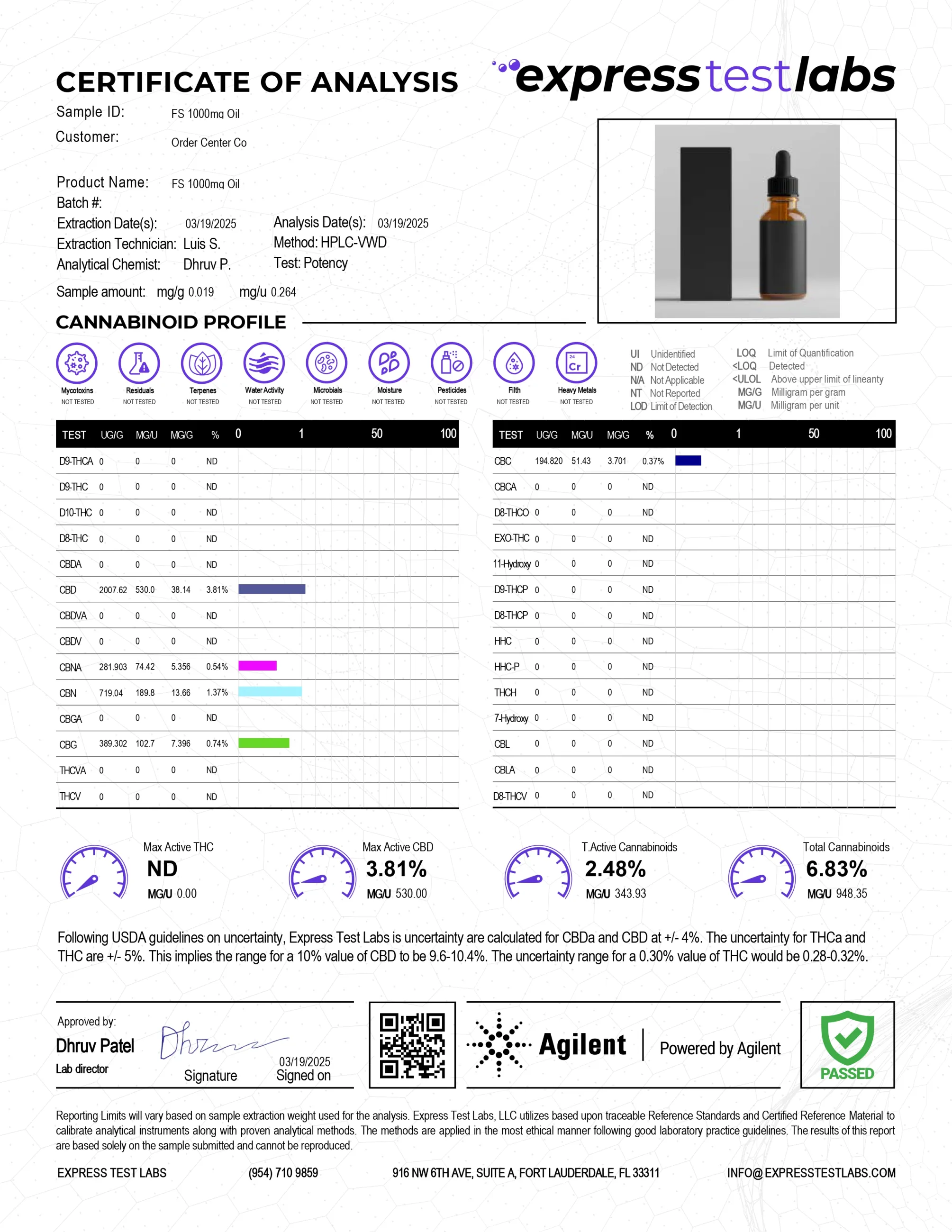
The 3.6/10 verdict rests mainly on evidence Diamond publishes today. Its linked March 2025 potency report names FS 1000mg Oil but displays no batch number, identifies Order Center Co. as customer, and reports 530.0 mg/u CBD and 948.35 mg/u total cannabinoids. The page never explains the unit. The same report marks pesticides, heavy metals, residual solvents, mycotoxins, microbials, and several other panels not tested. The product FAQ then says the MCT oil may be vaped. A functioning seller, responsive policies, and many happy reviewers do not close those product-level gaps.
What the original Diamond CBD review said
The recovered 2019 page reviewed an Unflavored Diamond CBD Oil 550mg bottle and praised the wider brand. It called Diamond the best CBD oil, described CBD as proven safe and effective, discussed many diseases, and carried conflicting-looking 9.5/10 and 4.6/5 ratings. The claimed 845-review base had no recoverable bodies, source list, inclusion rule, or calculation, so that aggregate is withdrawn.
Common Crawl captured the page on November 11, 2019. Its metadata says Amanda Wilder published it October 15 and modified it November 1. The text moved from a broad primer on CBD to a purchase-oriented product recommendation. It invoked pain, inflammation, insomnia, depression, anxiety, arthritis, seizures, multiple sclerosis, Crohn's disease, diabetes, Parkinson's disease, and autism. It also said recent studies proved CBD was safe, effective, and free from danger. Even in 2019, those statements required distinctions the article did not make: ingredient versus finished product, prescription versus retail CBD, preliminary evidence versus established treatment, and possible benefit versus no meaningful risk.
The rating problem is independent of the prose. Structured data exposed a 9.5 score on a ten-point scale. The visible article said 4.6 out of five based on 845 Real Reviews. We recovered no review entries, dates, platform names, screening rules, deduplication method, count reconciliation, or weighting. The two ratios are close enough to look intentional, but similarity is not verification. A responsible restoration cannot invent the missing corpus, quietly translate the old number into a current score, or imply that 845 buyers endorsed a product whose identity has since changed.
A January 2020 capture later sent the old path toward an unrelated VerifiedCBD page, another clue that the route lost its original editorial purpose. This page reverses that drift. It stays self-canonical, names the historical SKU, withdraws unsupported claims, and sends readers to the separate national profile for the current bottle. The correction is not an accusation that the former author fabricated every sentence. It is a statement about what the surviving record can prove. The old praise had no reproducible product method and does not meet the present publication standard.
Sources for recovered publication record
The bottle changed, so the review subject changed
The old article centered on Unflavored Diamond CBD Oil 550mg. Diamond's current official page sells a 30 ml 1,000mg Full Spectrum CBD Oil with MCT carrier, 600 drops, and a stated 1.67 mg CBD per drop. Those are not interchangeable SKUs. The historical page explains the old bottle; the 3.6/10 national profile scores the current exact product and uses old records only as labeled context.
Product names create false continuity easily. A brand can keep the same root name while its milligram total, spectrum, carrier, ingredients, manufacturer, laboratory program, price, claims, and terms change. A useful review therefore starts with identifiers rather than reputation. For the live Diamond offer, the page says 1,000 mg CBD in 30 ml, about 600 drops, full-spectrum industrial hemp CBD, and MCT oil. The linked report calls its sample FS 1000mg Oil. Those markers define the current evaluation even though they do not yet form a complete batch chain.
The 550mg bottle belongs in two older records. It was the oil named by the 2019 RealReviews article, and it appeared in the later class-settlement paperwork after a purchaser alleged that named Diamond products contained less CBD than represented. The settlement did not decide that issue. Nor can a 550 mg allegation answer whether a later 1,000 mg bottle meets its label. It can explain why current, legible, batch-matched verification would be especially valuable, but it cannot be used as a substitute for that verification.
The distinction protects the company as much as the consumer. Historical e-liquid findings are not pasted onto an oral tincture. An old litigation allegation is not described as a laboratory fact. At the same time, positive reputation from an old article does not flow automatically to a new formulation. Each side must meet the same identity rule. Evidence travels only when product, batch, route, time, and responsible operator match—or when the page openly explains that it is background rather than direct proof.
Sources for historical and current sku boundary
The number on the report does not cleanly match the number on the page
Diamond's linked Express Test Labs image reports CBD at 530.0 mg/u and total cannabinoids at 948.35 mg/u for FS 1000mg Oil. The sales page says 1,000 mg CBD, not 1,000 mg total cannabinoids. Because mg/u is not defined and no retail batch is visible, RealReviews labels this a material unresolved discrepancy. The report neither proves a precise shortage nor verifies the advertised CBD total.
The arithmetic on the product page is straightforward: 1.67 mg CBD per drop multiplied by 600 drops is about 1,002 mg. The laboratory table is also readable: CBD 530.0 mg/u at 3.81 percent, CBC 51.43, CBNA 74.42, CBN 189.8, CBG 102.7, total cannabinoids 948.35, and THC not detected. A total-cannabinoid result cannot be relabeled as CBD. The public page offers no note explaining whether u means bottle, sample unit, or another normalized quantity, and it does not reconcile the difference.
Identity makes the comparison weaker still. The report says its customer is Order Center Co., while the storefront and terms use Diamond CBD and First Capital Venture. It has an extraction and analysis date of March 19, 2025, but no visible batch number. A current buyer cannot compare a lot printed on the bottle to the document. The sample name is suggestive, not sufficient. If the file is a representative or formulation report rather than a lot certificate, the seller should say that and stop presenting it as though every delivered batch has been verified by the image.
This article deliberately avoids a sensational claim that the product contains only 53 percent of its stated CBD. That conclusion would require a resolved unit, container mapping, sample chain, and preferably the full signed report. It also avoids the opposite marketing leap that the certificate proves 1,000 mg. The right interim judgment is documentation failure: the seller chose to link this document from the current page, and the document does not make the central potency claim reproducible. That failure carries significant weight in the 3.6/10 grade.
Sources for page and report potency comparison
What survived from 2019—and what must be evaluated now
| Factor | Historical record | Current decision record |
|---|---|---|
| Reviewed product | Unflavored Diamond CBD Oil 550mg | 1,000mg Full Spectrum CBD Oil, 30 ml MCT tincture |
| RealReviews rating | 9.5/10 schema and 4.6/5 from an unsupported 845-review claim; withdrawn | 3.6/10 from seven disclosed weighted dimensions |
| Laboratory evidence | Older potency allegation settled without merits finding | March 2025 potency image; 530.0 mg/u CBD, no visible batch, contaminant panels not tested |
| Safety history | FDA claim warning and sampled 2017-era vape-liquid findings on other products | Current oral product judged by its own page, report, ingredients, FAQ, and terms |
| Buying decision | Old purchase endorsement is withdrawn | Not recommended until lot verification, testing scope, claims, and route guidance improve |
A potency page is not a contaminant clearance
The posted report marks mycotoxins, residual solvents, terpenes, water activity, microbials, moisture, pesticides, foreign material or filth, and heavy metals as not tested. That does not show those panels failed. It shows the public certificate cannot establish that they passed. Calling the bottle third-party tested without naming the limited scope invites readers to infer a broader safety check than the evidence contains.
Hemp products can raise several independent analytical questions. Potency asks how much of each cannabinoid is present. Pesticide, elemental, residual-solvent, microbial, and mycotoxin panels ask whether other substances are present above defined limits. A laboratory may perform one without performing the others. The Diamond image is a potency report. Its unchecked scope is not hidden in fine print; each unperformed category is explicitly labeled not tested. That makes the gap easy for the seller to describe and difficult for a reviewer to overlook.
A complete consumer-facing system would let the bottle lead to its own report through a lot number or QR code. The report would show sample receipt, test dates, methods, limits, measurement uncertainty where relevant, pass criteria, and the legal client responsible for the lot. If separate laboratories ran potency and contaminants, both reports would share the same lot identifier. A generic image with no visible batch cannot do that work indefinitely, even if the laboratory is independent and the underlying number is accurate for the sample it received.
RealReviews did not buy the oil or commission a laboratory. The finding is limited to the seller's public decision record as of August 17, 2026. Diamond may possess other certificates privately; their absence from the linked page means a shopper cannot evaluate them before paying. Publishing a full current lot package would improve the score. Until then, people who decide to buy CBD should prefer a bottle whose exact lot has current potency, THC, pesticide, metal, solvent, microbial, and mycotoxin results from an identifiable qualified laboratory.
Sources for public testing scope check
Testimonials and prescription-CBD research do not validate this tincture
The live listing and FAQ associate Diamond CBD oil with analgesic or pain relief, stress, anxiety, sleep, mood, calm, and recovery. No located study tested this finished 30 ml tincture for those outcomes. FDA approval of purified prescription CBD for limited seizure indications cannot be borrowed by an over-the-counter full-spectrum oil. Customer symptom stories are experiences, not controlled evidence.
The old RealReviews article made the same category error at a larger scale. It started from research interest in cannabinoids and arrived at confidence about a branded bottle. The current version of that error is subtler: benefit words are distributed across product copy, FAQ answers, and customer reviews, allowing the page to feel medical without presenting an exact-product trial. A shopper searching for pain, anxiety, or sleep help is still likely to understand those statements as reasons the bottle will address a symptom.
NCCIH and FDA draw a narrower boundary. One purified cannabidiol drug has an approved role in specified rare seizure disorders under medical supervision. Over-the-counter products can differ in purity, dose, additional cannabinoids, carrier, and contaminants, and unapproved CBD products have not been evaluated by FDA for effectiveness, proper dosage, interactions, or other safety questions in the way an approved drug is. That does not make every wellness experience imaginary. It means the current Diamond page needs evidence matched to what it sells and implies.
The seller's 4.8 review widget is not a clinical workaround. People choose whether to post, symptom baselines are unknown, bottles and doses vary, other treatments are uncontrolled, nonresponders may remain silent, and visible moderation is seller-controlled. The stories can reveal a recurring hope for relaxation or sleep and a recurring report of easy use. They cannot tell a reader the probability of benefit, the size or duration of an effect, or the risk for a person with medicines or a medical condition.
Sources for claim and evidence boundary
Outside ratings
| Source | Rating | Reviews | Checked |
|---|---|---|---|
| Diamond CBD seller-hosted current-SKU widget | 4.8/5 | 126 | 2026-08-17 |
| Trustpilot Diamond CBD brand profile | 3.7/5 | 199 | 2026-08-17 |
Seller-hosted and Trustpilot ratings are shown separately because their product scope, collection context, and independence differ. Neither is converted into the RealReviews score.
Consensus coverage
moderate confidence. We coded 52 content-bearing bodies across 3 eligible sources. Product specificity was mixed.
Eligible: Diamond CBD current-SKU verified-review widget, Trustpilot Diamond CBD brand profile, BBB Diamond CBD business profile and complaints.
- Excluded Old RealReviews 4.6/5 based on 845 reviews — No source list, review bodies, inclusion rule, collection period, or calculation was recoverable.
- Excluded Affiliate rankings and coupon pages — Commercial summaries without inspectable product testing or attributable owner evidence.
- Excluded Reviews of gummies, vapes, creams, delta products, and other catalog items — Wrong SKU; retained only where a platform-level fulfillment theme is clearly labeled brand-wide.
- Excluded Pet-use testimonials — Anecdotal animal use cannot establish veterinary safety, dosing, or efficacy.
What reviewers repeatedly said
Recurring positives: Many seller-page reviewers describe the dropper and flavor as easy to use and report buying again.; Subjective relaxation, sleep, and discomfort benefits recur in seller-hosted bodies, although they are not clinical evidence.; Brand-level reviewers often praise the range of products, promotional pricing, and helpful support when an order goes smoothly.; The company publishes a telephone number, email, mailing address, return policy, and a laboratory image for the current SKU..
Recurring negatives: Some owners report no noticeable effect, an unwanted headache, or variation between products or orders.; Delivery delays, missing or different items, and slow support recur on outside brand-level platforms.; The current certificate does not answer the most important potency and contaminant questions.; Medical-style anecdotes dominate much of the positive seller corpus, making the rating a poor measure of verified product performance..
Counterexamples retained: A 4.8 seller widget does not establish that the tincture treats pain, anxiety, or insomnia.; A 3.7 brand-level Trustpilot score does not describe this one tincture because it combines many products and years.; Historical contamination findings in named vape liquids do not prove contamination of today's oral oil.; The absence of a comprehensive published certificate does not itself prove contaminants are present; it means the public evidence does not rule them out..
This is a mixed-specificity consensus. Twenty-four current-SKU seller bodies and twenty-eight outside brand-level bodies or complaint narratives were inspected. Ratings remain separate, medical outcomes are treated as anecdotes, and the RealReviews grade is not an average of stars.
An oral MCT oil should not casually become a vape liquid
Diamond's current FAQ says its MCT-based dropper oil can be put into a vape pen. The page supplies no inhalation formulation, aerosol analysis, emissions test, or route-specific certificate. RealReviews treats this as a serious current instruction problem and does not repeat it as advice. A carrier selected for oral use is not automatically suitable for heating and inhalation.
Route is part of product identity. The bottle is sold in a dropper, measured by drops, and described with MCT carrier oil. Those signals establish an oral tincture. Adding a vape option in an FAQ changes where the preparation goes and how it is transformed. Heating can create different exposures, and the lungs do not evaluate ingredients by the same assumptions used for swallowing. A seller should not ask a consumer to bridge that safety question from convenience or from the broad fact that some separate CBD products are designed for vaping.
The linked report cannot support the instruction. Its stated method is HPLC-VWD potency analysis. It does not assess an aerosol, thermal products, or inhalation suitability. Residual solvents, terpenes, pesticides, metals, microbials, mycotoxins, and foreign material are not tested on the posted page. Even if every listed contaminant result were clean, route-specific formulation questions would remain. The responsible wording for a dropper product would be unambiguous: use only as labeled and do not place an oral oil into a vape device.
This finding also prevents a historical misreading. Diamond's 2017-era vape-liquid controversy is relevant background, but the current warning does not depend on assuming those old products resemble today's oil. It comes from the current FAQ and current ingredient list. The company can fix it immediately by removing the instruction, reviewing its catalog for route clarity, and publishing evidence appropriate to every intended use. That would not erase the incomplete certificate, but it would remove a direct and avoidable source of consumer confusion.
Sources for intended-use boundary
The historical red flags are real, but they have exact boundaries
FDA's 2019 letter challenged disease claims on Diamond pages for named gummies and crystals. A peer-reviewed paper reported undeclared 5F-ADB or dextromethorphan in four of nine CBD e-liquids, and Consumer Reports connected three affected vape products to Diamond's site. Those records test the brand's historical quality culture. They do not establish contamination of the present 1,000mg oral tincture.
FDA reviewed diamondcbd.com in September 2018 and later wrote to PotNetwork Holdings. The letter quoted disease-oriented website statements and explained why named products were unapproved new drugs and misbranded under the agency's analysis. It also restated FDA's position that CBD products cannot be marketed as dietary supplements under the cited exclusion. The current tincture was not one of the letter's named products. The fair relevance is continuing claim discipline: a seller with that history should be especially precise when current copy invokes pain, anxiety, sleep, or other health outcomes.
The laboratory paper requires product-level care. Researchers purchased nine e-liquids marketed as CBD and detected the synthetic cannabinoid 5F-ADB or the cough suppressant dextromethorphan in four. Contemporary Consumer Reports coverage said three Diamond-site products contained 5F-ADB: Liquid Gold Strawberry, Liquid Gold Jungle Juice, and Diamond CBD Vape Additive. Diamond criticized the work and described formula or testing changes. The record supports saying those sampled e-liquids were involved; it does not support saying every Diamond product was adulterated then or is contaminated now.
Why include history at all? Quality assurance is partly a trust problem. When old products and claims raise credible questions, a modern company can answer with stronger traceability, not just a reset slogan. A lot-linked, comprehensive certificate for the current tincture would provide that answer. The image now available does not: it lacks a visible batch and leaves contaminant categories untested. The present documentation gap stands on its own, while the historical events explain why readers are right to demand a complete rather than symbolic testing program.
Sources for regulatory and study chronology
The 550mg case settled; it did not prove the allegation
A purchaser sued PotNetwork and related defendants in 2019, alleging that the older Unflavored Diamond CBD Oil 550mg and gummies contained less CBD than labeled. The court allowed parts of the case to proceed, then the parties settled. Class members could receive vouchers; the agreement denied wrongdoing. No merits judgment established a potency number, and the case cannot be treated as a test of today's bottle.
Civil procedure is often flattened into a headline. The complaint in Potter v. PotNetwork Holdings described the plaintiff's testing allegations and legal theories. A partial denial of a motion to dismiss means some pleaded claims were legally sufficient to continue under the stage's assumptions. It does not mean the judge weighed laboratory proof and found the allegation true. The case's existence and exact products are facts; the pleaded quantities remain allegations unless independently established.
The SEC-filed settlement exhibit gives the resolution unusual transparency. It identified the Unflavored Diamond CBD Oil 550mg among covered products, offered ten-dollar vouchers to qualifying class members, proposed five thousand dollars for the named plaintiff, and allowed up to two hundred thousand dollars in attorneys' fees. The defendants did not admit liability. Settlement can reflect litigation cost, risk, or business judgment as well as views about facts. The article reports those terms without converting them into a confession.
The current 1,000 mg report creates a legitimate new comparison question but not a shortcut. Its 530.0 mg/u CBD line needs an explained unit and batch chain. Its 948.35 mg/u total-cannabinoid number cannot be substituted for CBD. RealReviews would reach that conclusion if the old lawsuit had never existed. The litigation adds historical reason to insist on clarity, and it shows why the vanished 2019 article's unqualified enthusiasm aged poorly, but the 3.6/10 score remains reproducible from current evidence rather than an old plaintiff's allegation.
Sources for allegation and settlement boundary
The customer consensus is positive in-house and mixed outside
Diamond's current oil page displays 4.8/5 from 126 seller-hosted verified reviews. Trustpilot displays 3.7/5 from 199 reviews across the whole brand, while BBB shows a B rating and 18 complaints in three years. The seller pool is more product-specific; the outside pools are more independent but mix products. None supports the old claim of 845 verified RealReviews contributors.
On the oil page, recurring positive themes include easy use, acceptable taste, relaxation, sleep, discomfort relief, and repeat orders. Those bodies are useful for learning what visible customers value. They also contain medical and pet-use anecdotes that should not be amplified as advice. Twenty-four current-SKU bodies were inspected for the evidence matrix. Some described no clear benefit or a variable response. The seller labels reviews verified, but RealReviews did not audit how purchase verification, invitations, moderation, or removal works.
Trustpilot broadens the picture and weakens product specificity. At capture it showed 199 brand reviews, a 3.7 average, and a distribution of 72 percent five-star versus 18 percent one-star, with the remainder spread across the middle. Only nine appeared in the latest twelve months. Positive writers mention quality, deals, variety, and successful support. Negative writers describe slow deliveries, contact difficulty, inconsistency, mismatch, headache, or no effect. Those themes can inform company-level fulfillment risk; they cannot be assigned to this tincture without a matching body.
BBB showed a B grade, no accreditation, eighteen complaints over three years, and six in the latest year. Delivery dominated the categories. Fourteen complaints were answered and four marked resolved. One certificate-related dispute in 2026 included a denial and explanation from Diamond; it remains contested. The combined consensus is neither 4.8 nor 3.7. It is that many customers report satisfaction while a meaningful minority describe friction, and that customer sentiment cannot cure an unresolved label-to-report comparison or absent safety panels.
Sources for customer-source comparison
Read the 100-day promise as a policy, not a slogan
The 30 ml bottle carried a $90 list price and a $67.48 structured promotional price when researched; checkout promotions may move. Shipping was $9.99 below a $99 threshold. The 100-day policy allows a full refund for unopened goods, but opened products ordinarily qualify for store credit or replacement. The general terms also request notice of product issues within 24 hours, creating a boundary buyers should clarify in writing.
Percent-off banners are not stable price evidence. The date and final cart matter, including shipping, tax, subscriptions or bundles, and any state restriction. At the observed sale price, a shopper might calculate cost from the advertised 1,000 mg. That value calculation becomes unreliable when the certificate's CBD line is 530.0 mg/u and the unit is undefined. A serious comparison should use a lab-verified CBD total for the exact lot and the total delivered price, not whichever denominator makes a promotion look cheapest.
The refund policy is better than no remedy. It provides a named return address in Daytona Beach and says unopened products within one hundred days may receive a full refund. It also changes the remedy after opening: usually replacement or store credit. A customer buying specifically to see whether the oil works should not interpret the policy as a guaranteed cash trial. Wholesale orders are outside the promise, and product-specific exclusions elsewhere on the site reinforce the need to save the terms that apply at checkout.
The twenty-four-hour notice clause in the broader terms may be intended for visible shipping or product problems rather than dissatisfaction under the hundred-day program. The documents do not make that interaction effortless to understand. Before opening the package, photograph the seal, lot, label, and delivered items; save the certificate and page; and ask support how a potency concern, damaged shipment, or no-effect complaint will be handled. Those steps are not a substitute for fair terms, but they preserve the evidence needed to use the remedy Diamond publishes.
Sources for price and remedy checklist
What would have to change before we recommend it
Diamond CBD oil is not worth recommending on the current public record. A buyer can find the company, terms, and many favorable reviews, but cannot match a current lot to a complete certificate or reconcile 1,000 mg CBD with 530.0 mg/u on the linked report. The medical-style copy and MCT-vaping instruction add problems the seller controls directly. Better-documented alternatives exist.
A credible improvement path is concrete. Publish a certificate for each current lot, let the bottle's code retrieve it, identify the responsible company and laboratory client, define every unit, and show the advertised CBD within a disclosed tolerance. Add current pesticide, heavy-metal, residual-solvent, microbial, mycotoxin, and relevant other panels with methods and limits. If the posted image is only one part of a multi-laboratory package, link the other parts and show the shared lot. None of this requires a customer to take a position on old litigation or old vape products.
Then fix the words and route. Remove the suggestion that an MCT oral tincture belongs in a vape pen. Replace pain-relief, anxiety, sleep, and similar implications with language proportionate to evidence for the exact product. Keep the adult, pregnancy, medication, and FDA cautions visible, and give consumers an adverse-event route. Reconcile the hundred-day policy with the twenty-four-hour clause, specifying when an opened product receives cash, credit, replacement, or no remedy. These changes would improve both safety and decision quality.
Until those steps occur, a shopper who still wants an OTC CBD oil should compare exact lot reports rather than logos. Check tested CBD and THC against the label, contaminant coverage, carrier and route, serving clarity, final delivered price, interaction concerns, and the opened-product remedy. For persistent pain, anxiety, sleep disturbance, seizures, or another health problem, use qualified clinical guidance rather than a retail review as treatment advice. The final verdict is product-specific: 3.6/10 for this current Diamond tincture, with no affiliate link and no claim that every Diamond item shares the same result.
Sources for recommendation threshold
An exact-URL restoration should preserve more than a keyword. The original page existed, had a named author and date, reviewed a specific 550mg oil, awarded a striking score, and helped build the link record that still points here. It also overreached. General cannabinoid discussion became branded-product confidence, a large review count appeared without an auditable corpus, and a purchase recommendation arrived without testing or a transparent method. Those facts belong in the correction rather than behind a redirect.
Diamond CBD today is not an anonymous ghost brand. It operates a substantial store, publishes contact and return information, has many visible customers, and links a real laboratory image. Those are meaningful positives. They also make the remaining failures more avoidable. A company capable of maintaining this retail operation can identify the exact tested lot, explain the report's unit and client, publish the missing contaminant panels, separate oral and inhaled routes, and write claims that do not depend on customers mistaking anecdotes for trials.
The historical records are included with their limits intact. FDA's letter concerned named older products and web claims. The peer-reviewed contamination work involved 2017-era e-liquids, not this tincture. The 550mg lawsuit ended in a no-admission settlement, not a potency judgment. None is used to declare the current oil contaminated or fraudulent. The 2026 verdict stands without that leap because the current certificate and current FAQ already create material unresolved questions.
RealReviews has no affiliate relationship with Diamond CBD and did not purchase or laboratory-test a bottle for this recovery. The score measures the public evidence a prospective customer could inspect on August 17, 2026. On that record, the current 1,000mg Full Spectrum CBD Oil earns 3.6/10 and is not recommended. The old 9.5 is withdrawn; the path to a better grade is specific, public, and entirely within the seller's ability to follow.
Final verdict
Diamond CBD 1,000mg Full Spectrum CBD Oil earns 3.6/10. The seller and terms are identifiable and many customers report satisfaction, but the linked report does not visibly match a retail batch, shows 530.0 mg/u CBD against a 1,000 mg CBD claim, and leaves common contaminants untested. No finished-product trial supports the page's health implications, and the MCT-vaping instruction is not defensible. The former 9.5/10 rating and undocumented 845-review claim are withdrawn.