
This profile evaluates the current Diamond CBD 1,000mg Full Spectrum CBD Oil: a 30 ml, MCT-based oral tincture sold through diamondcbd.com. It does not silently transfer evidence from the 550mg oil reviewed by RealReviews in 2019, from Diamond gummies or crystals named in an FDA letter, or from vape liquids sampled in 2017. Those records appear only where their product and time limits are explicit.
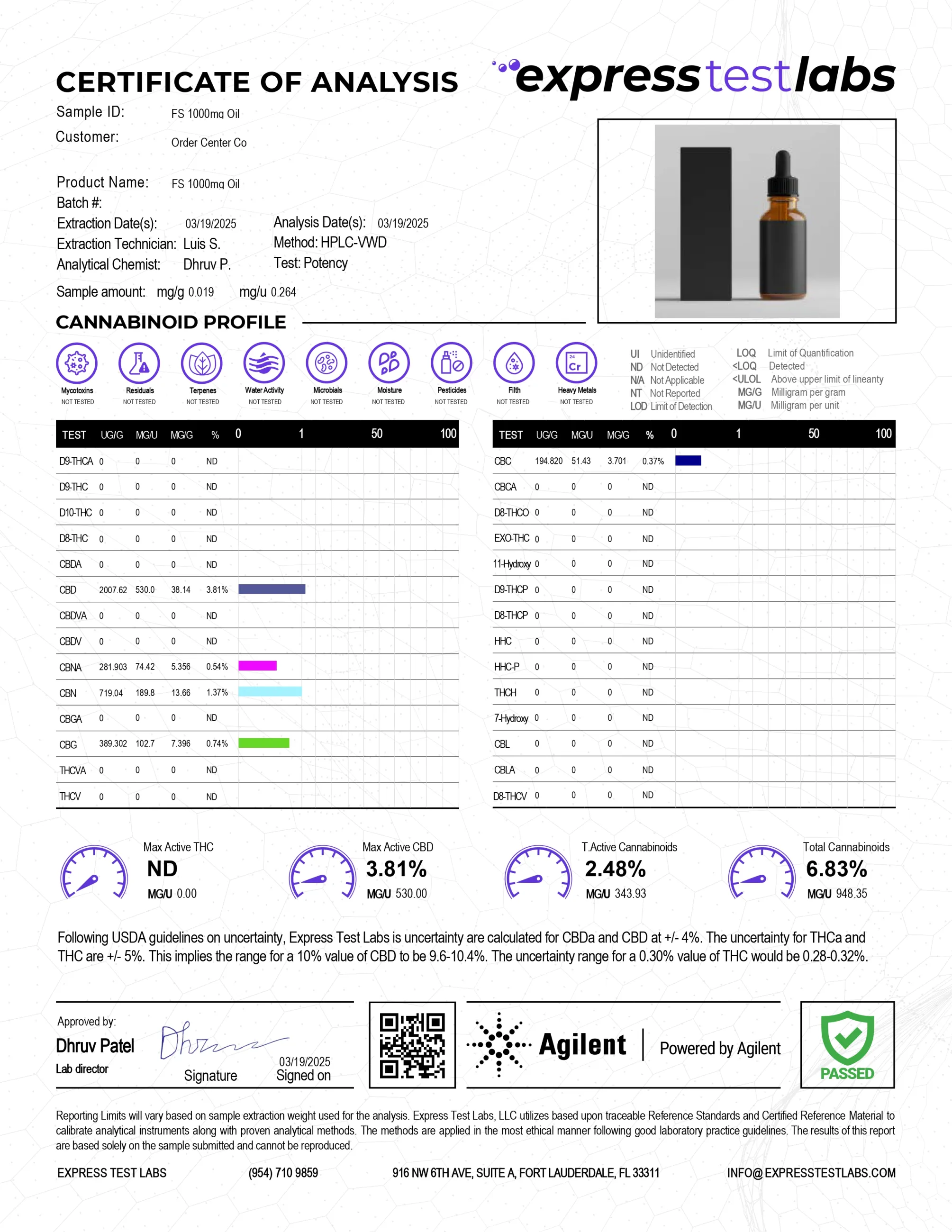
The current page says the bottle provides 1,000 mg CBD, 1.67 mg per drop and 600 drops. Its linked March 2025 Express Test Labs image reports 530.0 mg/u CBD and 948.35 mg/u total cannabinoids, does not explain the unit on the seller page, shows no visible batch number and names Order Center Co. as customer. That is a material unresolved label-to-report discrepancy, not proof of a precise shortage and not verification of the advertised CBD amount.
The same report is limited to potency. Pesticides, heavy metals, residual solvents, mycotoxins, microbials, terpenes, foreign material, moisture and water activity are marked not tested. The product FAQ also says the MCT oil may be used in a vape pen despite the dropper format and absence of inhalation-specific evidence. Those current records—not guilt by association with old news—drive the low testing and safety scores.
Customer evidence is mixed in scope. The seller shows 4.8/5 from 126 verified current-SKU reviews; Trustpilot shows 3.7/5 from 199 brand-wide reviews; BBB lists a B rating and 18 complaints in three years. RealReviews keeps those pools separate, treats health outcomes as anecdotes, and does not average them into the grade. Seven disclosed evidence dimensions total 3.6/10.
Diamond CBD oil review: the 3.6/10 verdict
Diamond CBD 1,000mg Full Spectrum CBD Oil earns 3.6/10 and is not recommended on the current record. The bottle and seller are identifiable, but the linked report shows about 530 mg CBD per unit rather than the advertised 1,000 mg, lacks a visible batch number, and leaves major contaminant panels untested. Current medical-style claims and an instruction to vape the MCT oil deepen the concern.
The grade does not come from one scandal headline or an outside star average. Seven weighted dimensions examine operator identity, label and use clarity, testing, finished-product evidence, safety, customer experience, and remedies. Identity and published terms earn real credit. Testing and claim discipline carry more weight because a consumer cannot infer bottle contents from a phone number, a polished store, or even a large set of enthusiastic testimonials. The arithmetic is 0.75 plus 0.60 plus 0.40 plus 0.40 plus 0.30 plus 0.50 plus 0.65, producing 3.60 out of ten.
The most consequential facts are current. Diamond links a March 2025 Express Test Labs image from the live 1,000 mg product page. It calls the sample FS 1000mg Oil but reports CBD at 530.0 mg/u and total cannabinoids at 948.35 mg/u. The page does not explain the unit, the report displays no batch number, and the customer is Order Center Co. Those limitations prevent us from declaring an exact shortfall, yet they also prevent the certificate from verifying what the product page asks a buyer to believe.
A lower score is not a permanent verdict. A current lot-specific certificate could identify the marketed company, bottle size, lot, laboratory accreditation, methods, measurement uncertainty, CBD and THC totals, and screens for pesticides, heavy metals, residual solvents, microbials, mycotoxins, and other relevant contaminants. Diamond could also remove the vaping instruction and narrow its copy to defensible non-medical descriptions. Until the evidence changes, the rational response is to choose a product with a clearer label-to-lab match and complete batch documentation—or to avoid OTC CBD when the intended use really calls for clinical care.
What the Diamond CBD lab report actually verifies
The linked March 19, 2025 Express Test Labs report verifies a potency test on a sample called FS 1000mg Oil. It does not visibly identify a retail batch. It reports 530.0 mg/u CBD and 948.35 mg/u total cannabinoids, with THC not detected. Because the seller does not define mg/u, the prudent finding is an unresolved material mismatch—not a fabricated certainty about the bottle's contents.
Certificates of analysis are useful only when their identity chain is intact. A buyer should be able to match the report's product, lot or batch, container size, collection date, and client to the package in hand. Here the sample name resembles the listing, but the report shows no batch number and names Order Center Co. as customer. The official page and terms use Diamond CBD and First Capital Venture. That may have an innocent operational explanation, but the page does not supply it or offer a lot selector that would connect a particular bottle to this result.
The potency table deserves exact wording. CBD is reported at 530.0 mg/u, 3.81 percent. CBC, CBNA, CBN, and CBG contribute to a total-cannabinoid result of 948.35 mg/u. The product page, however, says 1,000mg Full Spectrum CBD Oil and describes 1.67 mg CBD per drop across 600 drops, which multiplies to roughly 1,002 mg CBD. Total cannabinoids are not interchangeable with CBD. Nor should an editor silently assume what the laboratory means by u when the linked customer page never defines it.
RealReviews therefore avoids two opposite errors. We do not announce that independent testing proved the bottle contains only 530 mg, because the unit and batch link are unresolved. We also do not repeat the seller's statement that every batch is third-party tested as though the accessible image confirms the advertised CBD amount. The evidence supports a sharper consumer question: which current lot does this report cover, what does mg/u mean for the 30 ml bottle, and where is the full signed result? A vendor should answer those questions before checkout, not after a buyer disputes the label.
Third-party tested does not mean fully tested
Diamond publishes a third-party potency image for the current tincture, but that report is not a comprehensive safety panel. It marks mycotoxins, residual solvents, terpenes, water activity, microbials, moisture, pesticides, foreign material, and heavy metals as not tested. The public document therefore cannot show that the current bottle passed those screens, even if the company has additional unpublished records.
The phrase third-party tested describes who performed at least one analysis, not what was measured. A potency-only certificate can answer a cannabinoid question while saying nothing about lead, arsenic, cadmium, mercury, solvent residues, pesticide residues, mold, bacteria, or mycotoxins. The Diamond image is unusually clear about that boundary: the non-potency sections are labeled not tested. That transparency in the laboratory form is helpful. The seller's broader marketing should be equally precise instead of allowing a general batch-testing claim to carry more assurance than the linked result provides.
A useful hemp-oil record would be current, lot-specific, and easy to retrieve from the bottle. It would identify the laboratory and its relevant accreditation, sample reception and test dates, methods, limits of quantitation, pass criteria, and complete results. A QR code or lot lookup should land on the exact report, not a generic image reused across an open-ended selling period. If a panel was outsourced to another laboratory, the seller should link that complementary document and show how the samples and lots match.
Missing public testing is evidence absence, not proof of contamination. That distinction protects both the reader and the company. No responsible review should claim that an untested panel failed. At the same time, a buyer selecting a CBD oil cannot personally see or smell heavy metals, pesticides, or microbes. For those questions, a complete certificate is the product evidence. Diamond gets limited credit for making a potency image accessible, but the scope is too narrow to justify a quality-assurance claim or a recommendation at this price.
Does Diamond CBD oil work for pain, anxiety, or sleep?
No located trial tested this Diamond tincture for pain, anxiety, sleep, mood, or recovery. Customer stories cannot supply that missing control group, dose verification, or safety monitoring. FDA has approved one purified CBD drug for specific seizure disorders; that does not validate an over-the-counter full-spectrum oil for the broader uses suggested on Diamond's page. Expectation should follow exact-product evidence, not CBD's reputation.
The live copy uses terms such as analgesic, pain relief, anti-stress, better sleep, calm, mood, and post-activity recovery. Its FAQ also frames CBD as useful for sleep, anxiety, and restlessness. Those statements occupy a grey-looking retail page but make consequential health promises to a person deciding what to ingest. A study of a different purified compound, dose, route, population, or condition cannot be transferred simply because both products contain some CBD. Finished-product evidence must match the formulation and claimed outcome.
The review widget is full of sincere-sounding reports about discomfort, insomnia, anxiety, relaxation, and even animals. Such accounts can identify what customers hoped to achieve and whether they liked the routine. They cannot determine how many non-reviewers saw no effect, how symptoms changed without the product, what else the person took, whether the bottle matched its label, or whether expectancy influenced the result. A 4.8 average may describe the visible contributors' satisfaction; it is not a treatment effect.
For someone using CBD in place of evaluation for persistent pain, anxiety, or insomnia, the opportunity cost matters. Symptoms may have multiple causes, CBD can interact with medicines, and drowsiness or liver-related risks may be relevant. The evidence-based next step depends on the underlying problem, current medications, work and driving demands, pregnancy status, and local law. This review does not tell a reader that all CBD is useless. It says the current Diamond bottle has not earned the medical meanings its page and testimonials invite.
Outside ratings
| Source | Rating | Reviews | Checked |
|---|---|---|---|
| Diamond CBD seller-hosted current-SKU widget | 4.8/5 | 126 | 2026-08-17 |
| Trustpilot Diamond CBD brand profile | 3.7/5 | 199 | 2026-08-17 |
Ratings are reported exactly as displayed by each platform on the capture date. RealReviews does not combine, rescale, or treat a one-review page as representative.
Consensus coverage
moderate confidence. We coded 52 content-bearing bodies across 3 eligible sources. Product specificity was mixed.
Eligible: Diamond CBD current-SKU verified-review widget, Trustpilot Diamond CBD brand profile, BBB Diamond CBD business profile and complaints.
- Excluded Old RealReviews 4.6/5 based on 845 reviews — No source list, review bodies, inclusion rule, collection period, or calculation was recoverable.
- Excluded Affiliate rankings and coupon pages — Commercial summaries without inspectable product testing or attributable owner evidence.
- Excluded Reviews of gummies, vapes, creams, delta products, and other catalog items — Wrong SKU; retained only where a platform-level fulfillment theme is clearly labeled brand-wide.
- Excluded Pet-use testimonials — Anecdotal animal use cannot establish veterinary safety, dosing, or efficacy.
What reviewers repeatedly said
Recurring positives: Many seller-page reviewers describe the dropper and flavor as easy to use and report buying again.; Subjective relaxation, sleep, and discomfort benefits recur in seller-hosted bodies, although they are not clinical evidence.; Brand-level reviewers often praise the range of products, promotional pricing, and helpful support when an order goes smoothly.; The company publishes a telephone number, email, mailing address, return policy, and a laboratory image for the current SKU..
Recurring negatives: Some owners report no noticeable effect, an unwanted headache, or variation between products or orders.; Delivery delays, missing or different items, and slow support recur on outside brand-level platforms.; The current certificate does not answer the most important potency and contaminant questions.; Medical-style anecdotes dominate much of the positive seller corpus, making the rating a poor measure of verified product performance..
Counterexamples retained: A 4.8 seller widget does not establish that the tincture treats pain, anxiety, or insomnia.; A 3.7 brand-level Trustpilot score does not describe this one tincture because it combines many products and years.; Historical contamination findings in named vape liquids do not prove contamination of today's oral oil.; The absence of a comprehensive published certificate does not itself prove contaminants are present; it means the public evidence does not rule them out..
This is a mixed-specificity consensus. Twenty-four current-SKU seller bodies and twenty-eight outside brand-level bodies or complaint narratives were inspected. Ratings remain separate, medical outcomes are treated as anecdotes, and the RealReviews grade is not an average of stars.
Do not treat this MCT tincture as vape liquid
The current FAQ says the oil can be put in a vape pen and vaped, even though the ingredient description identifies MCT oil and the product is presented as a dropper tincture. RealReviews does not endorse that instruction. Route matters: an ingredient used orally is not automatically appropriate for inhalation, and the linked certificate contains no inhalation-specific safety assessment or contaminant panel.
A product boundary should answer a basic question before any dose discussion: is this meant to be swallowed, held under the tongue, applied to skin, or aerosolized into the lungs? Diamond's page identifies a 30 ml dropper, calculates milligrams per drop, and lists MCT as the carrier. Then the FAQ opens a second route by saying the oil can go into a vape pen. That is not a small lifestyle tip. Inhalation changes exposure, equipment conditions, thermal decomposition questions, and the organs receiving the product.
The posted report cannot resolve those questions. It is a potency analysis by HPLC-VWD. Terpenes, residual solvents, pesticides, metals, microbials, mycotoxins, and foreign material are marked not tested, and there is no aerosol or emissions analysis. Even a clean oral certificate would not automatically validate heating and inhalation. A careful manufacturer would sell and label separate formulations for separate routes, publish appropriate testing, and state plainly that an oral MCT tincture is not designed for vaping.
This route confusion receives meaningful weight because it is both current and correctable. It does not depend on old press coverage, a plaintiff's allegation, or an unhappy review. The company controls its FAQ. Removing or correcting the statement would not solve the potency and contaminant gaps, but it would eliminate an avoidable instruction that can lead readers to use the bottle in a way its primary presentation and evidence do not support. Until then, keep the product within its clear oral-tincture boundary and consult qualified guidance where inhaled cannabinoid use is being considered.
What Diamond CBD reviews and complaints actually show
The current tincture page shows 4.8/5 from 126 seller-hosted verified reviews; Trustpilot shows 3.7/5 from 199 brand reviews; BBB lists a B rating, no accreditation, and 18 complaints in three years. These numbers measure different populations. Together they suggest many satisfied repeat buyers alongside recurring delivery, support, consistency, and no-effect complaints—not a trustworthy medical-success rate.
RealReviews inspected twenty-four bodies tied to the current seller page and twenty-eight recent outside bodies or complaint narratives. On the product page, taste, dropper convenience, relaxation, sleep, discomfort, and repeat buying recur. A few reports indicate little effect or variable experience. On Trustpilot, successful customers mention deals, selection, product quality, and helpful service, while critical reviews mention delays, support gaps, mismatch, inconsistency, headache, or lack of effect. Trustpilot displayed only nine contributions in the latest twelve months, which makes old history a large part of the 3.7.
BBB contributes a different signal. Its profile spans the company rather than this tincture and lists eighteen complaints in three years, six in the latest twelve months: twelve delivery, three product, two service or repair, and one order issue. Fourteen were answered and four marked resolved at capture. Most readable complaints concerned other SKUs. One recent certificate dispute included a company response and competing accounts; this review records it as contested, not as proof that a report was falsified or reused improperly.
The responsible synthesis keeps the pools separate. We do not average 4.8 and 3.7, convert complaints into one-star reviews, or repeat the old page's undocumented 845-review aggregate. The seller widget is the most product-specific but least independent. Trustpilot is more independent but brand-wide and historically weighted. BBB is useful for handling and response patterns but not efficacy. Customer evidence raises the grade above an unknown seller, yet it cannot compensate for a certificate that leaves the label and contaminant questions open.
Current safety evidence and the historical record
The public record does not justify calling the current tincture proven safe or contaminated. Its certificate omits common contaminant panels. Separately, a 2019 FDA letter addressed disease claims for other Diamond products, and a peer-reviewed investigation found undeclared compounds in several 2017-era Diamond-associated vape liquids. Those events matter to quality oversight, but neither establishes the contents of today's oral tincture.
FDA's March 2019 warning letter followed a review of diamondcbd.com pages and identified claims that made named gummies and Blue CBD Crystals look like unapproved drugs. The letter did not name this current 1,000 mg tincture, which was not the page under review. Its relevance is narrower: the company ecosystem has previously drawn regulatory attention for connecting consumer CBD products to disease uses, while today's page still invokes pain, sleep, anxiety, and related benefits. A warning letter is not a criminal judgment, but it is an authoritative record of the agency's stated concerns.
The contamination history needs an equally firm SKU line. Researchers bought nine CBD e-liquids and reported 5F-ADB or dextromethorphan in four. Consumer Reports identified three Diamond-site products associated with 5F-ADB: Liquid Gold Strawberry, Liquid Gold Jungle Juice, and Diamond CBD Vape Additive. Those were vape liquids purchased in 2017. Diamond disputed or contextualized the findings and said formulas and testing changed. The study is real; so is the fact that the sampled products, era, and route differ from the present oral oil.
What can be said now comes back to the linked evidence. FDA and CDC warn that CBD can produce side effects, drug interactions, drowsiness, and other risks, and products may be mislabeled or contaminated. The seller advises adults only, cautions against use during pregnancy or nursing, and tells people with conditions or medications to consult a doctor. Those statements are useful but cannot replace complete lot testing. A reader should not use a historical vape incident to diagnose this bottle, and should not use a standard disclaimer to assume this bottle passed tests that its report says were not performed.
What the CBD-content lawsuit did—and did not—decide
A 2019 lawsuit alleged that the older Unflavored Diamond CBD Oil 550mg and certain gummies contained materially less CBD than labeled. The case survived in part and later settled, with vouchers and no admission. The court did not decide that the potency allegation was true. It is relevant history for label verification, not proof about the current 1,000mg tincture.
Potter v. PotNetwork Holdings was filed in federal court in South Florida. The complaint named a 550 mg unflavored oil—the SKU discussed by the old RealReviews article—and challenged CBD-content representations across named products. A complaint is a party's allegation. A ruling that allows a claim to continue addresses legal sufficiency at that stage, not whether laboratory facts have been proven. This page therefore avoids the familiar but inaccurate shortcut that the company was caught selling a particular amount.
A settlement exhibit later filed with the SEC describes a class resolution. It included ten-dollar vouchers for qualifying buyers, a five-thousand-dollar payment to the named plaintiff, and up to two hundred thousand dollars in attorneys' fees. The agreement denied wrongdoing and did not admit the allegations. Readers may reasonably view a potency settlement as a reason to ask for stronger current verification. They may not fairly present it as a judicial laboratory result or transfer the older bottle allegation to every later Diamond product.
The current certificate makes the history newly relevant without erasing its boundary. A product sold as 1,000 mg should have a lot-matched report whose CBD total and unit can be compared directly to that label. Instead, the public image shows 530.0 mg/u CBD and 948.35 mg/u total cannabinoids without a visible batch. That is an independent present-day reason for caution. The editorial conclusion does not require the old allegation to be true; it requires the current seller to close a current documentation gap.
Price, shipping, and the 100-day policy
At evaluation, the page's list-price metadata was $90 and structured data showed a promotional $67.48; promotions can change. Standard shipping was $9.99, with free shipping above $99. The 100-day policy offers a full refund for unopened items, while opened products ordinarily receive store credit or replacement. That is more limited than a universal money-back guarantee.
Dynamic storefronts can show different discounts in banners, page text, and structured metadata. RealReviews records the dated values without converting them into a promise. At the structured sale price, the bottle works out to roughly 6.7 cents per advertised milligram before shipping, but that calculation assumes the 1,000 mg label is accurate. Using the report's unexplained 530 mg/u number would produce a different figure, which is another reason the certificate needs clarification. Shoppers should compare final checkout totals and exact tested CBD, not headline percent-off language.
The make-it-right policy distinguishes sealed and opened goods. An unopened return within 100 days may qualify for a cash refund. Once opened, the ordinary remedy is store credit or replacement. Wholesale sales are excluded, and some product-category FAQs add other limits. The seller provides a return address in Daytona Beach, an email, and a telephone number. Those are meaningful consumer protections compared with a vanished direct-response funnel, but they are not equivalent to a no-questions-asked cash refund after trying the oil.
There is also a policy-reading problem. The general terms ask customers to report a product issue within twenty-four hours, while the refund page advertises a hundred-day framework. The documents may be intended for different problems, yet a consumer should not have to guess which controls after opening a shipment. Save the product page, discount, checkout, lot photograph, certificate, order confirmation, delivery time, and all support messages. Ask in writing whether an opened bottle can receive a refund to the original payment method before treating the guarantee as a trial period.
Who operates Diamond CBD?
Diamond's current terms say First Capital Venture operates the website. BBB lists Diamond CBD at 3531 Griffin Road in Fort Lauderdale, names alternate businesses including CBD LLC and First Capital Venture Co., and identifies Kevin Hagen as president. Historical SEC filings describe CBD LLC doing business as Diamond CBD within PotNetwork. RealReviews does not assume the old public-company chain remains today's complete ownership map.
The practical identity is stronger than it was on many old CBD funnels. The current site publishes support@diamondcbd.com, a 305 telephone number, a Fort Lauderdale headquarters, and a Daytona Beach return address. Its terms identify an operator and select Broward County law and dispute procedures. BBB supplies a B rating, non-accredited status, business tenure, and alternate names. Together those records give a buyer real counterparties and places to send a problem, which is why identity is the profile's highest-scoring dimension.
The names still need careful handling. Corporate groups use trade names, subsidiaries, fulfillment companies, and historical parents. The laboratory report adds Order Center Co. as its customer, but the product page does not explain that relationship. RealReviews can state each record exactly; it cannot infer that every name is the same legal person or that the historical PotNetwork ownership description remains current in 2026. A clean quality record would identify the responsible labeler and explain how the laboratory client maps to it.
Operator clarity matters because it connects every other promise. The company responsible for the label should be the company able to produce lot records, receive adverse-event reports, honor the guarantee, and correct the vaping instruction. If Diamond or First Capital Venture believes the certificate belongs to a current lot, it can publish that chain. If Order Center Co. is a testing or fulfillment affiliate, the seller can say so. Those steps would reduce uncertainty without relying on a consumer to reconstruct corporate history from terms, BBB, SEC exhibits, and an image file.
Why the old 9.5/10 score was withdrawn
The recovered 2019 RealReviews article carried a 9.5/10 schema score and said 4.6/5 based on 845 Real Reviews. No review corpus, inclusion method, or arithmetic was recovered, and the article made broad safety and disease statements the evidence did not support. The score is withdrawn. The restored route now links to this current exact-SKU profile and its reproducible 3.6/10 method.
Common Crawl preserved the original article published October 15, 2019 and modified November 1. It focused on an Unflavored Diamond CBD Oil 550mg bottle and the broader brand, called Diamond the best CBD oil, and sent readers toward a purchase. It also described CBD as proven safe, effective, and free from danger while discussing an extensive list of conditions. That was not careful product review work. General research interest around CBD did not establish that the 550 mg bottle treated those conditions or carried no meaningful risk.
The rating record conflicted internally. Search and schema data exposed 9.5 out of ten; the body displayed 4.6 out of five and attributed it to 845 Real Reviews. Those ratios happen to be close, but no bodies, dates, platforms, sampling rule, exclusions, or calculation survived. A number does not become a consensus because it is precise. This profile does not inherit the score and does not backfill imaginary customers. It displays two current outside snapshots separately and grades the product through disclosed weighted evidence.
Restoration is not deletion of uncomfortable history. The old page's assertions are summarized and corrected at the exact backlinked URL. The 2019 bottle remains part of the litigation and publication record, while the national profile evaluates the currently sold 1,000 mg oral tincture. That arrangement preserves why an old link existed without misleading a reader into thinking the product, formula, evidence, or verdict stood still for seven years. If an original source list for the 845 figure is produced, it can be audited; until then, the aggregate remains withdrawn.
Core sources for this score
- Diamond CBD current 1,000mg product page
- Express Test Labs report linked by Diamond
- Diamond CBD refund policy
- Diamond CBD terms and operator disclosure
- FDA PotNetwork warning letter
- FDA CBD consumer update
- NCCIH cannabinoid evidence overview
- Forensic Science International e-liquid study
- Trustpilot Diamond CBD profile
- BBB Diamond CBD profile
Final verdict
Diamond CBD 1,000mg Full Spectrum CBD Oil earns 3.6/10 and is not recommended. The company, product, support routes, and return policy are real and many visible customers are positive. The linked report still does not visibly match a retail batch, does not cleanly verify the 1,000 mg CBD claim, and leaves common contaminant panels untested. Current medical-style copy and a direction to vape the MCT oil create further avoidable risk. Prefer an exact lot with complete, interpretable testing and use guidance matched to its route.