
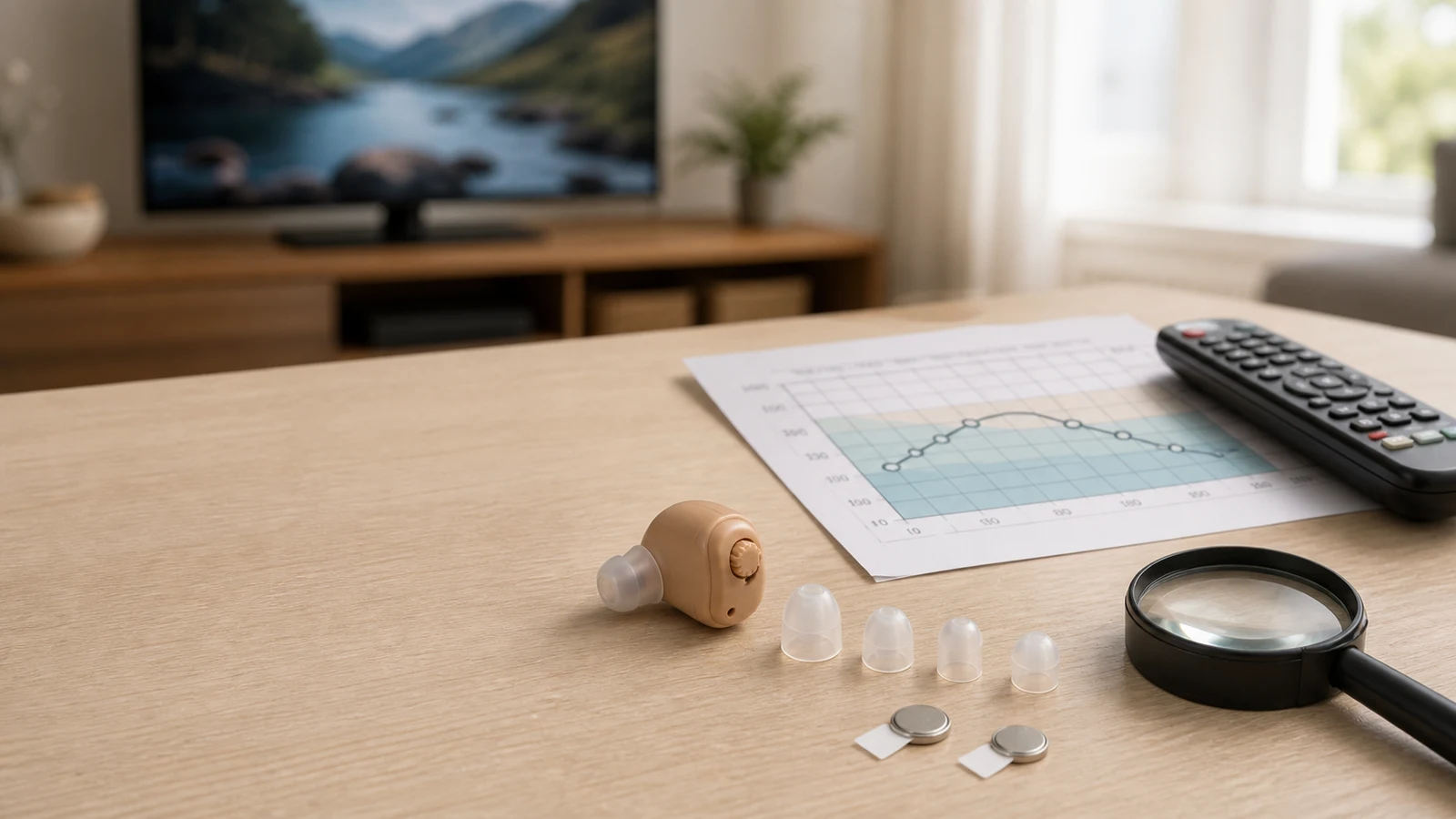
This is the exact RealReviews address that outside articles linked to years ago. Restoring it is more useful than sending every visitor to a generic home page, but a restored URL should not become a museum label for an outdated conclusion. The phrase hearing aid remains in the address because URLs are historical artifacts. It is not our present classification. Bell + Howell's own surviving campaign sold TAC as a situational amplifier for the field, church, dinner, and television. FDA draws a clear line between that kind of consumer product and a medical device intended to compensate for impaired hearing.
TAC also turns out not to be fully defunct. On August 17, 2026, the current Bell + Howell consumer store run by E. Mishan & Sons listed SKU 2335, UPC 080313023354, at $19.99 with an add-to-cart control. Walmart showed a $24 listing but marked it out of stock; a True Value store showed one unit locally. Availability is therefore fragmented, not gone. That makes a current review more necessary, because an old link can still lead to a purchase decision.
The easy version of this article would say that a cheap amplifier is obviously bad or surprisingly good. The surviving evidence refuses both shortcuts. Three Walmart writers described useful amplification, discreet wear, or good value. Five of nine inspectable bodies gave one star, and feedback, static, no useful operation, battery confusion, and weak instructions recur. One repeat user said the wrong ear tip caused static and that changing it solved the problem. That counterexample matters, but it does not erase reports of squeal at every volume.
Our current score is 3.2/10. The product receives credit for a traceable operator, stable identifiers, a low price, adjustable volume, interchangeable tips, and a real remedy policy. It loses much more for what the public offer does not show: maximum output, gain, bandwidth, equivalent input noise, distortion, compression, a speech test, an independent laboratory report, or a verified hearing-aid pathway. The linked national profile carries the complete arithmetic. This page handles the older, messier question: what should a reader make of the review that used to live here?
The old TAC Amplifier review needed a category correction before a rating
RealReviews now scores the Bell + Howell TAC Amplifier 3.2/10. It is a low-cost personal sound amplifier, not a verified hearing aid. A few owners found it useful for conversation or television, but the current offer supplies almost no acoustic performance data and the small inspectable owner record is dominated by feedback, static, nonoperation, battery confusion, and poor instructions. The old hearing-aid framing gave the product a job it had not earned.
Category is not a technicality. A hearing aid is bought because hearing is impaired; the device is expected to compensate for that impairment. A personal sound amplification product is bought by a normal-hearing person who wants a selected situation louder. The plastic can look similar, and both products can contain a microphone, amplifier, and receiver. The difference lives in intended use, regulatory controls, performance expectations, and the risk of delaying care. Calling TAC a hearing aid made a twenty-dollar situational gadget answer a medical-device question without the evidence that question requires.
The correction does not mean that TAC cannot amplify. Positive owner accounts are perfectly compatible with a low score. One reviewer said conversation became audible again and the unit stayed discreet. Another called reception clear and sensitive for the price. A repeat user said the right ear tip prevented static. These are useful observations about a particular ear, device, and setting. They do not establish controlled maximum output, speech discrimination in noise, frequency-specific fitting, or safety for a person with hearing loss.
The negative record cannot be converted into a universal failure claim either. Twelve Walmart ratings are not a national sample; nine inspectable bodies are not enough to estimate a population rate. What they can do is reveal repeated failure modes. High-pitched feedback appears in several independent bodies, including one report that it continued regardless of volume. Static, short use, uncertainty about a disposable battery, ear discomfort, and missing help also recur. A responsible verdict keeps the recurrence and the counterexample together.
Sources for historical verdict evidence
Why the Bell + Howell TAC Amplifier is not a verified hearing aid
Nothing in the reviewed public record establishes TAC as an FDA-regulated hearing aid. Its 2018 television campaign emphasized enhanced hearing in the field plus church, dinner, and television—classic situational uses. FDA says PSAPs are consumer electronics for normal-hearing listeners in selected environments, while hearing aids are medical devices intended to compensate for impaired hearing. Retailer use of hearing-amplifier language does not supply a medical-device classification.
The original slug probably reflected the way inexpensive in-ear amplifiers were commonly described online. Marketplace taxonomies still intensify the confusion: an eBay page may place TAC under hearing assistance, a reseller may say hearing amplifier, and the product may resemble a small in-the-ear aid. FDA's guidance exists because visual similarity and loose marketing created exactly this problem. Intended use controls the distinction. A merchant category or search keyword does not turn consumer electronics into a hearing aid.
The surviving ad is unusually helpful on this point. It begins with tactical advantage in the field and then moves through ordinary settings where someone might want sounds louder. It does not document an audiogram-based fitting, a medical indication, or an OTC hearing-aid label. That record supports PSAP treatment even though a line about church or conversation may attract someone who actually has hearing loss. Marketing can reach beyond the category's safest audience without changing the evidence required.
For an adult with perceived mild-to-moderate hearing loss, the proper comparison is an FDA-compliant OTC hearing aid. That category exists specifically to broaden access without a prescription while retaining a medical-device intended use and applicable controls. Prescription care remains relevant for children, more severe loss, complex needs, or red flags. TAC belongs in a different decision: whether a normal-hearing person wants a cheap situational amplifier despite thin performance documentation and a poor small-sample owner record.
Sources for regulatory category boundary
The category correction
| Factor | TAC Amplifier record | FDA hearing-aid standard |
|---|---|---|
| Intended use | Situational enhanced hearing for field, church, dinner, and television | Compensating for impaired hearing |
| Public classification evidence | Consumer sound-amplifier marketing; no verified medical-device record located | OTC or prescription medical-device pathway |
| Performance disclosure | No located TAC output, gain, noise, distortion, or speech test | Applicable controls and labeling depend on device category |
| Best use | Narrow normal-hearing situational experiment | Hearing-loss support matched to the user's needs |
TAC's identity is clearer than its performance record
The current consumer-product store identifies E. Mishan & Sons, Inc. as the operator behind Bell + Howell and TAC. The exact reviewed item is SKU 2335, UPC 080313023354. The same identifiers appear across the direct offer and retailer records. This consumer brand should not be confused with the unrelated industrial automation business Bell and Howell, LLC. Clear identity earns credit, but it does not validate acoustic claims.
The official terms give a New York address, telephone number, and support email for E. Mishan & Sons. The store footer repeats the operator. That matters because old as-seen-on-TV products often survive as orphan listings with no obvious responsible party. Here, a buyer can at least identify the company offering the current unit, see its current store policies, and preserve a dated order record. The national television campaign also connects the TAC name to a 2018 offer and the old buytacamp.com response URL.
Stable identifiers help separate this review from similarly named electronics. SKU 2335 and UPC 080313023354 recur on the direct page, the True Value listing, a Target-derived archive, and marketplace records. A model suffix such as 2335FE appears on some old-stock pages, but the base SKU and UPC supply the strongest match. Buyers should use those identifiers rather than a beige-device photo, because generic in-ear amplifiers can be visually interchangeable.
The current URL is an odd weak point: bell-howell.com serves TAC under a path ending in bionic-outdoor-trimmer-1. The rendered page title, SKU, UPC, price, and images identify TAC, so the mismatch looks like store maintenance rather than a different product. Still, it reinforces a larger pattern. The official page is good at proving that an offer exists and poor at documenting what the device does. Identity is the beginning of reviewability, not the end.
Sources for operator and model record
The public specifications stop where a sound-amplifier review should begin
The surviving record supports a compact single-ear amplifier with adjustable volume, left- or right-ear use, multiple ear tips, and disposable zinc-air batteries. It does not disclose TAC's maximum output, gain, frequency response, equivalent input noise, distortion, compression, latency, water resistance, or verified speech performance. Battery records also conflict between A312 and A10. The official page does not resolve the conflict.
A True Value page lists adjustable volume, either-ear use, and two zinc-air batteries. A Target-derived record says the package includes two A312 zinc-air cells, carries an adult-use and latex warning, and historically represented a one-year limited warranty. Ubuy says A10 instead. Because A10 and A312 cells differ physically, that is not a harmless naming variation. The marking on the device or unopened package should control; the official store should have stated it plainly.
The missing acoustic numbers are more consequential. Maximum output helps a buyer understand how loud the receiver can become. Gain describes amplification. Frequency response shows which parts of sound are emphasized. Equivalent input noise matters when a device sits in a quiet room. Distortion affects clarity. Compression and limiting help manage peaks. Published research measures these characteristics because two products that both say digital amplifier can behave very differently in an ear.
No reviewed source supplies those values for TAC, and no independent laboratory report or speech test was found. A claim that the product can detect slight movement or work better than normal hearing in background noise therefore remains advertising, not a measured result. The absence does not prove dangerous output or zero benefit. It means a reviewer cannot responsibly infer selectivity, safety, or clarity from the words advanced microprocessor, tactical, or high performance.
Sources for known versus missing specifications
The surviving TAC Amplifier review consensus is small, specific, and unfavorable
Walmart displayed 2.4/5 from 12 ratings and nine inspectable bodies. Five bodies were one-star; repeated negatives were high-pitched feedback, static, no useful operation, battery confusion, discomfort, and weak help. Three favorable bodies described useful conversation amplification, discretion, sensitivity, or value. Ubuy added one four-star rating and a mixed synthesis. The pattern is useful, but the sample cannot estimate a failure or benefit rate.
The most informative positive review came from a repeat user, not because it was five stars but because it named a mechanism. The writer said people complain about static when the wrong tip is used and advised changing the tip. Another writer described clear reception and sensitivity after an initial hiss, and a third said conversation became audible while the device remained hard to see. These accounts establish that some units and ears can produce a useful result.
The negative accounts converge more strongly. One purchaser buying for an older relative with existing hearing aids got high-pitched feedback at every setting and could not find adequate help. Another said the unit failed from the beginning and produced static. A third heard only a high-pitched noise. Other bodies said it simply did not work, hurt the ear, or died before a meaningful trial because the buyer thought it was rechargeable. These are not interchangeable complaints, but setup documentation runs through several of them.
We keep three brakes on the synthesis. Walmart is one retailer, so selection and display effects are unknown. Ubuy's underlying customer material is not transparent enough to code in the same way. Reviews say what happened to self-selected writers, not what a controlled sample experienced. The proper conclusion is that feedback, fit, battery, and instruction problems are credible recurring risks; a minority found the device useful; exact prevalence and clinical benefit remain unknown.
Sources for coded review consensus
Outside ratings
Outside ratings remain separate and are not converted into the RealReviews score.
Consensus coverage
low confidence. We coded 13 content-bearing bodies across 5 eligible sources. Product specificity was high.
Eligible: Walmart, Ubuy, Bell + Howell official store, iSpot TV ad archive, True Value retailer.
- Excluded eBay ended listings — Listings established identity and old-stock status but did not expose a product-specific owner body.
- Excluded heiasist listing mirror — Seller feedback and unrelated amplifier prose were mixed into the page.
- Excluded BBB E. Mishan complaints — Operator-wide complaints covered many products and no TAC-specific body was located.
What reviewers repeatedly said
Recurring positives: A minority of owners found conversation or television amplification useful for the price.; The in-ear device could be discreet, and correct tip size helped at least one repeat user control static.; The current $19.99 direct price keeps the initial purchase inexpensive before shipping..
Recurring negatives: High-pitched feedback, static, or no useful operation recurred across multiple owner bodies.; Battery type, rechargeability, battery life, setup information, and support confused buyers.; Broad clarity and noisy-room claims lack TAC-specific acoustic or speech measurements..
Counterexamples retained: One repeat user said changing ear-tip size solved static.; Two other owners described clear or useful conversation amplification.; One failure involved a user who already had hearing aids, highlighting category mismatch.; The direct store remains active even though Walmart and Ubuy showed unavailable states..
The nine inspectable owner bodies are concentrated on Walmart and span 2020-2024. The evidence identifies failure modes and fit counterexamples but cannot establish a clinical benefit rate, safety rate, or population complaint prevalence. First-party and merchant bodies inform only identity, claims, availability, specifications, and remedies.
Feedback is partly a fit problem—and still a product problem
A poor ear-tip seal can let receiver output reach the nearby microphone and create a feedback loop. That makes the successful tip-change report plausible. Volume, insertion, blocked openings, wax, or battery condition can also affect sound. Yet several owners reported persistent high-pitched noise or static, including at every setting. Fit is a sensible troubleshooting step, not an excuse to dismiss recurrent failure.
TAC places its microphone and receiver in a very small space. When amplified sound leaks out of the canal, returns to the microphone, and is amplified again, a whistle can build. A tip that is too small may leak; a tip that is too large may hurt or sit incorrectly. Covering the microphone during insertion can also change the loop. That explains why an initial burst, a continuous squeal, and static may not have the same cause.
A safe first test begins with the exact fresh disposable battery, minimum volume, a clean suitable tip, and a quiet room. Insert the unit without blocking its microphone, then raise volume only enough to judge the sound. Try one other comfortable tip if feedback appears. Check that the receiver and microphone openings are not clogged. Stop if output is painful, unstable, or startling. Repeatedly turning a squealing device higher is not useful troubleshooting.
The obligation does not sit entirely with the buyer. A product sold on ease and perfect volume should clearly document battery activation, tip selection, insertion, control direction, cleaning, feedback correction, output limits, and the point at which use should stop. Multiple bodies reveal confusion on exactly those subjects. Even if better instructions would rescue some units, an in-ear amplifier that predictably invites misuse through weak documentation deserves a lower usability and safety score.
Sources for feedback troubleshooting record
The PSAP evidence improved; TAC's own evidence did not
Research published around and after TAC's television run shows that selected PSAPs can improve speech understanding for some listeners, especially when the device is measured and fitted. Other trials find hearing aids superior in functional gain, word recognition, and speech in noise. Products vary substantially. TAC itself was not a reviewed model in the located studies, so category evidence cannot fill its missing output, noise, distortion, or speech data.
A 2017 JAMA comparison helped puncture the idea that every low-cost listening product is automatically useless. Some selected commercial PSAPs improved sentence understanding in noise among older adults with mild-to-moderate loss, while the cheapest tested option performed poorly. That result is important because it shifts the question from PSAP or no PSAP to which device, for which listener, under which fitting and outcome. It does not identify TAC as one of the capable products.
Later crossover and electroacoustic work sharpened the distinction. One randomized study in unilateral loss found both PSAPs and hearing aids improved some measures, but hearing aids produced greater functional gain and better word and speech performance. A pilot measuring six PSAPs examined maximum output, frequency range, equivalent input noise, distortion, simulated real-ear response, and clinical outcomes. Different models behaved differently, and fitting mattered. Those are exactly the TAC-specific facts still missing.
A systematic review and meta-analysis found a limited, heterogeneous comparative evidence base. That is not a verdict that no PSAP can help. It is a warning against transferring the result of a selected, measured device to an untested product sharing the category label. TAC's marketing says high performance and enhanced hearing; its public evidence packet says price, SKU, tips, volume, and zinc-air batteries. The gap between those two records drives the low performance-evidence score.
Sources for psap research update
The $19.99 price is real; the cheap trial is not
The official store listed TAC at $19.99 on August 17, 2026, with shipping calculated at checkout and free contiguous-US shipping only above $49.99. The return policy allows a request within 30 days but requires unused, original-condition merchandise, may retain up to $9.99 for shipping and restocking, and may deduct the return label. Those deductions can consume much of a $19.99 purchase.
The direct offer is more credible than an orphan marketplace listing because it exposes an active cart, current operator, SKU, UPC, support route, shipping policy, and refund policy. It remains a dated observation, not a perpetual quote. The terms say prices, descriptions, and availability may change. Walmart's $24 page was out of stock when captured, while a True Value store showed one local unit at $19.99. A buyer should compare the delivered cart, not snippets.
Returns are the harder part. An in-ear product normally must be opened, fitted, and powered before feedback or comfort can be assessed. The policy says the item must be unused and also lists personal-care goods among categories that may be nonreturnable, though it does not name TAC specifically. That ambiguity should be resolved in writing before checkout. A nominal thirty-day period is not a meaningful home trial if opening the box defeats eligibility.
Even an accepted return may have little residual value. Up to $9.99 can be kept for shipping and restocking, and the label may also be deducted. Add original outbound shipping on an order below the $49.99 threshold, and the buyer can spend most of the price to learn that a squealing unit is unsuitable. Preserve the offer, ask how opened in-ear returns are handled, photograph the exact contents, and report a defect promptly rather than describing it as ordinary dissatisfaction.
Sources for delivered trial economics
TAC has one defensible audience, and it is narrower than the ad
The defensible TAC buyer is a normal-hearing adult who wants occasional situational amplification, accepts the missing measurements, verifies the battery, starts at low volume, and understands the weak return economics. Someone with ongoing hearing difficulty should compare FDA-compliant OTC hearing aids or seek professional care. Sudden, progressive, one-sided, painful, draining, or dizziness-associated hearing change needs medical evaluation.
A narrow use case might be listening for quiet environmental sounds, following a distant guide, or testing whether personal television amplification is comfortable. Even there, a venue listening system, TV transmitter, remote speaker, or captions may improve the wanted signal without raising every nearby sound. TAC's microphone sits with the listener, so it does not automatically solve distance or background noise. The advertised situation and the acoustic problem should match before a device is inserted.
For hearing loss, the stakes change. FDA-compliant OTC hearing aids are intended for adults with perceived mild-to-moderate loss and operate within a defined device category. Prescription aids and professional fitting remain relevant for greater complexity. A hearing evaluation can distinguish audibility from poor word recognition, identify frequency patterns, examine the ear, and help catch causes that simple gain will not fix. A cheap amplifier can be an expensive detour when it delays that work.
Red flags are not an upgrade prompt. FDA advises medical attention when hearing changes progress or occur with dizziness, pain, or drainage. Sudden or one-sided changes also deserve prompt care. Remove any amplifier that causes pain or unstable loud output. Keep button batteries away from children and pets. Do not use a retailer's phrase hearing amplifier as reassurance that the product is appropriate for a symptom the retailer has never evaluated.
Sources for appropriate-use boundary
What the restored TAC Amplifier review should leave on the record
The restored record should say five things plainly: TAC is currently orderable, E. Mishan & Sons is the operator, SKU 2335 is a PSAP rather than a verified hearing aid, useful amplification is possible but inconsistent, and no located TAC-specific measurements support its broad clarity or noisy-room claims. At 3.2/10, it is a risky situational experiment—not a hearing-loss solution or a general recommendation.
The old link still has value because it preserves a question people actually asked. The correct response is not to manufacture a nostalgic endorsement. It is to show how the answer changed when the product, regulatory framework, customer record, and research record became clearer. The URL can retain its old wording while the article labels that wording as history. That is better for the reader and more faithful to the reason an external writer linked here in the first place.
The product deserves limited credit. It is not an imaginary offer. The operator is traceable, the direct price is low, identifiers match across stores, and some users did get useful amplification. The ear-tip counterexample is especially worth preserving because it supplies a real setup lesson. But a serious recommendation needs more than possible function. TAC's current page should disclose the exact battery, complete contents, acoustic measurements, instructions, output controls, warranty, and an opened-product trial policy.
Until that record improves, buyers should solve the listening job by the least risky route. Captions and a remote TV speaker may beat an ear-worn amplifier for television. Venue systems may beat it for a lecture. A measured PSAP with a usable return window may beat it for normal-hearing situational listening. An FDA-compliant OTC hearing aid or professional pathway is the relevant route for hearing loss. Low price does not make those categories interchangeable.
Sources for restored review bottom line
A backlink is not a command to repeat the page that earned it. It is a reason to honor the reader's path. Someone arriving here should be able to identify the product, understand why the hearing-aid label was wrong, see both favorable and unfavorable owner evidence, and reach a current decision. The national profile performs the entity and score job; this restored editorial performs the correction and history job. Neither canonicalizes to the other, and both point across the pair.
The open evidence questions are concrete. E. Mishan & Sons could improve this record by publishing maximum output, full-on gain, bandwidth, equivalent input noise, distortion, compression or limiting behavior, exact battery and package contents, detailed setup instructions, warranty terms, and a return rule that addresses opened in-ear products. An independent test of speech in quiet and noise would be stronger still. Until then, the broad marketing remains much more confident than the evidence.
RealReviews did not buy or laboratory-test TAC for this recovery article. We audited the current operator pages, archived advertising, matching retailer records, FDA guidance, comparative PSAP research, and thirteen product-specific evidence bodies, including nine inspectable owner reviews. That boundary matters. We can grade documentation, category fit, observed consistency, price, and remedies. We cannot tell a particular reader how the device will sound in a particular ear.
Final verdict
The Bell + Howell TAC Amplifier earns 3.2/10. Its traceable identity, current $19.99 price, simple controls, and minority of useful owner experiences establish that it can be more than a novelty. Its missing acoustic evidence, category confusion, repeated feedback and failure reports, battery and instruction ambiguity, and weak practical return value keep it far below a recommendation. Preserve the old URL, retire the old hearing-aid premise, and choose the next step by the actual listening problem.