
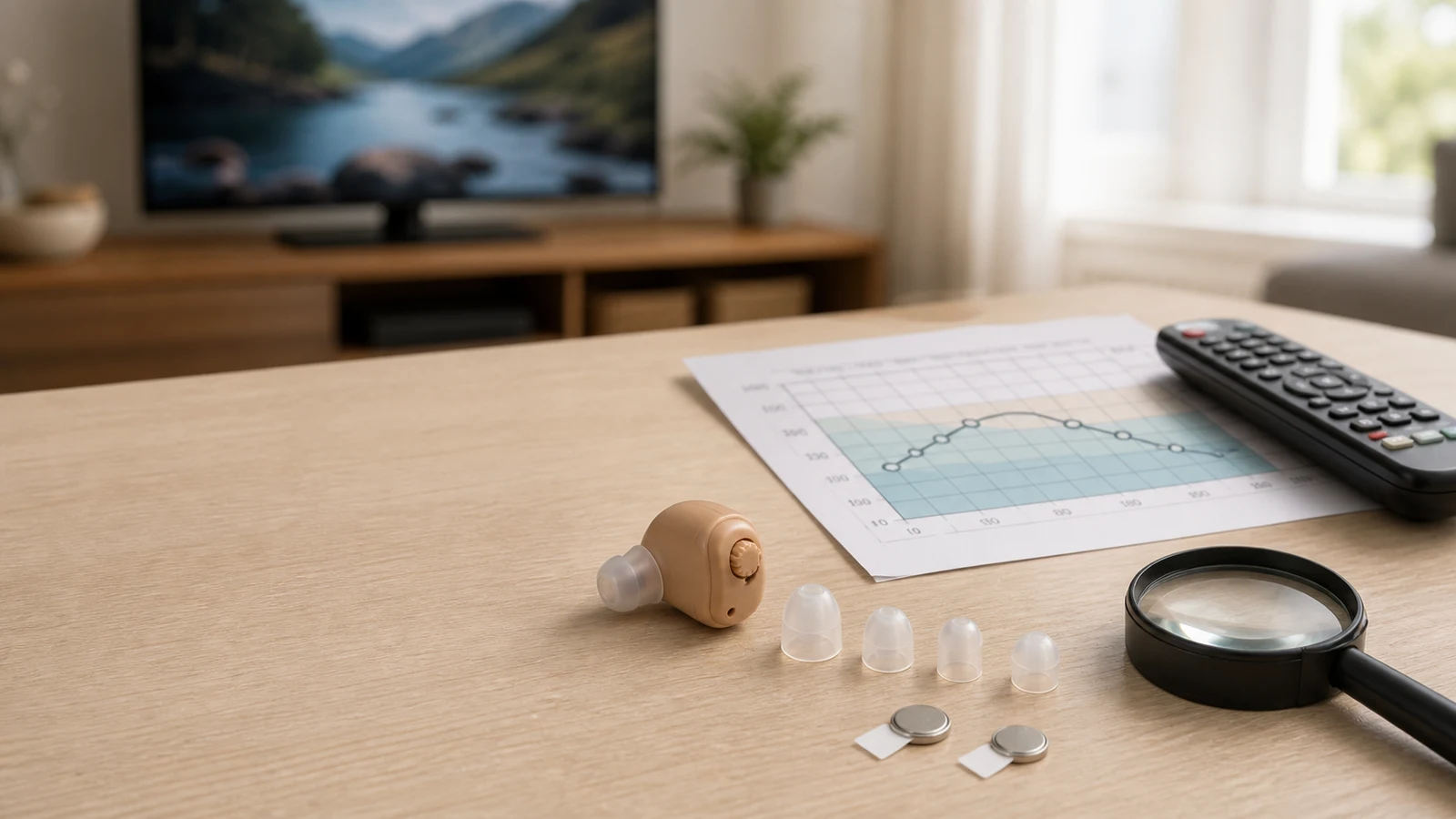
Bell + Howell's TAC Amplifier is easy to identify and hard to evaluate. The current E. Mishan & Sons store lists SKU 2335, UPC 080313023354, for $19.99. The page supplies a cart and almost nothing an informed amplifier buyer would want next: no maximum output, gain curve, bandwidth, equivalent input noise, distortion, compression, speech test, or independent laboratory record. Retailer pages add adjustable volume, interchangeable tips, and zinc-air batteries, but even they conflict on battery size.
We classify TAC as a personal sound amplification product, or PSAP. Its television advertising promoted enhanced hearing for the field, church, dinner, and television. FDA says PSAPs are consumer electronics for normal-hearing people who want selected situations louder; hearing aids are medical devices intended to compensate for impaired hearing. The word hearing aid survives in RealReviews' old backlinked URL, but it is not carried into this national profile as a product classification.
The owner evidence is small and concentrated. Walmart displayed 2.4/5 from 12 ratings and nine inspectable bodies. Repeated problems were high-pitched feedback, static, no useful operation, battery confusion, discomfort, and inadequate instructions. Three favorable bodies prevent an absolute dismissal: owners described clearer conversation, discreet wear, sensitivity, and reasonable value. One repeat user said changing to the correct ear tip stopped static. Those reports help explain likely experience; they do not validate safe output or clinical benefit.
The 3.2/10 score comes from seven weighted dimensions shown below, not from averaging Walmart and Ubuy stars. TAC scores best on traceable identity and current offer clarity. It scores worst on product-specific performance evidence, regulatory fit for hearing loss, and acoustic safety transparency. The resulting recommendation is narrow: a normal-hearing adult might consider it as a low-stakes situational experiment after confirming battery and return terms. A person with hearing loss should compare FDA-compliant OTC hearing aids or appropriate professional care.
Bell + Howell TAC Amplifier review: the 3.2/10 verdict
The Bell + Howell TAC Amplifier earns 3.2/10. It is a real, inexpensive situational sound amplifier, and a few owners reported useful conversation or television amplification. However, no product-specific acoustic or clinical testing was found, the current product page omits basic performance specifications, and Walmart's small record is dominated by static, feedback, failure, battery, and instruction complaints. It is not a substitute for an FDA-regulated hearing aid.
The score does not assume that every inexpensive amplifier is useless. TAC has a traceable operator, exact SKU and UPC, adjustable volume, several ear tips, disposable zinc-air power, and a current direct cart. Three Walmart writers described useful amplification or acceptable value. Those facts keep the device above a nonfunctional shell. They do not answer whether the output is safe, whether speech is separated from noise, or how consistently production units work.
No independent TAC-specific result was located for maximum output, gain, frequency response, equivalent input noise, total harmonic distortion, compression, latency, speech understanding, or real-ear fit. These are not decorative laboratory details. They help distinguish a device that merely makes everything louder from one that produces controlled, tolerable, intelligible amplification. The official page currently supplies price and identity but none of those measurements.
The owner record is small enough that the exact 2.4/5 platform score should not become a failure-rate estimate. It is still directionally useful because the same failure mode appears repeatedly: high-pitched feedback or static. A good review also names a counterexample—changing ear-tip size—which makes fit a reasonable first troubleshooting step. The verdict therefore remains narrow: cheap situational amplification with unusually weak documentation and poor observed consistency.
The 3.2 is reproducible rather than impressionistic. Seven dimensions total exactly 100 percent: identity 10, documented design 15, product-specific performance 20, regulatory and hearing-loss fit 20, owner consistency 15, safety transparency 10, and price and remedies 10. Multiplying each dimension value by its weight yields 3.2. A new independent acoustic report, clearer category labeling, consistent owner evidence, or a more usable trial could change later evaluations. The score is dated, source-linked, and open to correction.
Is the TAC Amplifier a hearing aid?
The reviewed record supports calling TAC a personal sound amplification product, not a hearing aid. Its advertising centers on making selected sounds louder for outdoor activity, church, dinner, and television. FDA says PSAPs are consumer electronics for normal-hearing people in specific situations, while hearing aids are medical devices intended to compensate for impaired hearing. The old URL's wording is historical and does not change that distinction.
The old RealReviews address contains the phrase hearing aid because that was the wording attached to the former article. Keeping the exact address preserves the citation trail; it does not preserve the classification. The surviving 2018 commercial called TAC a tactical innovation for enhanced hearing in the field and also promoted church, dinner, and television use. That is situational-amplification language, not proof of a hearing-aid intended use or FDA compliance.
FDA's dividing line is purpose, not appearance. A hearing aid is a medical device intended to compensate for impaired hearing. An OTC hearing aid is limited to adults with perceived mild-to-moderate hearing loss and must satisfy the applicable device controls. A PSAP is consumer electronics for a normal-hearing person who wants selected environmental sounds louder. Both can sit in an ear and contain a microphone, amplifier, and receiver without becoming the same category.
This distinction changes the buying decision. Someone who wants to hear a distant bird, a guide, or a quiet television at a personally convenient level may be shopping for situational amplification. Someone who regularly misses conversation because of hearing loss needs a device selected for that impairment, with suitable output controls and a meaningful return path. The word amplifier on a package does not bridge the gap.
Search pages often erase the boundary because they group hearing aids, amplifiers, and listening accessories together. The legacy RealReviews slug did the same. This profile preserves the search history without copying its assumption. If a future TAC package makes an explicit hearing-loss intended-use claim, that would trigger a new regulatory review; until then, the substantiated public positioning and the FDA definitions support PSAP treatment.
Does the TAC Amplifier work?
It can make sound louder, but the evidence does not support a reliable clarity or noisy-room promise. Three Walmart reviewers described useful or acceptable amplification; five gave one star, most often because of high-pitched feedback, static, or no useful operation. Research shows that selected PSAPs can help some listeners, but products differ substantially. No TAC-specific speech test or acoustic measurement was located, so category results cannot prove this device works for a particular buyer.
Working has several meanings here. A microphone may pick up sound and a receiver may deliver a louder signal while speech remains no easier to understand. Broad amplification can also elevate competing voices, dishes, ventilation, traffic, and clothing noise. The Walmart listing's claim that hearing becomes better than normal in a noisy room would require product-specific speech-in-noise evidence. None was located in the reviewed record.
The positive owner bodies are concrete but limited. One person said conversation returned; another called reception clear and sensitive for the price; a repeat user said the units worked once the correct ear tip was used. The negative bodies are equally concrete about failure sound: feedback, static, high-pitched noise, or no operation. That conflict is exactly why an aggregate star alone cannot answer whether a new unit will work in a new ear.
Published research on other PSAPs supplies context, not a borrowed endorsement. Some selected devices improved speech understanding under controlled conditions, and some comparisons found hearing aids superior in functional gain and noisy speech. Tested models, fitting, hearing configuration, and outcome all mattered. TAC was not one of the documented devices in the reviewed studies, so its own missing measurements remain decisive.
A better TAC evidence packet would begin with an ANSI/CTA-style electroacoustic table, followed by independent speech testing in quiet and noise, reporting for every tested setting, and a clear description of fit. It also would state whether the volume control includes limiting or compression. Without that work, a buyer cannot tell whether an apparently crisp first impression comes from useful speech emphasis, simple broadband gain, or an output peak that becomes tiring.
What do TAC Amplifier reviews and complaints show?
The surviving owner consensus is unfavorable but small. Walmart displayed 2.4/5 from 12 ratings and nine bodies; repeated negatives were feedback, static, failure to work, short or misunderstood battery life, discomfort, and weak instructions. Positive counterexamples said the device was discreet, sensitive, inexpensive, or improved conversation. One owner said the correct ear tip stopped static. These reports identify failure modes, not a population failure rate.
Five of the nine inspectable Walmart bodies gave one star. Three described high-pitched noise or static; two said the device did not work in a useful way; one also could not find adequate help in the box. A three-star owner mentioned ear discomfort and did not understand recharging. Another one-star owner learned only after purchase that the cell was not rechargeable and said the trial ended quickly.
The favorable accounts matter because they narrow the conclusion. A five-star repeat user attributed static to the wrong tip and advised changing sizes. Another buyer described clear, sensitive reception at a low delivered price, though that body incorrectly described charging a zinc-air battery. A four-star verified buyer said conversation became audible and the device was discreet, with a loud noise during insertion. Benefit was possible, but setup information was evidently not robust.
Ubuy displayed only one four-star rating and a generalized mixed synthesis mentioning some improvement alongside battery, packaging, and information problems. We did not combine that number with Walmart's. Platforms recruit and display reviewers differently, and one rating cannot stabilize a small dataset. The consensus is therefore thematic: feedback and instruction problems recur; discreet low-cost amplification works for a minority; prevalence remains unknown.
Outside ratings
Ratings are reported exactly as displayed by each platform on the capture date. RealReviews does not combine, rescale, or treat a one-review page as representative.
Consensus coverage
low confidence. We coded 13 content-bearing bodies across 5 eligible sources. Product specificity was high.
Eligible: Walmart, Ubuy, Bell + Howell official store, iSpot TV ad archive, True Value retailer.
- Excluded eBay ended listings — Listings established identity and old-stock status but did not expose a product-specific owner body.
- Excluded heiasist listing mirror — Seller feedback and unrelated amplifier prose were mixed into the page.
- Excluded BBB E. Mishan complaints — Operator-wide complaints covered many products and no TAC-specific body was located.
What reviewers repeatedly said
Recurring positives: A minority of owners found conversation or television amplification useful for the price.; The in-ear device could be discreet, and correct tip size helped at least one repeat user control static.; The current $19.99 direct price keeps the initial purchase inexpensive before shipping..
Recurring negatives: High-pitched feedback, static, or no useful operation recurred across multiple owner bodies.; Battery type, rechargeability, battery life, setup information, and support confused buyers.; Broad clarity and noisy-room claims lack TAC-specific acoustic or speech measurements..
Counterexamples retained: One repeat user said changing ear-tip size solved static.; Two other owners described clear or useful conversation amplification.; One failure involved a user who already had hearing aids, highlighting category mismatch.; The direct store remains active even though Walmart and Ubuy showed unavailable states..
The nine inspectable owner bodies are concentrated on Walmart and span 2020-2024. The evidence identifies failure modes and fit counterexamples but cannot establish a clinical benefit rate, safety rate, or population complaint prevalence. First-party and merchant bodies inform only identity, claims, availability, specifications, and remedies.
Why does the TAC Amplifier squeal or produce static?
Feedback can occur when amplified output leaks from the ear canal back to the microphone. Ear-tip seal, insertion, microphone blockage, volume, earwax, and battery condition can all affect sound. One owner said changing tip size solved static; others reported squeal at every setting. Start at minimum volume, fit the correct tip, keep openings clear, and stop if sound is painful or unstable. Persistent feedback makes the unit unsuitable for that user.
An in-ear amplifier places a microphone and receiver close together. If output escapes around the tip and reaches the microphone again, the loop can produce a whistle. A poorly sealed tip can encourage that loop, while a blocked microphone or receiver can create distortion and unstable behavior. Raising volume may intensify the problem. This mechanism makes the ear-tip counterexample plausible without proving every complaint is user error.
A careful first setup is simple: confirm the exact disposable battery and polarity; allow a freshly activated zinc-air cell to begin working; select a clean tip that seals without pain; insert the device before raising volume; start low; and test in a quiet room. Do not cover the microphone with a finger. If the unit squeals continuously, try one other suitable tip and a fresh correct battery rather than repeatedly turning it louder.
Troubleshooting has a stopping point. Pain, sudden loud output, persistent distortion, or a tip that can become lodged is not a normal adjustment exercise. Remove the device. An ear canal with drainage, marked wax, soreness, or foreign material needs appropriate care, not more gain. If a properly fitted unit still feeds back, the practical conclusion is that TAC is a poor match or defective, regardless of the $19.99 price.
What battery and ear tips does the TAC Amplifier use?
Retailer records agree that TAC uses disposable zinc-air button batteries and came with multiple ear tips, but they conflict on the battery size: a Target-derived record says A312 while Ubuy says A10. The official current page does not resolve the conflict. Verify the marking on the device or package before buying replacements. Zinc-air cells are not rechargeable, and button batteries must stay away from children and pets.
The current official page identifies SKU 2335 and UPC 080313023354 but does not state battery chemistry, size, included quantity, or tip count. A True Value listing says two zinc-air batteries are included and that the unit fits either ear. A Target-derived archived record specifies two A312 zinc-air cells. Ubuy instead describes an A10 battery. That conflict is material because the physical sizes are not interchangeable.
Treat the package and device marking as controlling. Do not infer a replacement from a reseller title, and do not force a cell that does not seat normally. Zinc-air batteries activate after the sealing tab is removed and air reaches the cell; they are disposable. A review that says to charge the battery likely reflects misunderstanding, not a recharge feature. Removing the tab early can also shorten useful shelf life before insertion.
Tip size affects comfort, retention, acoustic seal, and feedback. The largest tip is not automatically best; the correct one seals gently without pressure or pain. Keep the receiver opening clear and use only clean, intact tips. Button batteries create a serious ingestion hazard and must be stored away from children and pets. If the original instructions or markings are missing, ask the operator to confirm the exact replacement before ordering cells.
How much does the Bell + Howell TAC Amplifier cost?
Bell + Howell's official store listed TAC at $19.99 on August 17, 2026. Shipping is calculated at checkout because free contiguous-US shipping begins over $49.99. Walmart displayed $24 but showed the product out of stock. Compare the delivered total, included batteries, and seller-specific remedy—not the sticker price alone. Marketplace old stock may have aged zinc-air batteries or different return terms.
The direct price is verifiable because the current operator page exposes SKU, UPC, quantity control, and add-to-cart state. That is stronger availability evidence than a marketplace result alone. It is still a dated capture. The terms allow price, description, and availability to change, and the product URL itself contains an unrelated trimmer slug, so a buyer should confirm the cart line before paying.
A $19.99 device can become materially more expensive after calculated shipping and replacement batteries. It also can become poor value quickly if the intended use is daily hearing support, because the buyer may soon need a better measured device. Conversely, a normal-hearing person who needs occasional situational amplification may value a low initial cost more than streaming, self-fitting software, or professional service. The job matters more than the absolute price.
Old stock deserves a separate check. Zinc-air cells may be included, but their usable life depends on intact tabs and storage. A third-party seller may display a higher price, no returns, or different contents. Match UPC 080313023354 and SKU 2335, obtain the return terms in writing, inspect the seal before use, and do not treat a listing photo as proof that fresh batteries or every tip remains in the box.
What is the TAC Amplifier return policy?
The direct store gives 30 days after receipt to request a return, but the item must be unused, in original condition, and in original packaging. The policy says up to $9.99 may be retained for shipping and restocking, and the return-label cost can also be deducted. On a $19.99 in-ear device, those deductions are substantial. Ask support in writing how opening or fitting TAC affects eligibility before ordering.
The return window sounds broad until it is compared with the product. An in-ear amplifier normally must be opened and fitted to discover comfort, feedback, and useful gain, yet the posted policy requires an unused item and separately identifies personal-care goods as potentially nonreturnable. TAC is not expressly named in that exception. The ambiguity should be resolved with the seller before purchase, not after the ear tips have been tried.
The arithmetic is unusually important. The store may retain up to $9.99 for shipping and restocking and deduct a provided return-label cost. Those amounts can consume much of a $19.99 purchase price even before original outbound shipping is considered. A nominal thirty-day window therefore is not equivalent to a low-cost home trial. Save a screenshot of the offer and the written answer about opened in-ear returns.
For a defective or wrong item, the policy tells buyers to contact the company immediately so it can evaluate the issue. Photograph the package, model, UPC, battery compartment, contents, and observed damage before use. Describe feedback or nonoperation precisely, including fresh battery, tip, and volume steps. Keep the order record and support thread. A marketplace purchase follows that marketplace seller's remedy, not automatically Bell + Howell's direct policy.
Should someone use TAC Amplifier for hearing loss?
Do not use TAC as a hearing-aid substitute. An adult with perceived mild-to-moderate hearing loss can compare FDA-compliant OTC hearing aids, whose intended use and controls differ from a PSAP. Sudden, rapidly worsening, one-sided, painful, draining, or dizziness-associated change needs medical evaluation. A hearing test also clarifies whether the problem is audibility, speech discrimination, wax, medication, middle-ear disease, or another cause simple amplification will not solve.
Price is not the only difference. A hearing aid is intended to compensate for hearing impairment and falls within a medical-device framework. An OTC hearing aid is for adults eighteen and older with perceived mild-to-moderate loss and must meet relevant controls, including limits intended to manage acoustic risk. TAC's public offer does not supply evidence that it belongs to that category or meets those requirements.
Symptoms can point beyond ordinary age-related hearing loss. FDA advises medical attention when hearing changes progress or occur with dizziness, ear pain, or drainage. Sudden or one-sided changes also deserve prompt evaluation. Wax, infection, middle-ear problems, medication effects, or a less common nerve condition cannot be safely sorted by turning up a general amplifier. Louder sound can mask delay without addressing the cause.
A basic hearing test also improves device selection. Two people who both say speech is quiet may have different frequency patterns, word recognition, comfort limits, and ear anatomy. One may benefit from an appropriately fitted OTC hearing aid; another may need prescription care, an assistive listening system, captions, or medical treatment. TAC supplies one small volume control, not an individualized assessment or frequency-specific fitting.
What are sensible TAC Amplifier alternatives?
Choose by job. For television, try captions, a remote speaker, or a TV listening system. For a lecture or tour, use a venue listening system. For normal-hearing outdoor observation, compare PSAPs with published output, frequency response, noise, distortion, and return terms. For perceived hearing loss, compare FDA-compliant OTC hearing aids or professional care. A replacement is better only if its measurements and remedy match the actual listening problem.
Television listening does not always require an ear-worn amplifier. Captions improve access without acoustic risk. A remote speaker can bring dialogue closer while preserving shared room volume. Dedicated TV headphones or loop, infrared, and radio-frequency systems can improve signal-to-noise ratio by delivering the program directly. Those options solve distance and competing-room-noise problems more specifically than amplifying every nearby sound.
At a lecture, theater, worship service, museum, or tour, ask about the venue's assistive listening system. A microphone near the speaker and a direct receiver can improve signal-to-noise ratio more effectively than a microphone sitting in the listener's ear. For outdoor observation by a normal-hearing user, demand published maximum output, bandwidth, equivalent input noise, distortion, controls, and a return trial from any PSAP candidate.
For ongoing hearing difficulty, the alternative set changes to FDA-compliant OTC or prescription hearing aids, plus professional evaluation when appropriate. Compare fitting method, frequency shaping, directional microphones, feedback management, output limits, battery plan, service, and trial economics. Category research suggests some PSAPs can help selected users, but variation is the lesson: a named alternative must earn its recommendation with its own measurements and terms.
Core sources for this score
- Bell + Howell current TAC Amplifier offer
- Walmart rating and nine inspectable owner bodies
- Bell + Howell refund policy
- FDA hearing-aid and PSAP comparison
- FDA hearing-aid and PSAP regulatory guidance
- JAMA speech-understanding PSAP comparison
- Randomized PSAP and hearing-aid crossover trial
- Electroacoustic and clinical PSAP pilot study
Final verdict
The Bell + Howell TAC Amplifier earns 3.2/10. A traceable operator, current $19.99 offer, adjustable volume, multiple tips, and several favorable owner reports show that useful low-cost amplification is possible. The public record still lacks the product-specific measurements needed to judge output, noise, distortion, selectivity, or speech performance, while repeated owner feedback and failure complaints weaken confidence further. The return deductions can erase much of the price advantage. Use TAC only as a narrow normal-hearing situational experiment, never as a substitute for an FDA-regulated hearing aid or evaluation of concerning symptoms.