
Independent Key West marina and storage guide
Key West Boat Storage: Dry Racks, Wet Slips, Trailer Parking, and Marina Rates
Compare Key West dry-stack storage, wet slips, trailer parking, transient dockage, launch access, hurricane terms, and published marina rates.
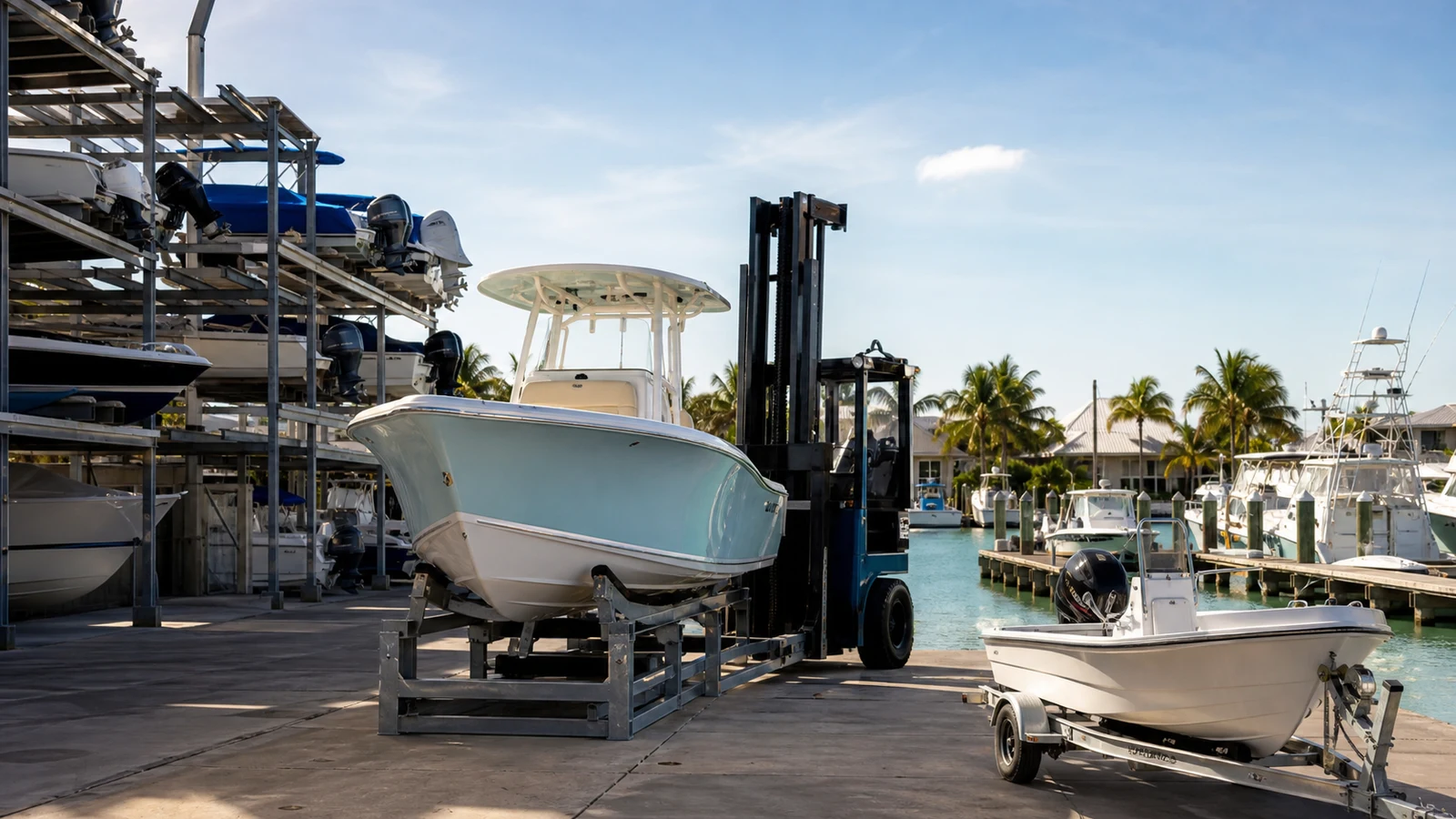
A 23-foot center console used every Saturday needs a different Key West home than a 42-foot cruiser arriving for ten nights. One owner needs a forklift launch and trailer space. Another needs shore power, pump-out access, a safe approach, and a hurricane clause that agrees with the insurance policy. Calling both arrangements boat storage hides the details that determine cost and risk.
The useful local choices are not interchangeable. Beach Weekend publishes 144 high-and-dry spaces with valet launching but no rate sheet. Hurricane Hole publishes dry-barn, trailer, wet-slip, and transient prices. City Marina at Garrison Bight publishes ramp and short trailer-parking rates alongside transient dockage. Stock Island Marina Village is the deep-water wet-slip comparison for larger boats, while Sunset Marina publishes 20- to 60-foot slip sizes but requires a direct price and availability check.
Match the berth to the actual boat
Send dimensions, dates, storage type, and launch needs once
Include length overall, beam, height, loaded weight, draft, engines, trailer axles, desired wet/dry/trailer arrangement, dates, launch frequency, shore power, insurance, and hurricane plan.
Local businesses compared
These are identity-checked local profiles, not paid placements. The fit notes describe differences supported by current official information; ratings shown remain attributed to their outside source.
- Model
- High-and-dry marina with 144 published rack spaces, valet launching, wet slips, fuel, ship store, parts, and service.
- Best starting fit
- Rack-compatible powerboats whose owners want staff launching rather than trailering every trip.
- Why it is on this list
- The official page states 144 high-and-dry slips, short- and long-term storage, scheduled valet launches, daily 7 a.m.–6 p.m. hours, and a 5710 US-1 address.
- Confirm before booking
- Rates, rack limits, launch lead time, late-return procedure, included washdown, storm terms, and insurance limits are not public. Obtain them in writing.
- Model
- Hurricane Hole groups four storage products at Cow Key Channel: an indoor dry barn, trailer space, front and back wet docks, and transient dockage. Its published boat limit is 34 feet, and the site also lists fuel and bait.
- Best starting fit
- Owners comparing dry, trailer, and wet storage at one facility who want public prices before calling.
- Why it is on this list
- Long-term low-profile storage is listed at $440 monthly, high-profile at $610, back dock at $800, front dock at $850, and trailer at $240, plus tax with a two-month minimum.
- Confirm before booking
- Confirm what low/high profile means, dimensions, weight, launches, utilities, deposits, storm duties, insurance, liveaboard rules, and current availability.
- Model
- Municipal marina with transient dockage, public ramp, and limited first-come trailer parking.
- Best starting fit
- Short trailer stays, same-day launching, or transient dockage where posted municipal pricing matters.
- Why it is on this list
- Effective October 1, 2025: $3.36/foot daily or $44.88/foot monthly transient dockage plus tax/utilities, $15 ramp, $10 same-day trailer, $10 nightly single/double axle, and $20 triple axle.
- Confirm before booking
- Trailer parking cannot be reserved. Confirm availability, vessel fit, checkout, utilities, cancellation, insurance, and storm obligations.
- Model
- Deep-water marina with 288 slips, 218 concrete docks, boats advertised to 450 feet, no overhead obstruction, and Dockwa reservations.
- Best starting fit
- Larger cruising boats needing deep-water access, security, pump-out, parking, showers, laundry, fuel, and resort-style amenities.
- Why it is on this list
- The marina's North Pier sheet opens at $4.50 per foot for a day. Its posted monthly figure is $50 per foot, while the annual figure is $40 per foot. Water and pump-out come with the berth; electricity does not. Boats drawing more than 12 feet must call.
- Confirm before booking
- From-pricing is not a final quote. Confirm berth, beam, draft, power, deposit, liveaboard status, event premiums, storm plan, taxes, and mandatory fees.
- Model
- Stock Island wet-slip marina publishing 20-, 30-, 40-, 50-, and 60-foot slip bands, fuel, and ship-store access.
- Best starting fit
- Owners seeking a longer-term Stock Island wet slip and a direct conversation with marina staff.
- Why it is on this list
- The Key West site identifies 5555 College Road and sizes from 20 to 60 feet. Google Places reported 4.3 from 180 reviews on August 5; that is an attributed outside aggregate, not a RealReviews score.
- Confirm before booking
- A complete Key West rate, utility, availability, insurance, waitlist, and hurricane table is not public. Ignore similarly named marinas in other states and request a written local proposal.
Choose high-and-dry, trailer storage, or a wet slip by how you use the boat
High-and-dry keeps the hull out of salt water and transfers launching to marina staff. It works only if the rack accepts length overall, beam, height, loaded weight, engines, hardtop, antennas, and hull geometry. Ask how much launch notice is required, where the boat waits afloat, the final launch and haul times, what happens after hours, and whether washdown, engine flushing, battery charging, storm moves, and service access are included.
Picture a trailer owner arriving Friday afternoon. The gate must admit the full rig, the tow vehicle needs somewhere legal to sit, and the ramp still has to be usable when the boat returns. Give the facility the combined length, width, height, weight, and axle count, and say whether the space holds an empty trailer or the boat as well. City Marina's posted $10 and $20 overnight tiers can work for that short stay, but the lot is first come, first served; bearings, tires, turning room, and a storm-removal route remain the owner's problem.
Now picture a cruiser staying for a month. The marina should write the billed length and any minimum on the quote, then identify the actual berth, usable beam and depth, dock construction, shore-power connection, water and pump-out arrangement, parking, security, contractor rules, liveaboard permission, and named-storm deadline. Wet storage removes the launch ritual but adds bottom care. Electricity, minimum footage, deposits, parking, and event premiums can reverse what looked like the lowest per-foot offer.
- High-and-dry: verify rack geometry, lift weight, launch timetable, washdown, service access, and storm handling.
- Trailer: verify combined dimensions, axle class, ramp, vehicle parking, access, security, and mandatory removal.
- Wet slip: verify billed length, beam, draft, power, utilities, liveaboard permission, bottom care, and storm duties.
Normalize the published rates before choosing the cheapest option
Hurricane Hole has the clearest small-boat table: with a two-month minimum, low-profile storage is $440 plus tax monthly, high-profile $610, back dock $800, front dock $850, and trailer $240. Transient storage or dockage is $65 daily, $350 weekly, or $1,100 monthly; transient trailer storage is $30 daily, $150 weekly, or $300 monthly. Those numbers do not guarantee fit or availability.
City Marina publishes $3.36 per foot daily and $44.88 per foot monthly for transient dockage plus tax and utilities. Stock Island Marina Village publishes North Pier prices from $4.50 per foot daily, $50 per foot monthly, or $40 per foot annually, with water and pump-out included and electricity separate. The word from matters because berth, date, vessel, events, deposits, and power change the total.
Put every offer on the same term and dimensions. Add minimum length, tax, electricity, water, pump-out, parking, cards, liveaboard fees, launches, washdown, lockers, deposits, reservations, events, late returns, forklift moves, contractor access, cancellation, and termination. A monthly rack quote and annual wet-slip rate cannot be ranked until the time period and included work match.
Measure the boat the way the marina will lift, berth, and bill it
Use overall length, not the model number. Include engines, bracket, platform, pulpit, anchor, davits, tender, and fixed projections. For rack or trailer storage, give maximum beam, height from ground or keel, and loaded weight with engines, fuel, water, batteries, gear, and trailer. For wet slips, add draft, mast or tower height, hull type, tender arrangement, and shore-power voltage and amperage.
The number on a forklift is only a capacity rating. It says nothing about where the boat's weight sits or whether the forks, bunks, hull shape and engine clearances work together. A stepped hull or a transducer in the wrong place can change the lift. Those details belong on the marina's written acceptance, before the first launch ticket is opened.
A wet-slip owner needs a similarly specific record. The useful line is not ‘marina handles 60-foot boats’; it is ‘this boat fits berth C-14.’ That record should pair the vessel's actual beam, draft and electrical load with the berth's usable width, controlling depth, approach and pedestal. It turns a broad marketing claim into a checkable promise.
Write down the four storm deadlines that matter
A named storm creates four separate deadlines: the owner's decision, mandatory removal, gate closure, and arrival at the backup location. They are rarely the same. Match each one to a person, destination and price. Florida law gives marinas room to take certain reasonable protective steps after a watch; the signed agreement supplies the earlier, practical deadline that matters when US-1 traffic and mainland yard space tighten.
Miami-Dade's preparation guidance says boats ashore perform better on average, but ‘ashore’ is not enough detail for a Keys plan. Will this boat stay in its everyday rack? Is that structure engineered for the wind claim being made? Does a trailer remain in the lot, get anchored, or leave? If the answer is merely ‘hurricane proof,’ there is no plan yet.
The insurer gets the final copy. Include the exact marina, storage method and storm destination. A policy may limit navigation, impose a named-storm deductible, require a haul or relocation, or make coverage depend on a lay-up promise. A Key West rack can be excellent for ordinary weekends and still fail the policy if the carrier expects the boat north of the Keys.
Rehearse the day you will actually use the marina
For dry stack, imagine the return from a Saturday fishing trip after a squall slowed the boat. The decisive questions are the last haul, where the boat may wait, and whether an evening return triggers a fee or an overnight wet berth. Launch lead time matters in the morning; the closing routine matters more after the weather changes. Flushing, washing, battery care and gear left aboard are separate services, not assumptions.
Trailer storage is easier to judge in person. Make the turn from the street with the whole rig, locate tow-vehicle parking and look at the surface under the tires. Lighting and gate access matter, but so do drainage and the person allowed to move a blocked trailer. City Marina's spaces cannot be reserved, which makes a second holiday-weekend lot or ramp part of the plan rather than a nice backup.
A wet berth deserves one daylight approach at the tide the owner expects to use. Check the controlling pinch point, not only the depth beside the dock. Connect the specified pedestal, then walk the real route among parking, fuel, pump-out and deliveries. Stock Island advertises a long amenity list; the comparison should charge only for the features this boat and crew will actually use.
Three contract moments reveal most of the risk
The first moment is a marina move. The agreement should say who may relocate the boat, where it can go, what notice is due and whether the price changes with the berth. The accepted dimensions and assigned rack or slip belong beside the operator's legal name. Launches, power, tax, deposits and event surcharges belong on the same money page, not scattered through email.
The second is damage. Read the procedure for three different events: theft, dock or weather damage, and a problem during a staff lift. Note the reporting deadline and how long camera footage is kept. Dated intake photographs should cover the hull, running gear, engines, electronics and trailer closely enough that an old mark cannot be confused with a new one.
The third is departure. A useful exit calendar shows renewal, cancellation, late fees, lockout, holdover and the last day for ordinary removal. It also answers the awkward case in which the vessel is disabled and cannot leave under its own power. That is where lien language and a seemingly small missed deadline become expensive.
Match the facility to the constraint that cannot bend
Beach Weekend is the rack-and-valet candidate, provided the unpublished limits and price work for the hull. Hurricane Hole is the easiest place to compare posted dry, trailer and wet products without changing operators. City Marina is different: its public ramp and short trailer pricing suit a brief stay, but first-come space makes it a poor single plan for a busy weekend.
For a larger cruiser, Stock Island Marina Village supplies the deep-water and service-heavy comparison. Sunset Marina is the nearby direct-quote alternative with published slip bands from 20 to 60 feet. None is the universal winner. The non-negotiable constraint—lift geometry, trailer certainty, draft, shore power or storm relocation—should decide which quotes survive.
- Rack-compatible boat and staff launch: Beach Weekend.
- Published mixed storage menu: Hurricane Hole.
- Short trailer stay or municipal ramp: City Marina.
- Large-boat wet slip and amenities: Stock Island Marina Village.
- Direct-quote Stock Island wet slip: Sunset Marina.
Give every marina the same one-page boat brief
Page one identifies the boat as it will arrive: make, year, true overall length, beam, highest point, loaded weight, draft, hull, engines and electrical service. A trailer adds total rig dimensions and axle count. The owner then states the wanted arrangement, dates, likely launch rhythm, after-hours needs, maintenance access and whether anyone plans to live aboard.
The marina fills in the other half: accepted fit, actual rack or berth, start date, term and recurring total. Separate lines cover launches or moves, utilities, parking, insurance, storm duties, deposit and cancellation. Sensitive items such as gate codes, keys, policy documents and payment data stay out of the public request.
- Boat dimensions and loaded weight.
- Trailer footprint, axles, vehicle and ramp needs.
- Storage type, dates, term, launches and after-hours returns.
- Insurer requirements and hurricane destination.
- Base price, taxes, utilities, moves, parking, events and exit fees.
Sources and verification
Rates and facility terms were checked August 5, 2026. Prices can change and do not establish fit or availability. Outside ratings stay attributed and are not RealReviews scores.
Frequently asked questions
How much does boat storage cost in Key West?
Hurricane Hole currently lists long-term dry storage at $440 monthly for low-profile and $610 for high-profile boats, trailer storage at $240, and wet docks at $800 or $850, plus tax with a two-month minimum. City Marina lists transient dockage at $3.36 per foot daily or $44.88 monthly plus tax and utilities. Stock Island lists North Pier rates from $4.50 daily, $50 monthly, or $40 annually per foot. Beach Weekend is quote-only. Add mandatory fees before comparing.
Where is high-and-dry boat storage available in Key West?
Beach Weekend publishes 144 high-and-dry spaces with valet launching. Hurricane Hole publishes indoor dry-barn space in low- and high-profile tiers. Confirm accepted length, beam, height, loaded weight, lift method, launch timing, late return, washdown, service access, insurance, and storm plan.
Can I store a boat trailer overnight in Key West?
Yes. City Marina lists $10 nightly for single/double-axle trailers and $20 for triple-axle trailers, but spaces are first come and cannot be reserved. Hurricane Hole lists transient trailer storage at $30 daily, $150 weekly, or $300 monthly. Confirm whether the price covers an empty trailer or boat-on-trailer, dimensions, vehicle parking, hours, and storm removal.
Is dry storage safer during a hurricane?
Usually, but not automatically. Official guidance says boats stored on land fare better on average, but that does not make every rack or lot storm-rated. Compare construction, elevation, anchoring, removal deadlines, inland destination, and insurance requirements. Obtain the facility plan and insurer approval before relying on it.
What measurements does a marina need?
Provide length overall including engines and projections, beam, height, loaded weight, draft, hull type, engines, and shore power. For trailer storage add the complete rig and axle count. For wet slips add mast or tower height and tender arrangement. Ask the marina to accept the measurements and berth or rack in writing.
Can I live aboard at a Key West marina?
Only at a facility and berth that expressly permit liveaboards. Dry racks and trailer lots do not, and a wet slip is not automatically a liveaboard lease. Ask about permission, waitlist, residency process, person fees, parking, utilities, sewage, insurance, and minimum length.
What should a boat-storage quote include?
A usable quote names the vessel and the exact rack or berth the marina has accepted. It states the dates, minimum term and recurring total, then separates tax, power, launches, parking and other required charges. It also covers insurance, named-storm responsibility, cancellation, renewal and the procedure for reporting damage. If a required cost or duty is missing, the quotes are not yet comparable.