
Independent Key West roll-off and debris guide
Key West Dumpster Rental: Permits, Sizes, Prices, Materials, and Local Providers
Compare Key West roll-off dumpster sizes, current price anchors, City right-of-way permits, accepted materials, truck access, local haulers, weight limits, and pickup terms.
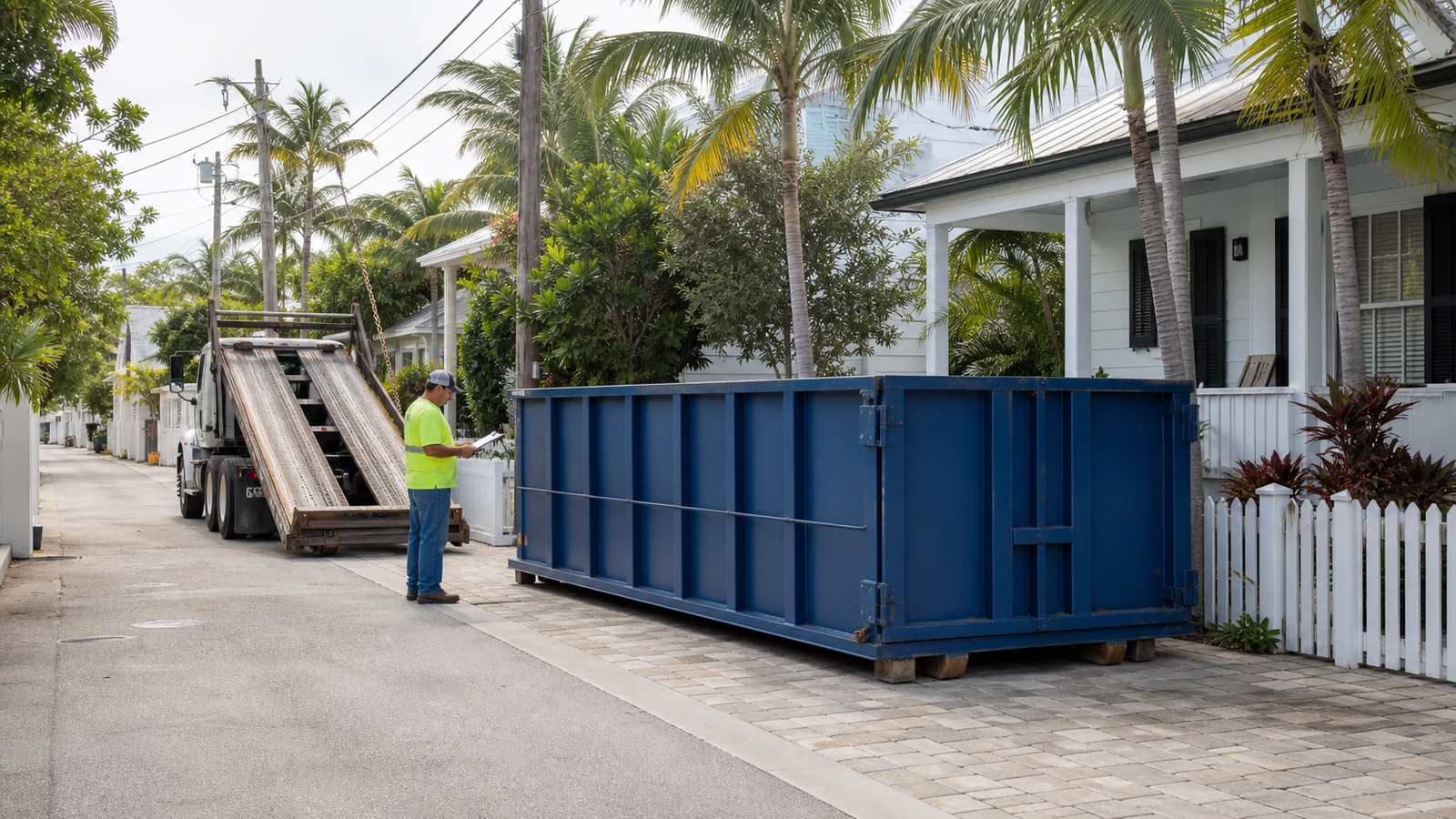
A dumpster that fits the debris can still be wrong for the property. The delivery truck may not clear the turn. A container that sits partly in a metered space can need City approval and daily meter charges. A 30-yard box can be the wrong choice for dense concrete even when it has plenty of empty space. In Key West, placement, material, weight, timing, and disposal route belong in the first call—not after the truck arrives.
The current search results do not put those pieces together. Atlantic Trash publishes Key West-specific sizes, 30-day prices, weight limits, exclusions, and a roughly two-hour dispatch distance from Key Largo. Discount Rock & Sand publishes a broader 5- to 40-yard Florida Keys fleet from Marathon but no complete Key West price table. Monroe County separately lists Keys Quality Dumpster Rentals and Mile Zero Dumpster as specialty haulers. The City supplies the right-of-way permit, current transfer-station fees, separation rules, and rejected-material guidance that a sales page usually leaves out.
Price the actual load and placement
Send one debris, access, permit, and timing brief
Include the address, private-property or right-of-way placement, debris types, heavy materials, estimated volume, access width, overhead clearance, delivery date, rental term, exchanges, and permit status.
Local businesses compared
Four profiles appear here because each has a verifiable operator or Monroe County record relevant to this job. RealReviews did not accept payment for inclusion. Any rating remains labeled to its original source; the fit notes are our reading of the cited public record, not a user-review score.
- Model
- Key Largo-based roll-off operator publishing a dedicated Key West service page for 10-, 20-, and 30-yard containers.
- Best starting fit
- Buyers who want public size, dimension, 30-day price, included-weight, overage, material, and dispatch anchors before requesting a final quote.
- Why it is on this list
- The official page states Key West coverage from mile markers 0 to 4, roughly 120 minutes from its Key Largo headquarters, 30-day packages at $525/$770/$1,100, stated 5/10/12-ton limits, and $120 per ton overage.
- Confirm before booking
- Material restrictions differ by container. Same-day service is not guaranteed, and permit, access, relocation, prohibited-load, damage, dry-run, exchange, and final local terms still need confirmation.
- Model
- Marathon-based Florida Keys construction, hauling, demolition, aggregate, portable-toilet, and roll-off operator publishing containers from 5 to 40 yards.
- Best starting fit
- Projects that may need a smaller box, heavy-material planning, hauling, site work, demolition, aggregate delivery, or several coordinated services.
- Why it is on this list
- The official page identifies 10500 Aviation Boulevard in Marathon, 305-743-5680, C&D recycling and roll-off sizes including 5, 13, and 30 yards with capacity stated through 40 yards.
- Confirm before booking
- The page does not publish a complete Key West all-in price, weight, duration, exclusion, exchange, or right-of-way table. Require a job-address quote and exact container specification.
- Model
- Authority-listed specialty hauler with Monroe County publishing 305-432-1047 and C&D and metal categories.
- Best starting fit
- Worth one comparison call for a C&D or metal load. Ask what equipment is actually available in Key West and where that material would go.
- Why it is on this list
- The verifiable lead is narrow: Monroe County's current specialty-hauler list gives the business name, phone number, and those two material categories.
- Confirm before booking
- We did not find an official site, street address, price sheet, container list, contract terms, or independent review record. Treat the County entry as a contact lead, not an endorsement or proof that the company is available.
- Model
- Authority-listed Key West-named hauler with County categories spanning commercial recyclables, white goods, C&D, e-waste, and metal.
- Best starting fit
- Material-separated local projects that need to discuss more than ordinary mixed construction debris.
- Why it is on this list
- Monroe County lists Mile Zero Dumpster at 305-797-5687 with five accepted specialty-hauler categories.
- Confirm before booking
- The County page does not prove the company accepts every listed material in one container, rents roll-offs, has a particular size available, or charges a particular price. Verify each service and destination.
Determine the Key West permit before scheduling the truck
A container entering a City street, parking space, sidewalk area, or other public right-of-way belongs in the permit conversation. Key West's current right-of-way page links a dedicated Dumpster and Bagster application. The form says applications should arrive at least three business days before placement; where unmetered parking and barricades are needed, approval may take at least five business days. The provider—not merely the homeowner—is identified as responsible for the permit and related fees.
The City's form is unusually useful because it shows what staff want to see: the work address and owner; the dumpster company and phone; container size and dates; nearby cross streets; the house, driveway and yellow curb; and a legible placement drawing. Two location rules are printed on it—a box cannot occupy the sidewalk or sit within 30 feet of a corner. The form currently shows $10 to apply, $10 for the first 15-day permit, $20 per obstructed meter per day, and a possible 15-day extension at $10 per day. Check those amounts when filing rather than treating this page as the cashier's quote.
A driveway placement still deserves a photograph with the proposed rectangle marked on it. One Old Town test is simple: can the truck enter, lower and retrieve a loaded box without borrowing sidewalk or meter space, swinging over a yellow curb, fouling a fire lane, or contacting wires, balconies, trees or pavers? The owner also has to clear lease or association rules, allowed work hours, historic-property conditions and any building-permit limits. If any part of the maneuver reaches public space, send the marked photo to City staff. The filed permit should name who handles the fee, meters and barricades, be submitted on the City's timetable, and remain displayed on the container.
Choose container size only after measuring the debris and the truck path
Start with material, not a room-count slogan. Flattened cabinets, drywall and framing consume volume; concrete, block, tile, roofing, soil and wet debris reach weight limits while the box still looks empty. Atlantic's published Key West line uses 10-, 20-, and 30-yard containers measuring about 8 feet wide by 10 or 21 feet long and 4, 5, or 6 feet high. Discount Rock & Sand advertises smaller 5- and 13-yard options and capacity through 40 yards. Inventory and exact dimensions should appear on the quote.
Then measure the delivery: gate opening, alley width, turn, parked cars, roof eaves, balconies, tree limbs, wires, signs, meters, hydrants, pavers, slopes, soft ground, septic or utility areas, and the space the truck needs to roll the container off and retrieve it. Ask the provider for the truck's straight-line and overhead requirements, not only the box footprint. A narrow Key West lot may favor a smaller roll-off, dump trailer, staged load-out, or grapple service even when the debris would fit a larger container.
Protect the surface deliberately. Specify boards or other approved protection, who places them, whether the driver may refuse the location, and who pays for cracked pavers, ruts, curbs, landscaping or building contact. Photograph the route and placement area before delivery. The provider should confirm that a full container can leave by the same path; a light empty box arriving successfully does not prove a heavy pickup will work.
Compare the price as a disposal package, not a container rental
Atlantic currently publishes Key West flat-rate anchors of $525 for 10 yards, $770 for 20 yards, and $1,100 for 30 yards for a 30-day rental. Its page states weight limits of 5, 10, and 12 tons and an overage rate of $120 per ton. Those unusually specific numbers make a useful benchmark. They do not prove another operator is expensive, because container size, included tons, material stream, dispatch distance, permit work, exchanges, disposal destination, local conditions and taxes may differ.
A comparable quote names delivery, included rental days, included weight, final pickup, disposal, fuel or environmental charges, tax, permit handling, surface protection and the exact debris class. Separate extension days, extra hauls or exchanges, overweight tonnage, contaminated load, prohibited items, wait time, blocked access, dry run, relocation, failed pickup, return trip, overfilled box, tarping, damage and cancellation. Ask when the scale ticket arrives and whether payment is adjusted automatically or after review.
The City transfer station's March 16, 2026 schedule provides disposal context, not a retail roll-off price. It lists $182.34 per ton for C&D, garbage and household items; $165 per ton for separately disposed yard waste; $80 per ton for clean single-stream recyclables with a $5 minimum; and $50 per ton for bulk metals and most white goods with a $5 minimum. Hauler routing, labor, truck time and commercial agreements mean a rental quote will not equal a City tipping fee.
- Base delivery and final pickup.
- Included days and included tons.
- Material class and disposal destination.
- Permit, meter, barricade, fuel, tax and environmental charges.
- Overweight, extension, exchange, wait, dry-run, relocation and contamination rates.
Identify the debris stream before it reaches the container
Do not use the word debris as a material description. List drywall, clean wood, roofing, concrete, block, tile, soil, yard waste, appliances, furniture, carpet, metal, cardboard, electronics, tires, batteries, paint, oil, chemicals, propane, refrigerants and suspected hazardous or regulated material separately. Florida DEP explains that C&D is generally non-water-soluble, nonhazardous material from construction or demolition; mixing it with other solid waste can change its classification.
The City transfer station says it does not accept mixed loads and may direct customers to unload and weigh different materials separately. It accepts C&D, garbage, metals, recycling and yard waste, but it does not accept end-of-life electronics or household chemicals at that facility. The City points residents to a monthly drop-off for chemicals and electronics and Monroe County resources. A rental provider may have narrower rules than the facility, so the signed material schedule controls the container.
Atlantic's Key West page excludes a long list from its ordinary roll-offs, including tires, batteries, electronics, appliances, mattresses, household trash, carpet, upholstered furniture, chemicals, liquids, propane and oily engine parts. Its container rules add dense-material limits: no concrete, rock, dirt, sand, seaweed or roofing in the 30-yard container; solid concrete only three-quarters full in a 20-yard container; no asphalt, dredging or sludge. These are provider-specific terms, but they show why size alone is not enough.
For paint, solvents, pesticides, cleaners, fuel, batteries or other potentially ignitable, reactive, corrosive or toxic household products, use the local hazardous-material route rather than hiding them in a roll-off. EPA's household hazardous waste guidance recommends local program instructions and warns against dumping such material on the ground, into drains or storm sewers. Ask who pays when a prohibited item is discovered and whether the whole load can be rejected or returned.
Match the provider to the material, location, and amount of public detail
Atlantic supplies the most transparent published Key West package: exact local coverage, three sizes, dimensions, 30 days, price anchors, weight limits, overage and material exclusions. The tradeoff is dispatch from Key Largo, which the company describes as roughly 120 minutes. That makes delivery window, exchange timing and a blocked-access return particularly important. Its page says most orders arrive next business day and same-day is sometimes available; neither should be treated as guaranteed until scheduled.
Discount Rock & Sand operates from Marathon and combines roll-offs with demolition, hauling, aggregates, site preparation, lot clearing and portable toilets. It is a logical comparison for a contractor coordinating several services or needing a smaller heavy-material container. The public site states 5-, 13-, 30- and other sizes through 40 yards, but the Key West term, weight, disposal, permit and fee package must come from a written address-specific quote.
Monroe County's current specialty-hauler list adds local candidates that ordinary web results overlook. It names Keys Quality Dumpster Rentals for C&D and metal, and Mile Zero Dumpster for commercial recyclables, white goods, C&D, e-waste and metal. The County expressly says the list may be incomplete and inclusion is not endorsement. Because official websites, inventories and public terms were not resolved for those two, verify the legal business, phone, insurance, service area, container or truck, accepted material, destination and complete price before paying.
A fourth call can go to another County-listed hauler when the debris is specialized. The list distinguishes C&D, recyclables, white goods, e-waste, metal and sludge. Do not infer that every listed company rents a roll-off or accepts household garbage. Ask for the specific service, vehicle, container, regulatory responsibility and disposal receipt that fit the project.
Run delivery day like a truck appointment, not a package drop
The expensive failure is often mundane: the roll-off reaches the block but cannot make the turn. Recheck the route that morning, including parked cars, school traffic, hotel loading, contractors and low branches. Someone at the address needs the approved placement drawing and enough authority to reject an unsafe substitute location. If meters or barricades are involved, that person should also know exactly when the reserved space begins.
Set the exchange rule before loading starts. Tile, roofing, concrete and rain-soaked debris can exhaust the weight allowance while plenty of wall remains visible; bulky demolition waste can fill the volume first. Write down the notice required for a swap, whether another rental period starts, which transport and disposal charges repeat, and what the crew does if the empty box is late. Nothing should project above the rail or block the pickup approach.
For pickup, uncover the truck path and take one photograph of the load before it moves. The tarp must close, the permit must still be valid, and locks or gates must be open. After the box leaves, photograph the same curb, paving and landscaping shown before delivery. Ask for the pickup confirmation and the scale or disposal record; if an overage appears, the invoice should show how it was calculated.
Read the final ticket before the crew leaves the job behind
Put the original quote beside the invoice. The agreed container, dates and included tons should be recognizable; so should the scale weight, overage rate, swaps, permit or meter expense, contamination or special handling, tax and any change the customer approved. When weight changes the total, request the supporting ticket rather than accepting an unexplained card charge.
Keep the before-pickup and after-pickup photographs with that paperwork. They show whether the curb, paving, landscape, gate and nearby public space were left as found. Record the pickup time and the disposition of meters or barricades while the site is still open. This is when a leaking load, broken paver or forgotten traffic device can still be dealt with promptly.
Some files require more than proof that a dumpster disappeared. Insurance work, demolition records, grants, recycling claims and owner reports may call for the receiving facility and material class. A useful disposal record connects the hauler, job address, date, box or vehicle, material, destination, weight and charge. Keep separate proof for metal, white goods, electronics, yard waste or clean recyclables when diversion of that particular stream matters.
Use one quote sheet so the low bid means the same thing
Page one begins with the address, decision-maker and requested dates. Mark whether the box stays on private land or touches the right-of-way, attach the placement photo, and note the permit status. Give the narrowest gate and turn, overhead clearance, surface, meter or sidewalk conflict and the work being done. Name each debris stream—especially concrete, tile, roofing, soil or other dense material—plus estimated volume, loading method, likely swaps and any demolition or building permit.
The hauler fills in the other half: legal company, insurance, exact equipment dimensions, included days and tons, allowed and excluded material, delivery and pickup windows, disposal route, scale documentation and base total. Add separate blanks for extra days, swaps, excess weight, contamination, waiting, blocked access, a dry run, moving the box, cancellation, damage, tax, fuel, permit handling and surface protection. If a line is blank, call and resolve it; do not read the blank as a free service.
A public request form is enough to establish fit and commercial terms. Exchange gate codes, payment information, building credentials, and sensitive documents directly with the selected company through an appropriate secure channel. Compare the returned briefs side by side; a workable placement and a complete charge sheet are worth more than the smallest headline number.
- Project address and private/public placement.
- Debris list, dense materials, volume and prohibited-item check.
- Container dimensions, truck path and surface protection.
- Delivery, term, exchanges and final pickup.
- Included tons plus every possible additional charge.
- Permit owner, disposal route, scale ticket and closeout proof.
Sources and verification
City, County, Florida DEP, EPA, and operator sources were checked on August 5, 2026. Prices, schedules, inventory, permits, fees, and accepted materials can change; obtain a project-address proposal and current approval before delivery.
Frequently asked questions
How much does a dumpster rental cost in Key West?
Atlantic currently publishes 30-day Key West packages at $525 for a 10-yard container, $770 for 20 yards, and $1,100 for 30 yards, with stated 5-, 10-, and 12-ton limits and $120-per-ton overage. Those are one operator's dated anchors. Compare delivery, included days and tons, pickup, disposal, tax, fuel, permit work, exchanges, extensions, blocked access, contamination, and prohibited-load charges.
Do I need a permit for a dumpster in Key West?
Use the City's Dumpster and Bagster application when placement affects the public right-of-way. The current form calls for at least three business days before placement and says unmetered parking may require at least five business days for approval and barricades. It prohibits sidewalk placement and placement within 30 feet of a corner. Confirm the exact site with the City and assign the application, fees, barricades, meter charges and renewal in writing.
What dumpster size should I rent?
Choose by both material and access. Light renovation debris may need volume; concrete, tile, soil, roofing and wet debris may hit weight limits in a partly empty box. Measure the container, truck approach, turn, gate, overhead wires and branches, pavers, slope and pickup path. Atlantic publishes 10-, 20-, and 30-yard Key West boxes; Discount Rock & Sand advertises smaller 5- and 13-yard options and sizes through 40 yards. Confirm exact inventory.
Can concrete or roofing go in a 30-yard dumpster?
No—not in Atlantic's published 30-yard container. Its rules prohibit concrete, rock, dirt, sand, seaweed and roofing material in that box; solid concrete in its 20-yard container may be filled only three-quarters full. Another hauler may use different equipment or terms. Disclose every dense material and estimated amount, then obtain the accepted container, fill limit, weight allowance, destination and overage rule in writing.
Can I put paint, batteries, electronics, tires, or propane in the dumpster?
Usually no. Atlantic excludes those items from its ordinary roll-offs, and the City transfer station does not accept end-of-life electronics or household chemicals at that facility. The City identifies separate collection resources. EPA also recommends local household-hazardous-waste programs for products that can ignite, react, corrode or poison. List the items before delivery and use the approved local route.
Who rents roll-off dumpsters in Key West?
Atlantic Trash publishes direct Key West service with 10-, 20-, and 30-yard roll-offs. Discount Rock & Sand publishes Florida Keys roll-off service and a broader 5- to 40-yard range from Marathon. Monroe County's specialty-hauler list also names Keys Quality Dumpster Rentals and Mile Zero Dumpster with material categories and phone numbers. County inclusion is not endorsement; verify the legal business, insurance, equipment, availability, accepted load, disposal route and complete price.
How fast can a dumpster be delivered to Key West?
On an already-cleared private site, Atlantic advertises next-business-day service for most Key West orders and occasional same-day delivery. Its own page estimates about two hours of driving from Key Largo, before traffic or site delay. A street or parking-space placement cannot use that sales timeline: Key West asks for the permit application at least three business days ahead, or at least five when unmetered parking and barricades are needed.