
Key West home-watch plan
Key West Property Maintenance and Home Watch for Absentee Owners
Build a Key West home-watch and property-maintenance plan with inspection evidence, humidity and leak controls, vendor access, storm preparation, reentry, and spending rules.
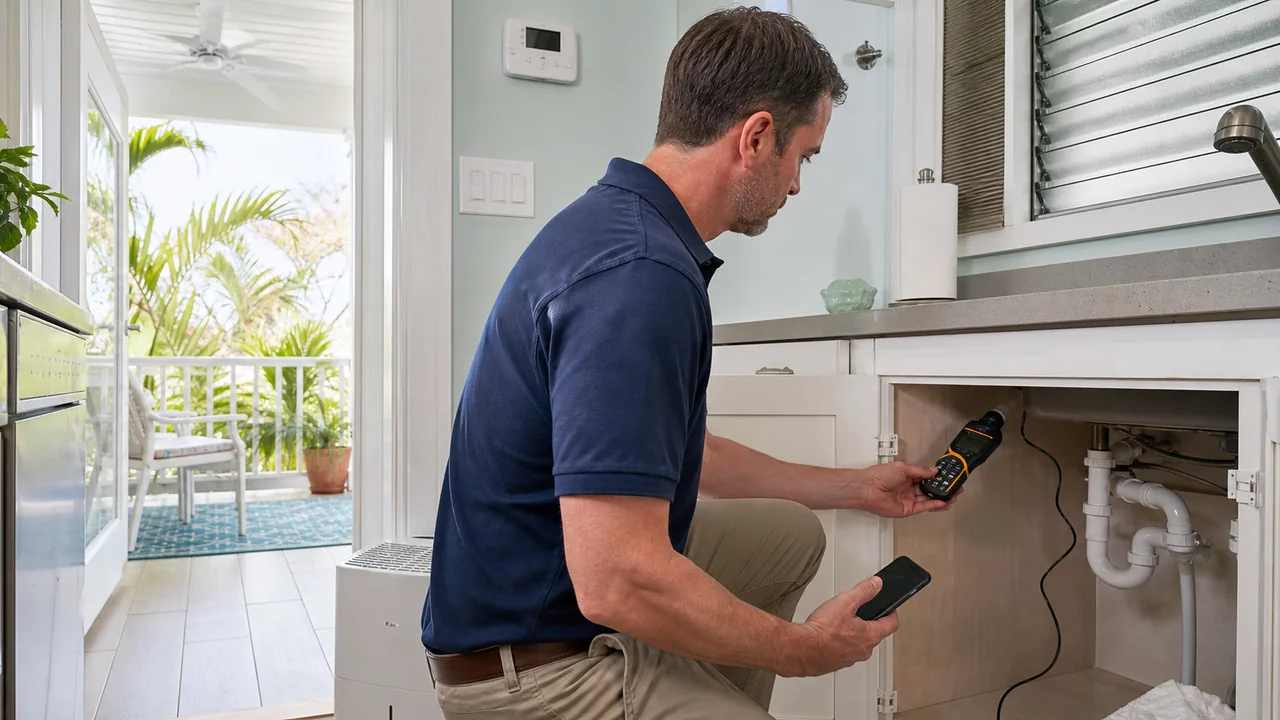
The dangerous Key West maintenance problem is often the one nobody sees for ten days. A condensate line backs up behind a closed door. The refrigerator circuit trips. Wind lifts something at an opening, or an air conditioner runs without bringing the house back toward its setpoint. Nothing about the front of the property announces the change.
If the Friday report says only “house checked—fine,” the owner still knows almost nothing. Ask what route was walked, what changed from Tuesday, and where the photographs and readings live. Home watch is observation and escalation. It does not insure the house or turn the visitor into an HVAC contractor, roofer, engineer, or mold professional.
For absentee and seasonal owners
Request a written Key West property-care plan
Give each provider the same address facts, vacancy pattern, systems, visit cadence, key rules, and emergency limit. The replies will be far easier to compare.
Local businesses compared
These are identity-checked local profiles, not paid placements. The fit notes describe differences supported by current official information; ratings shown remain attributed to their outside source.
- Model
- Its published Key West-area offer combines recurring exterior upkeep with turnover cleaning, landscaping, window and gutter work, pavers, and before-and-after photographs.
- Best starting fit
- Start here when an existing manager or co-host needs one recurring physical-care package around the property.
- Why it is on this list
- The company currently describes vacation-property maintenance packages, manager coordination, cleaning and exterior services, plus photographic reporting on its own pages.
- Confirm before booking
- RealReviews files this company primarily under House Cleaning. Put the address-level duties in writing, and send electrical, plumbing, HVAC, roofing, structural, or permit work to a separately verified trade.
- Model
- Square advertises residential, commercial, realtor, preventive-maintenance, and storm support in Key West and the Florida Keys. Its own disclaimer limits what it performs directly.
- Best starting fit
- A written list of smaller, non-permit maintenance jobs—not rental management and not regulated construction.
- Why it is on this list
- Its homepage describes repairs, improvements, maintenance, and project support. On that same site, Square says jobs needing a specialized contractor license or permit are referred to or coordinated with affiliated contractors.
- Confirm before booking
- The company also says it is a Florida corporation with general liability insurance. Treat that as a first-party statement, not a current insurance certificate or contractor credential; verify the payee, direct-work boundary, certificate, and any referred firm.
- Model
- This Key West firm publishes a home-watch and management offer built around customized inspection checklists, an emergency contact, and oversight of repairs or vendors.
- Best starting fit
- An absent owner who needs local eyes, a report, and coordination rather than a claim that one company performs every trade.
- Why it is on this list
- Its current home-watch and management pages describe inspections, emergency contact, repair oversight, tenant work, accounting, and association services.
- Confirm before booking
- The RealReviews primary category is Real Estate Services. Ask for the checklist itself, then mark every line as observation, coordination, subcontracted work, or work the company will perform directly.
Define home watch before discussing frequency
Put two columns in the agreement: WATCH and WORK. Under WATCH, list the places the visitor will look, the readings to take, the photographs to repeat, and the events that cause a call. This is scheduled visual observation of a vacant or intermittently occupied home. It does not become a building inspection, security guarantee, mold assessment, engineering opinion, or assurance that a concealed defect will be found.
Use WORK for assigned physical tasks such as changing a filter, lubricating named hardware, restocking a specified supply, admitting a vendor, or clearing an obstruction the provider may lawfully handle. If one visit includes both columns, the report should distinguish what was merely observed from what was touched, which material was installed, and which item was stopped and referred.
A Key West house with an aging condensate system, prior ceiling stain, pool, energized appliances, and a six-week vacancy should not inherit the same route as a recently renovated condominium occupied every other weekend. Roof and opening condition, flood context, plumbing and HVAC age, past losses, sensors, docks or pools, landscaping, association duties, and vacancy length belong in the property record before anyone proposes frequency.
- Circle every room and exterior camera position the visitor must reach.
- Beside each assigned task, name the permitted work and the completion evidence.
- Attach the system ages, old failures, association duties, and known access problem.
- Write “stop and call” beside anything that belongs to a licensed trade or specialist.
- Put a person's name and next date on every item that leaves the visit unfinished.
Build an exterior route that can be repeated
Draw the exterior route on one page and number the camera positions. Position 1 might be the street-facing opening; position 2, the side gate and drain; position 3, the rear elevation. On arrival, the visitor notes entry evidence, standing water, limbs, displaced furniture, fence damage, broken glazing, unusual odor, door condition, and any roofline or flashing change visible from the ground. A wet roof or unsafe area is recorded as inaccessible, not entered.
The value is in the repeat. A gate leaning farther than it did last week or a stain growing beyond the prior photograph is visible when the angle and filename stay consistent. Give the checklist four explicit results—normal, exception, not accessible, and not applicable. An empty box cannot be allowed to mean normal.
A dock, boat lift, pool, generator, irrigation system, or landscape contract is a separate technical file. A home-watch visitor may photograph apparent condition and confirm whether a scheduled vendor appeared. That record must not masquerade as a mechanical, electrical, marine, arboricultural, or pool-system inspection.
- 01 — approach, locks, doors, windows, screens, and entry evidence.
- 02 — ground-visible roofline, exterior finish, drains, and debris.
- 03 — standing water, vegetation, fences, and loose outdoor property.
- Separate file — pool, dock, lift, generator, irrigation, and landscape vendors.
- Close the route with all numbered images and an explicit inaccessible-area note.
Take the first interior reading before touching the thermostat
Suppose the visitor enters at 9:12 a.m. and the living-room sensor reads 82°F and 68% relative humidity while the thermostat is set to 76°F. That one line is more useful than “AC on.” Add odor, sound, alarm state, and whether cool air is actually moving. Then walk the known wet points: old ceiling stains, flooring edges, cabinets below fixtures, supply lines, toilets, water-heater area, refrigerator and ice maker, dishwasher, and the visible condensate path. Nothing needs to be dismantled.
A single humidity reading is not a diagnosis, but repeated readings show direction. Note the instrument and location so a future value is comparable. If the air conditioner runs continuously, short-cycles, stops draining, produces new noise, or cannot approach the setpoint, report the behavior and route diagnosis to a licensed mechanical contractor. Do not keep lowering the thermostat as a substitute for repair.
A wet baseboard at 10:20 a.m. is not an item for next week's checklist. Call it in that day, photograph the location, stop the source when that can be done safely and within authority, and record who takes over. EPA guidance says water-damaged material should be dried within 24 to 48 hours when possible; Florida health guidance likewise centers moisture control. Those are reasons to move quickly, not permission for an unlicensed observer to diagnose mold.
- 9:12 a.m., living room, meter H-2: 82°F / 68% RH; thermostat 76°F; system running.
- Northwest ceiling stain unchanged; kitchen sink cabinet dry; water-heater pan dry.
- Refrigerator powered; ice-maker line dry; visible condensate route clear at this visit.
- If any line changes, the note gives the location, photograph, call time, and next visit.
Choose frequency from risk, then write event-triggered visits
Write the weekly visit on the calendar, then write the reasons it can move. A policy or association rule may set the minimum. An old air conditioner, prior leak, long vacancy, or weak sensor coverage may justify more. A storm, alarm, outage, guest departure, contractor entry, known repair, or lost communications creates its own visit instead of waiting for the next Friday.
An owner who selects every two weeks should know what happens during the thirteen days between visits. Leak sensors, temperature and humidity monitors, power-loss alerts, cameras limited to lawful areas, and utility notifications can shorten detection time, but they need battery, connectivity, alert-recipient, privacy, and testing rules. A silent sensor is not coverage.
Consider a ceiling stain reported on Monday. The file is not closed because a roofer's number appears in a text thread. It remains open through appointment, access, finding, mitigation, and the next condition check. Assign a person and date at the first alert. Otherwise the record proves only that somebody noticed a problem.
- Calendar: the normal interval and the policy, association, or property reason behind it.
- Extra visit: storm, alarm, outage, departure, vendor entry, or known repair.
- Sensor sheet: device, location, last test, battery, connection, and alert recipients.
- Open item: owner, next date, approved spend, occupancy effect, and closing evidence.
Audit the keys before the next vendor change
Take an ordinary turnover: the cleaner leaves, but her door code still works; the new cleaner receives the same code; nobody can tell which person entered on Saturday. The fix is an owner-held register that names the physical key, individual door or alarm credential, gate permission, holder, job, issue date, and end or review date. Shared permanent codes do not belong in that file.
Mark occupied nights in the access file. A Friday vacancy round is not permission to walk in on an owner, vacation guest, or annual tenant. Alarm response may follow a different notice path. The manager or owner has to match each entry rule to the lease or rental agreement and applicable law; the vendor contract does not erase those duties.
On the last service day, stand at the door with the handoff list. The old key is back. The cleaner's code fails. The former vendor no longer appears in the alarm, camera, or lock account, and the owner can administer all three. Keep an owner-controlled entry method outside that relationship.
- Saturday, 10:14 — J. Rivera / code 0417 / HVAC access / owner text 09:58.
- July 18–23 — guest stay; routine round blocked.
- Lock failure — call owner, then named locksmith; no replacement above the written limit.
- Termination — key returned, code disabled, vendor account removed, owner login tested.
The contractor gets a ticket, not the whole problem
Ticket 24-071: north-bedroom ceiling stain, larger than the July 7 photograph. Tuesday access is 10 a.m.–noon. The requested result is a source diagnosis; opening the ceiling is excluded until the owner answers. The ticket names the company entering, price basis, site protection, cleanup, and the photographs and invoice due back.
The home-watch provider can manage entry and photograph the close. It cannot quietly add reconstruction. The authority note allows ordinary assigned work below the routine limit and safe temporary source control below the emergency limit if contact fails. A replacement, upgrade, or rebuild comes back as a new estimate.
Payee check: does the company on the invoice hold what this job requires? Monroe County says there is no catch-all handyman license. Key West publishes contractor registration and insurance information. Wiring, plumbing, HVAC, roof, structural, gas, and other regulated construction does not become lawful because the caretaker is familiar.
- 24-071 / north bedroom / change since 07-07 / Tuesday 10–12.
- Diagnose only. No ceiling opening, system replacement, or reconstruction.
- Invoice payee and credential record must name the party actually doing the regulated work.
- Return: entry photo, finding, protection, cleanup, invoice, and anything left open.
May file first; activation order later
The May file is physical: opening W-1 matches panel W-1; hardware bin is on the north shelf; the drill was tested; patio furniture goes to the storeroom. It also settles the boat, water, refrigerator, documents, and backup contact. That is how Monroe County's general advice about shutters, loose property, water, refrigeration, and belongings becomes work at this address.
The later order says GO. It quotes the agreed trigger and acceptance deadline, then points to the price, included openings, labor assumptions, storage, cancellation, and after-hours terms already signed. One question cannot stay vague: when ten clients activate, where does this address enter the queue?
“Storm prep included” is not enough. At close, require the time, photographs, and an unfinished line. Correct panels in storage provide no protection if the crew never reached the house.
- MAY: W-1 through W-9 matched; hardware bin sealed; tools tested.
- ADDRESS: patio, boat, water, refrigerator, documents, outage contact.
- GO ORDER: trigger, deadline, price sheet, cancellation, queue position.
- CLOSE: 18:42, eight openings complete; W-9 exception photographed and reported.
Do not start the post-storm clock before legal reentry
Call log, 8:05 a.m.: Monroe County reentry status not yet open to the provider. Roads, utilities, fuel, communications, medical resources, or emergency response may still be constrained during staged return. No honest company can promise an inspection before lawful, safe access. Once the gate changes, the log should show the client's place in line and the dispatch time.
The first report answers “did you reach it?” before “how is it?” It names unsafe or unavailable areas, visible openings, standing water, power, refrigeration, alarms, interior moisture, debris, and roof or tree conditions observable from safe ground. Photographs accompany the call. A finding that needs a roofer, electrician, plumber, restoration firm, engineer, or another specialist is handed off rather than diagnosed in the home-watch report.
Source control is one decision; professional diagnosis, insurance notice, and permanent repair are three others. An authorized visitor may take a safe temporary step and preserve evidence. That step does not determine coverage or authorize reconstruction.
- 08:05 — reentry closed; no dispatch promise.
- 11:40 — reentry confirmed; client queue position and route assigned.
- 13:15 — address reached; unsafe and uninspected areas named.
- 13:28 — first condition message and photographs sent; temporary spend recorded.
- 14:02 — specialist handoff booked; return inspection placed on the calendar.
A roofer should be able to use the visit file
KW-17 · July 14 · 9:12–9:47 a.m. · vacant · entered with key 2 · light rain. That header lets the next person place the visit. The route below uses four marks—normal, exception, not accessible, not applicable. There is no blank box and no “all good” shortcut.
Exception 03 reads: northwest bedroom ceiling; stain now extends past the pencil edge visible in the July 7 image; meter and three current photographs attached. The visitor does not write “roof leak confirmed.” A roofer or other qualified party gets to diagnose the source. Owner notified 9:31; Tuesday access booked for 10 a.m.
The owner exports that report and its images. Location names do not change between weeks. If the portal closes or the assigned visitor leaves, a contractor, manager, insurer, or buyer can still follow the dates.
- 03 / northwest ceiling / exception / compared with 07-07.
- Images 03A–03C / meter H-2 / exact reading point shown.
- Owner text 09:31 / contractor access Tuesday 10:00.
- Status stays OPEN until the follow-up carries the finding and completion proof.
Put the two quotes on the same sheet
Quote A includes four rounds, the agreed report, key custody, one contractor entry, one supply check, and file export. Quote B must price that same base. Only then add the extra visit, arrival setup, mail, car care, hurricane work, waiting, after-hours response, and project coordination. Otherwise two “monthly” totals may buy different work.
Write one alert across both bids: 7:03 p.m., temperature and humidity rising, owner not answering. In the margin, each company supplies its call order, entry rule, HVAC trigger, spending ceiling, overnight decision, evidence, and morning return. Compare the actual sequence rather than the service adjectives.
Finally, cancel on the fifteenth. What is charged? Who exports the reports, returns the keys, retires codes, transfers device control, resolves prepaid storm work, and owns the unfinished ticket? If those answers depend on the original salesperson, the system is not portable.
- Put each company's Column A total on the first line.
- Move every optional service and after-hours charge to Column B.
- Attach the company's marked-up answer to the 7:03 p.m. alert.
- Staple current insurance evidence and any role-specific credential record behind it.
- At the bottom, price and explain a mid-month exit with open work.
Sources and verification
Rules and public requirements link to the responsible agency. Business-specific service claims are checked against privately retained official material, while public ratings remain attributed to their original source. RealReviews does not turn outside reviews into invented testimonials, blend unrelated platforms into a house score, or sell placement in these comparisons. Recheck licenses, availability, scope, and price before hiring.
Frequently asked questions
How often should a Key West home-watch service inspect my property?
Start a fully vacant Key West home at weekly visits, then check the insurance policy, association rules, equipment condition, and loss history before making the interval longer. RealReviews also adds a visit after a storm, alarm, outage, departure, contractor entry, or known repair. Weekly is an operating starting point—not an insurance requirement.
What should be in every home-watch report?
RealReviews recommends that every report identify the property and inspector, arrival and departure time, access method, occupancy status, agreed temperature and humidity readings, exterior and interior checklist results, repeated photo views, inaccessible areas, exceptions, immediate actions, notifications, responsible party, follow-up date, and closure evidence.
Can a home-watch provider diagnose mold or structural damage?
No. The ordinary visit can say where discoloration appeared, what odor or reading was present, and which area was inaccessible. It cannot turn those observations into a mold or structural diagnosis. Send that file to the Florida-licensed mold professional, qualified contractor, engineer, or other credentialed specialist the condition requires.
Should my property-care provider have emergency spending authority?
Yes, but not a blank check. One workable clause lets the provider spend up to the stated ceiling to stop actively escaping water after the owner misses the stated callback window. The RealReviews emergency record shows the trigger, contact attempt, temporary step, photographs, and amount. Replacement, upgrade, and reconstruction are new jobs.
Can a Key West home-watch company promise immediate post-hurricane access?
No. Monroe County's staged reentry comes first. Replace “immediate” with a measurable commitment after lawful, safe access—plus the property's queue position and an outage contact route.
What is the difference between home watch and property management?
Home watch produces the vacancy-condition record. Property management operates the rental or tenancy, including leasing or reservations, money, guest or tenant communication, maintenance administration, and records. RealReviews puts them on separate scope lines even when the vendor is the same.
How soon should a provider escalate a leak or wet material?
That day—not at the next scheduled round. EPA's target is to dry water-damaged material within 24 to 48 hours when possible. Start only the source control and drying that are safe and authorized, and call qualified emergency help for electricity, contaminated water, concealed spread, or a large loss.