
Independent Key West tree-service guide
Key West Tree Services Compared: Arborists, Removal, Permits, Palms, and Mangroves
Compare genuine Key West arborists and tree companies by operating model, documented identity, trimming and removal scope, mangrove fit, permit handling, safety planning, cleanup, and quote detail.
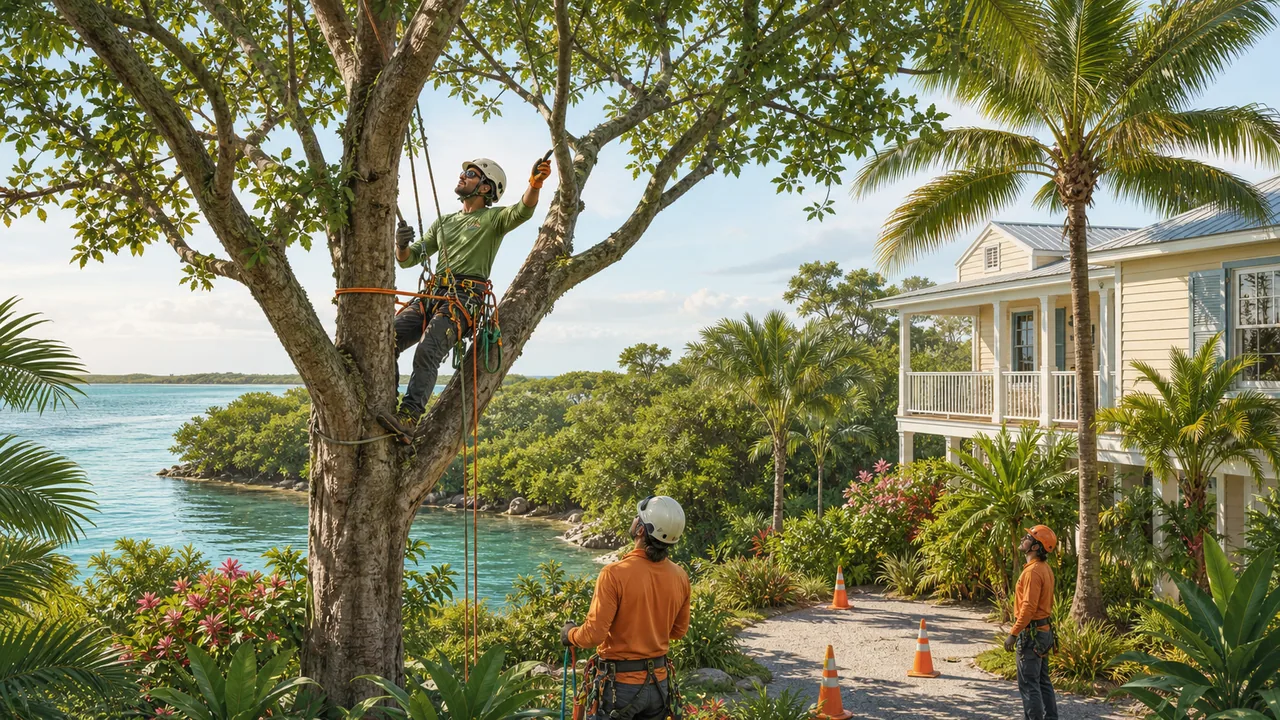
A leaning tree over a house, a coconut palm beside a walkway, a protected canopy tree, and a mangrove fringe are four different jobs. Tree Priorities is the clearest fit when the first purchase should be an arborist’s assessment rather than a removal crew. Limb Walkers publishes the broadest tree-only production model, including removal, trimming, stump work, land clearing, hurricane preparation, and mangrove work. Dot Palm combines tree work with landscaping and restoration. Golden Bough gives owners another established Key West production bid, but its limited first-party web evidence means the interview and written scope need to carry more weight.
Key West does not treat tree work as ordinary yard cleanup. The City’s Urban Forestry process covers removal, trimming, and transplant requests, while Florida has a separate mangrove law with its own exemptions, professional-trimmer rules, and permit triggers. The practical order is assessment, permission, safe work plan, comparable scope, and only then price—not a chainsaw estimate followed by a permit surprise.
Assessment, pruning, removal, palms, stumps, storm work, or mangroves
Send tree companies a brief they can price without guessing
Add the address, tree count and size, requested outcome, visible hazards, nearby structures and wires, access, stump and haul-away needs, permit status, photographs, urgency, and contact information. The request records scope and interest; the selected company must confirm dispatch, credentials, price, and availability.
Local businesses compared
These are identity-checked local profiles, not paid placements. The fit notes describe differences supported by current official information; ratings shown remain attributed to their outside source.
- Model
- Key West forestry-consulting practice owned and operated by Ed Cunningham, publishing ISA-certified arborist and utility-vegetation-management credentials rather than a generic landscape-crew model.
- Best starting fit
- Diagnosis before removal, tree-preservation decisions, owner or neighbor disputes, utility-vegetation questions, written opinions, and a second set of eyes on a high-consequence recommendation.
- Why it is on this list
- The official site publishes 1310 Olivia Street, 305-295-7800, appointment-based hours, 40 years of professional experience, and homeowner, utility, and municipal consulting specialties.
- Confirm before booking
- Consulting evidence does not establish a full production crew, crane, chipper, stump grinder, emergency response, debris hauling, or landscape restoration. Decide whether you need advice, execution, or both and contract each role explicitly.
- Model
- Key West tree company publishing trimming, removal, stump grinding, land clearing, hurricane preparation, mangrove work, and an ISA-certified arborist on staff.
- Best starting fit
- A tree-focused production bid, difficult removal, stump or clearing scope, storm preparation, and mangrove projects where the named credential and authorization can be confirmed.
- Why it is on this list
- The current official site publishes Key West service, 305-587-4834, an ISA-arborist-on-staff claim, more than 11 years of experience, and separate service pages for tree, stump, land-clearing, and mangrove work.
- Confirm before booking
- The profile’s older Google-derived phone differs from the current official number. Confirm the active contact, legal entity, named arborist and credential number, professional-mangrove-trimmer basis, insurance, assigned crew, equipment, and permit role.
- Model
- Florida Keys operator publishing tree trimming and removal, coconut and palm work, stump grinding, lot clearing, mangrove trimming, landscape maintenance, installation, and hurricane preparation.
- Best starting fit
- Tree work that also needs landscape repair, recurring grounds maintenance, coconut or palm attention, lot clearing, or one company to coordinate removal and the finished outdoor space.
- Why it is on this list
- Dot Palm maintains a dedicated Key West page describing confined-lot removal, bucket trucks and climbing equipment, cleanup and haul-away, palm work, storm preparation, and a licensed-and-insured claim.
- Confirm before booking
- Verify the assigned arborist, mangrove qualification, current insurance certificate, permit applicant, equipment, subcontractors, and whether every requested service is self-performed. Broad capability is not a project-specific plan.
- Model
- Established Key West tree-service identity associated with pruning, removal, stump work, and hauling-capable commercial vehicles.
- Best starting fit
- A fourth local production estimate when the owner wants to compare crew plan, access, rigging, debris removal, stump work, and price against the better-documented operators.
- Why it is on this list
- FMCSA’s current company snapshot resolves Golden Bough Tree Service Inc. to 1602 Laird Street, 305-296-8101, active USDOT status, two power units, and one driver. Local directory surfaces associate the same name and address with tree work.
- Confirm before booking
- FMCSA proves carrier identity, not arborist qualification or tree-work quality. The weak current first-party service surface makes direct verification of services, credentials, insurance, equipment, crew, permit handling, and warranty essential.
Buy the right first service: assessment, production, or landscape coordination
When the diagnosis is uncertain, the tree is valuable, removal is contested, a neighbor is affected, or several contractors recommend different solutions, start with an arborist assessment. Ask for species, condition, defects, root-zone limits, targets at risk, likely failure mode, treatment or pruning options, urgency, and the reason removal is or is not supported. Tree Priorities publishes the clearest consulting model in this set. A consultant can also write a scope that production crews bid on, which removes the financial incentive to make the diagnosis fit the most expensive work.
When the outcome is already established—a failed palm, a permitted removal, routine pruning, a stump, or storm debris—the production plan matters more. Limb Walkers and Dot Palm publish the most complete equipment-and-execution models. Golden Bough is a legitimate local comparison but supplies less current first-party detail. Ask every crew who will climb or operate the lift, who supervises rigging, where the drop and exclusion zones go, how fences, pools, roofs, vehicles, utilities, and neighboring property are protected, and which debris leaves the site.
Use a landscape operator when the finished ground matters as much as the cut. Removal can leave a stump, surface roots, compacted soil, damaged irrigation, bare planting beds, blocked drainage, or an empty canopy obligation. Dot Palm’s combined model can be efficient when those items belong in one contract, but separate them by price and acceptance standard. Tree work, stump work, soil restoration, irrigation repair, replacement planting, and recurring maintenance should never disappear inside one vague landscaping line.
- Assessment deliverable: species, condition, targets, defects, options, urgency, photographs, and recommended scope.
- Production deliverable: crew, equipment, rigging, exclusion zone, utility and traffic plan, protection, cuts, debris, and cleanup.
- Restoration deliverable: stump depth, grindings, fill, grading, irrigation, replacement planting, staking, watering, and survival terms.
- Emergency deliverable: scene control and stabilization first; permanent work only after the hazard and authorization path are clear.
Treat the City tree process as part of the job, not paperwork after the quote
Key West’s Urban Forestry Division says a tree permit application is required for work regarding trees and landscaping. To request a City evaluation for removal, trimming, or transplanting, the property owner submits the application. The current form distinguishes removal, transplanting, heavy-maintenance trimming, branch removal, crown cleaning or thinning, crown reduction, and other work. Those are materially different scopes. A quote that says “trim trees” does not tell Urban Forestry, the crew, or the owner what will actually happen.
The City process can include a representation form when the owner cannot attend a Tree Commission meeting, pick up a permit, or post it, plus a job-completion form to close the permit. Dicot-tree removals requiring Tree Commission review have published submission deadlines. Before accepting a work date, identify the applicant, owner signature, site plan or tree locations, species and sizes, work classification, arborist report or photographs, meeting path, permit pickup and posting, fees, replacement conditions, inspection, and completion filing.
Put denial and modification risk in the agreement. If the City approves pruning rather than removal, requires replacement trees, changes the permitted cut, or sets conditions, the contract should say who reprices and whether the deposit remains refundable. Do not let a contractor make an irreversible cut while an owner assumes a permit is pending. Ask for the issued permit and approved scope, display it when required, keep it with the job record, and obtain closure evidence before final payment.
Mangroves require a separate legal decision before anyone cuts
Florida’s Mangrove Trimming and Preservation Act covers red, black, and white mangroves, including seedlings attached to trees or growing along the shoreline. DEP says a homeowner may use a narrow exemption on a riparian mangrove fringe when the mangroves are no more than 10 feet high, are not trimmed below six feet, and are not defoliated. That is not permission to clear a view, create a kayak opening, remove rooted propagules, or apply ordinary tree-removal assumptions to shoreline vegetation.
DEP says mangroves over 10 feet generally require a professional mangrove trimmer for exempt trimming; trimming below six feet requires an individual permit, and removal may require an individual permit and mitigation. Other triggers depend on height, shoreline length, prior legal configuration, fringe depth, conservation or mitigation status, and the exact alteration. Before pricing, record species, shoreline, current height, desired finished height and width, past permits or lawful trimming, property survey, photographs, conservation restrictions, and the DEP district or delegated authority consulted.
Limb Walkers and Dot Palm both publish mangrove-service claims. That makes them candidates, not automatic authorization. Ask for the name and qualification basis of the person supervising the exact work. DEP explains that ISA-certified arborists and several other certified professionals automatically qualify as professional mangrove trimmers, while another pathway requires documented permitted experience and agency review. Put the legal basis, permit or exemption, approved configuration, supervision, debris controls, and closeout evidence in writing.
Make the safety plan match the actual Key West site
OSHA identifies falls from trees and lifts, falling trees and limbs, hand tools, moving traffic, lacerations, and energized lines among tree-care hazards. A tight Key West lot adds roofs, pools, parked vehicles, alleys, tourists, tenants, neighboring structures, overhead conductors, salt-damaged hardware, limited equipment access, and little room to lower material. “Licensed and insured” does not explain how a particular limb reaches the ground without injuring someone or damaging property.
Ask for the crew size, supervisor, climber or lift plan, rigging method, crane or loader plan when used, chipper and truck locations, exclusion zone, pedestrian and traffic control, underground and overhead utility review, weather limits, communication method, rescue preparation, and property-protection plan. Photograph roofs, fences, paving, pools, screens, irrigation, vehicles, and neighboring areas before mobilization. If equipment must cross another parcel, sidewalk, lane, or protected root zone, settle access and protection before the arrival day.
A tree or limb touching an energized line is not ordinary emergency removal. Keep people and pets away, assume the tree and ground can be energized, and contact 911 when immediate danger exists plus the responsible utility. Do not touch the tree, fence, equipment, or someone in contact with it. The selected contractor must identify whether the work requires utility de-energization or a properly qualified line-clearance operation. A fast arrival is not a substitute for authority and safe distance.
Use cost data to expose missing scope, not to dictate a Key West price
Angi’s current Key West tree-service page reports a national average around $460 for professional trimming and a broad range of roughly $75 to $1,800 depending on tree size, type, and timing. It gives examples from smaller ornamental trees to large pines. Those figures are useful only as a planning check. Key West access, protected-tree process, coconut or palm hazards, rigging over structures, bucket or crane needs, utility coordination, hauling distance, storm demand, stump work, and replacement requirements can move the total substantially.
Require each proposal to count and identify the trees, label the exact cuts or removals, state whether recommendations come from a named arborist, and separate mobilization, crew, lift, crane, rigging, traffic control, utility coordination, permit assistance, trimming, removal, stump grinding, root work, debris chipping, trunk or wood handling, hauling, raking, surface protection, fill, grading, irrigation, replacement trees, and taxes. A $1,200 quote that leaves the trunk and grindings is not comparable to a $1,700 quote that restores the site.
For pruning, specify the objective: deadwood, clearance, crown cleaning or thinning, reduction, structural correction, palm fronds, seed pods, or coconuts. State the branches or diameter threshold, finished clearances, prohibited cuts, and debris. For removal, specify whether the stump is cut flush or ground, grinding depth and diameter, root-chasing limits, grindings removal, backfill, utility marking, and restoration. For storm work, separate temporary hazard reduction from final permitted work and state the after-hours or surge price before mobilization.
Verify credentials and insurance against the work—not the logo
An ISA credential belongs to a named person, not automatically to every employee or every company with an arborist phrase on its site. Ask for the arborist’s name and credential number, then confirm who inspects the tree, writes the recommendation, marks the cuts, supervises the crew, and remains reachable if the field condition changes. Tree Priorities attributes its credential to Ed Cunningham. Limb Walkers says an ISA-certified arborist is on staff but should identify that person for the requested job.
Insurance should name the contracting entity and fit tree operations. Request certificates sent by the broker, not an undated screenshot. Confirm general liability, workers’ compensation or the lawful basis for any exemption, automobile coverage, and any limits or exclusions relevant to tree height, cranes, subcontractors, waterfront work, or line clearance. Confirm whether subcontractors are used and require their credentials and coverage before work begins. The property owner should not discover after damage that the insured landscaper and the tree crew were different entities.
Corporate, carrier, license, Chamber, directory, and review records answer different questions. FMCSA helps resolve Golden Bough’s legal carrier identity and vehicle status; it does not certify arboriculture. A City permit authorizes a scope; it does not recommend the contractor. An ISA credential supports knowledge; it does not guarantee price or outcome. Reviews describe experiences; they do not replace a safe plan. Use each source for what it proves and refuse the leap from one credential to every other risk.
Read reviews by tree, access, crew task, and cleanup
The external ratings shown on RealReviews stay attributed to the named platform and are not RealReviews scores. A five-star average can mix a small palm trim, a major removal, a consultation, weekly lawn care, and post-storm cleanup. Filter for the same tree type, lot constraints, work method, and recent period. Useful accounts describe arrival and notice, diagnosis, protection, permit handling, pruning quality, rigging, damage avoidance, cleanup, invoice changes, and response when a problem appeared.
Operator testimonials can reveal the jobs a company wants to emphasize but remain selected by the operator. Limb Walkers publishes testimonials mentioning palm removal, hurricane cuts, hard-working crews, and cleanup. Dot Palm publishes detailed service descriptions. Tree Priorities publishes credentials and consulting specialties. Use those pages to form interview questions and request two recent comparable references; do not restate operator-selected praise as independent consensus.
Ask references what the tree and access were, who inspected it, whether the same crew arrived, whether the permit matched the cut, how property and neighbors were protected, what changed, whether all debris and grindings left, and how the site looked after rain or irrigation resumed. For a consultant, ask whether the report clearly supported a decision and whether production bidders could use it. For mangroves, ask whether the qualification and authorization were documented before work.
Send one complete lead brief and close the job with evidence
For the first request, send the exact address, owner or manager role, number of trees or palms, species if known, approximate height and trunk size, requested outcome, visible lean, cracks, cavities, deadwood, root damage, hanging limbs, storm damage, contact with structures, nearby wires, access width, gates, stairs, pools, vehicles, neighboring property, waterfront or mangrove status, stump and hauling preference, permit status, timing, and photographs from several angles. Say whether you want diagnosis, pricing, or emergency stabilization.
Ask every finalist to return the same fields: legal entity, named arborist or supervisor, credential claims, insurance, crew and equipment, approved work, permit responsibility, mangrove basis, utility coordination, traffic and exclusion zones, property protection, price, deposit, changes, cancellation, weather delay, cleanup, damage process, warranty, and exclusions. If the bid depends on a site visit, keep the written brief attached so no one later claims the tree, stump, hauling, or access condition was omitted.
Before final payment, compare the property with the approved scope. Collect the permit and completion record where applicable, arborist report, photographs, stump and debris disposition, replacement-tree details, irrigation or surface repairs, damage releases only after inspection, and the responsible warranty contact. Record open items with dates. A clean invoice is not closure if a permit remains open, grindings remain piled over roots, irrigation leaks, replacement planting is missing, or neighboring damage has not been resolved.
Sources and verification
Rules and public requirements link to the responsible agency. Business-specific service claims are checked against privately retained official material, while public ratings remain attributed to their original source. RealReviews does not turn outside reviews into invented testimonials, blend unrelated platforms into a house score, or sell placement in these comparisons. Recheck licenses, availability, scope, and price before hiring.
Frequently asked questions
Do I need a permit to trim or remove a tree in Key West?
Plan on checking with Key West Urban Forestry before cutting. The City says its tree permit application is required for work regarding trees and landscaping and uses it to evaluate removal, trimming, or transplant requests. The form distinguishes branch removal, crown cleaning or thinning, crown reduction, heavy maintenance, transplanting, and removal. Some dicot removals go to the Tree Commission. Assign the application, meeting or representation, permit posting, conditions, replacement, inspection, and completion form before accepting a work date.
Can I trim mangroves on my Key West property myself?
Only within a narrow Florida exemption. DEP says a homeowner may trim mangroves in a qualifying riparian fringe when they are no more than 10 feet high, are not cut below six feet, and are not defoliated. Mangroves over 10 feet generally require a professional mangrove trimmer for exempt work; removal, cutting below six feet, rooted-propagule removal, and other alterations can require individual authorization and mitigation. Confirm the species, shoreline, height, prior legal configuration, conservation status, and DEP path before cutting.
How much does tree trimming cost in Key West?
Use the current national average of about $460 and broad $75-$1,800 range only as a planning check, not a Key West quote. The local total depends on tree and palm size, access, rigging over structures, lifts or cranes, power lines, permit work, storm demand, stump grinding, hauling, and restoration. Compare identical line items: exact cuts, crew and equipment, access, permit, utility coordination, debris, stump depth, grindings, fill, replacement planting, and taxes.
Should I hire an arborist or a tree-removal company?
Choose an arborist first when the condition or treatment is disputed, the tree is valuable, removal has major cost or neighbor consequences, roots or structure need diagnosis, or you want a scope independent of the production bid. Hire a production company after the outcome and permitted scope are clear. Tree Priorities publishes the clearest Key West consulting model; Limb Walkers and Dot Palm publish production tree work. Ask who diagnoses, who supervises the cuts, and whether the assessor benefits financially from removal.
What should be included in a Key West tree-removal quote?
Require the exact tree, approved scope, named supervisor or arborist, insurance, crew, lift or climbing method, rigging, crane if used, exclusion and traffic controls, utility coordination, permit responsibility, property protection, trunk handling, hauling, stump height or grinding depth, grindings removal, backfill, grading, irrigation or surface restoration, replacement planting, price, deposit, change process, weather delay, damage process, and warranty. OSHA’s hazard guidance makes crew, drop-zone, lift, struck-by, and energized-line planning material—not optional fine print.