
Independent Key West landscaping guide
Key West Landscaping Companies: Five Source-Checked Options, Costs, Permits, and Quote Rules
Compare five source-resolved Key West landscaping companies, recurring maintenance costs, tree and irrigation rules, salt-tolerant planting, fertilizer credentials, storm scope, and a line-by-line quote method.
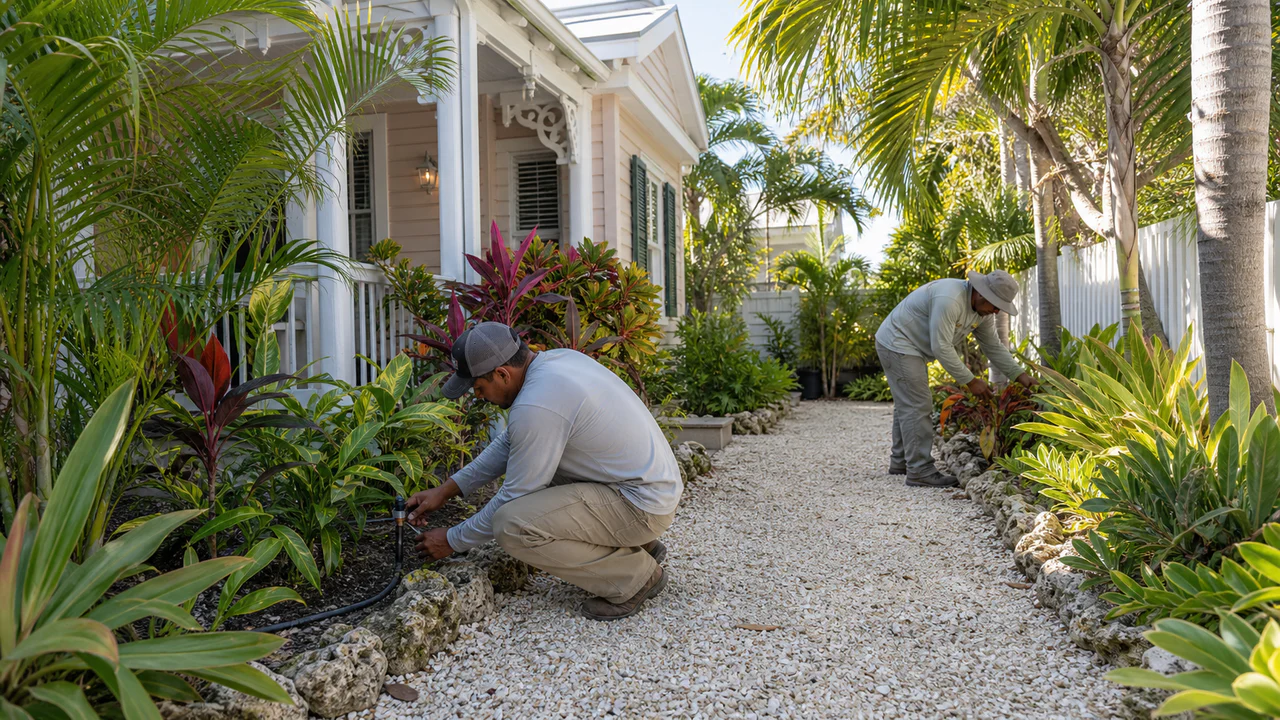
The best Key West landscaping company is the one whose operating model matches the property. Island Edge has the clearest documented fit for plant-forward design, orchids, containers, and a conditional new-plant warranty. Green World is a compact maintenance-and-design option. Green Keys publishes a maintenance, planting, tree-and-storm, pressure-washing, and organic-lawn-care menu, with the legal address kept separate from its verified Key West service area. Fabi's combines maintenance with irrigation, hardscape, equipment, palm, and haul-off work. Shorty's is the tree-and-lawn crossover when existing canopy or storm preparation drives the plan. Several familiar names remain outside this comparison because duplicate records, conflicting addresses, or unresolved brand relationships would make a confident ranking dishonest.
Price follows scope more than the word landscaping. A national 2026 planning range of $100 to $500 per month for basic residential lawn maintenance is useful only as a first budget marker. Key West bids change with service frequency, lot access, beds and containers, palm and tree work, irrigation, salt exposure, debris, guest schedules, commercial reporting, and storm obligations. The fastest way to get a defensible local number is to give each finalist the same property map and task schedule, then require every exclusion and unit price beside the base total.
Need landscaping in Key West?
Send a scope companies can price without guessing
Describe the property, frequency, turf, beds, trees, irrigation, salt exposure, access, storm needs, and desired start date once. Real scope produces more comparable landscaping quotes.
Local businesses compared
These are identity-checked local profiles, not paid placements. The fit notes describe differences supported by current official information; ratings shown remain attributed to their outside source.
- Model
- Key West-based garden design and recurring maintenance provider advertising Key West-to-Summerland Key service, orchids, containers, planting, mulch, rock, sod, artificial turf, edging, brick repair, and pressure washing.
- Best starting fit
- Plant-forward design, weekly or biweekly garden maintenance, orchid and container detail, and installations where a written establishment and replacement plan matters.
- Why it is on this list
- The official site publishes two contacts, a defined service area, a detailed task list, salt-aware plant selection, and a 90-day new-plant warranty conditioned on working irrigation and continuing Island Edge maintenance. Florida lists ISLAND EDGE LANDSCAPING LLC as active.
- Confirm before booking
- The warranty conditions must be written into the proposal. No individual independent review bodies or applicator certificate were inspected, and the current LLC filing date is 2024 even though the site says the founders began operating in 2016.
- Model
- Appointment-based Key West maintenance and design operator advertising mowing, lawn care, bush trimming, tree cutting, fertilizing, and custom landscape design.
- Best starting fit
- Routine lawn and hedge maintenance with a design conversation, especially when the owner can define exact service frequency and separately verify chemical or tree scope.
- Why it is on this list
- The official phone and domain align with the stored profile, and Florida lists GREEN WORLD OF KEY WEST L.L.C. as active. The official site publishes service hours and a concrete service menu.
- Confirm before booking
- The stored service address and legal principal address differ and are kept separate. Fertilizer, pesticide, and tree work require the actual applicator, license, and permit checks; four uninspected outside reviews are insufficient for sentiment.
- Model
- Key West service-area landscaper advertising organic lawn care, landscape and lawn maintenance, tree service, trimming and storm cleanup, pressure washing, and planting and mulching.
- Best starting fit
- Owners who want recurring grounds care plus separately priced planting, tree, storm, or pressure-washing work and will require each treatment, credential, quantity, and exclusion in writing.
- Why it is on this list
- The official phone and domain match the exact stored Google identity, the official contact page names Key West service, and Florida lists GREEN KEYS LANDSCAPING LLC as active. The 3726 Cindy Avenue filing is legal evidence, not a verified customer-facing office.
- Confirm before booking
- Licensed, insured, organic-fertilizer, eco-friendly, and child- or pet-safety wording comes from the company. Verify the applicable policy, product, applicator certificate, tree-permit path, and job documents; the 4.7-from-12 Google snapshot does not supply review themes.
- Model
- Broad Key West and Lower Keys landscaping provider advertising recurring maintenance, design, hardscape, palm care, stump and Bobcat work, waste removal, and irrigation inspection and repair.
- Best starting fit
- Owners who want one itemized proposal spanning routine maintenance and a defined improvement, irrigation, equipment, or haul-off project.
- Why it is on this list
- The current official site and Florida entity record align on the Key West business and phone. The site publishes weekly, biweekly, and monthly maintenance and a broad set of adjacent services.
- Confirm before booking
- City April 2025 minutes document a settlement involving permit, HARC, and licensed-contractor provisions. That past record does not decide current fit, but permit and licensed-trade responsibility should be explicit before regulated work.
- Model
- Sugarloaf Key-registered service-area provider advertising landscape design, tree management, lawn care, conceptual mockups, and tree trimming for Key West and the Florida Keys.
- Best starting fit
- Landscaping where mature trees, pruning, shade, risk, storm preparation, or tree-lawn coordination are more important than a maintenance-only route.
- Why it is on this list
- The official phone and service area align with the RealReviews profile, and Florida lists SHORTY'S TREE & LAWN CARE LLC as active at a Sugarloaf Key principal address.
- Confirm before booking
- Do not infer a Key West office. Price travel and disposal, resolve City tree permits, and verify the exact responsible arboriculture, fertilizer, pesticide, or landscape professional rather than treating the company name as a credential.
Choose the landscaping product before the company
Recurring grounds maintenance is a route business. The provider visits on a schedule and repeats defined tasks: mowing where turf exists, edging, trimming, blowing, bed weeding, pruning within an agreed height, collecting debris, and observing irrigation. Landscape design and installation is a project business. It needs a plan, plant schedule, quantities, material specifications, demolition, delivery, installation, establishment care, and acceptance. Irrigation repair, tree work, pressure washing, hardscape, pesticide treatment, and storm cleanup are separate specialties even when one company sells several of them.
Start the comparison by marking each requested task as recurring, one-time, allowance, unit-priced, or excluded. A recurring contract should not quietly include unlimited cleanup after construction or a named storm. A one-time installation should not imply that new plants will be maintained forever. A fertilizer line should not be used as shorthand for herbicide, fungicide, insecticide, or pest-control work. The provider that prices the correct product usually beats the one with the shortest service list or highest outside star aggregate.
Property type changes the product. An owner-occupied conch house may prioritize privacy, shade, heritage character, and hand access. A vacation rental needs a reliable service window, guest-safe work, photo reporting, and rapid correction without sharing gate or alarm codes through a lead form. A hotel or restaurant needs public-area safety, noise and delivery windows, incident reporting, and a route that does not interfere with guests. An HOA or commercial property needs a scope that a manager can audit across months.
Do not stretch this guide into adjacent decisions. A substantial removal, hazardous limb, or arboricultural diagnosis belongs in the Key West tree-services comparison. A lawn-and-ornamental pest program belongs with a correctly licensed pest-control business. Pool, fence, irrigation design, structural hardscape, drainage engineering, and property caretaking can overlap landscaping, but each needs its own responsible trade and contract line.
- Recurring: frequency, tasks, service window, reporting, skipped visits, and annual changes.
- Project: plan, quantities, materials, access, installation, establishment, warranty, and acceptance.
- Specialty: exact credential, permit, subcontractor, unit price, and responsibility.
- Storm: trigger, priority, access, minimum, debris, exclusions, and no-guarantee boundary.
What Key West landscaping costs: a usable planning answer
A current Angi national planning guide places basic professional lawn maintenance for a standard residential property at roughly $100 to $500 per month. That is not a Key West average and it should not be quoted back to a company as the expected price. It is a sanity-check bracket for a narrowly defined basic contract. A small accessible property with limited turf may price below the cost of a dense tropical garden requiring hand work, palms, containers, irrigation attention, and haul-off even when both are visited twice monthly.
Convert the monthly number into a comparable operating model. Suppose one finalist quotes $240 per month for two visits and another quotes $340. The lower bid is not cheaper if it excludes bed weeding, palm debris, and haul-off that the property needs. Add the stated unit prices and expected frequency. If the lower bid adds two $45 bed visits and one $70 haul-off in a typical month, its working total becomes $400. This arithmetic is RealReviews analysis, not a claim that those example unit prices are current market rates.
For installation, compare quantities rather than a square-foot slogan. List each plant by botanical name and installed size, soil amendment, mulch depth and area, rock tonnage or volume, sod or turf area, edging length, pot or planter, irrigation change, demolition, delivery, equipment, disposal, establishment visit, and tax. A proposal with fifteen three-gallon shrubs is not comparable to one with fifteen seven-gallon shrubs. A design fee that includes a measured plan and revisions differs from a free sales sketch tied to installation.
Use allowances only for unresolved choices and cap them. If the owner has not selected ceramic pots, show a pot allowance and the markup rule rather than a hidden placeholder. If concealed irrigation defects may be found, list diagnostic labor, standard parts, approval threshold, and hourly rate. If tree permit or HARC review is uncertain, keep application work separate from installation and state whether denial, delay, or redesign changes the fee.
Budget storm and seasonal work explicitly. A normal contract can include collection of ordinary fallen fronds while excluding tropical-storm debris, emergency response, tree hazards, standing water, contaminated material, or blocked-road mobilization. Ask for a pre-storm inspection price, post-storm minimum, crew-hour rate, equipment rate, disposal method, and priority rule. A company cannot promise immediate islandwide recovery to every customer after the same event; the contract should state the real commitment.
- National basic-maintenance planning point: about $100-$500 monthly, not a Key West tariff.
- Comparable monthly total = base contract + likely excluded tasks + expected unit-priced work.
- Installation comparison = identical quantities, installed sizes, materials, access, irrigation, disposal, and warranty.
- Storm work needs its own trigger, rate, priority, and exclusions.
Build one property brief and send it unchanged
Give every finalist the same service address, property type, approximate lot and landscaped area, site plan or sketch, current photographs, desired start date, and contact method. Mark turf, beds, hedges, palms, trees, containers, orchids, irrigation zones, lighting, rock, mulch, hardscape, artificial turf, drains, fences, pool deck, public walkway, and any area another vendor maintains. A labeled phone photograph is better than a paragraph that says normal yard.
Record access before price. Measure the narrowest gate and identify stairs, alley, parking, loading, hose bib, electrical outlet, irrigation controller, equipment path, surface that must be protected, and where debris may stage. Old Town hand access can change labor and tool selection. A waterfront property can expose plants to direct spray and wind. A condominium, hotel, HOA, or commercial site may require insurance wording, vendor approval, service windows, escorts, or elevator and loading reservations.
For recurring work, choose weekly, biweekly, monthly, seasonal, or one-time frequency and define the desired appearance. Count hedge lengths and approximate heights. Identify turf and edging. List palms and trees that are inside ordinary maintenance and those that require a separate quote. Define bed weed tolerance, fallen-frond handling, clipping removal, blower restrictions, container watering, orchid care, and irrigation observation. Ask how a rainout, holiday, locked access, guest complaint, or named storm affects the schedule.
For a project, attach the problem rather than prescribing every solution. State where privacy is needed, which view must remain open, where water collects, which plants fail, the maintenance hours the owner can afford, and whether pets, children, guests, salt, wind, shade, pool splash, or public traffic matter. Require each proposal to show the design consequence. A plant list that ignores mature size, irrigation, litter, roots, and access is not a complete design.
Never send lockbox, gate, alarm, or door codes in a public quote request. Share access credentials only through the selected company's secure operational process after identity and scope are confirmed. A useful lead can include access constraints, guest windows, parking, and contact preference without exposing control codes.
- Address, property type, photos, map, lot and landscaped area.
- Turf, beds, hedges, trees, palms, pots, orchids, irrigation, hardscape, and lighting.
- Frequency, appearance standard, service window, reporting, rainout, and storm rule.
- Gate width, stairs, parking, equipment route, surface protection, and debris staging.
- Do not include access codes in the request.
Tree permits belong in the scope before the chainsaw arrives
The City of Key West says a property owner must submit a tree permit application to request City evaluation for removal, trimming, or transplanting. Its process includes a representation form when the owner cannot handle specified steps and a job completion form to close permitted work. The practical conclusion is simple: identify the exact tree and proposed action before a landscaper prices heavy work, then determine the current City path rather than relying on a generic no permit needed statement.
Name the species when possible, trunk diameter, location, target clearance, reason for work, access, nearby wires or structures, wildlife concerns, equipment, protection, debris, stump, replacement requirement, and who attends any Tree Commission step. The proposal should name who submits the application, who receives the permit, who posts it, who follows conditions, and who files completion. A tree line that says trim all palms and trees leaves too much room for a scope dispute.
Ordinary light maintenance and permitted heavy maintenance are not interchangeable. A company may be capable of mowing, hedge trimming, and palm cleanup while a particular tree hazard calls for different equipment, insurance, arboricultural judgment, or municipal review. Use the dedicated tree-services guide for removal, risk assessment, large pruning, or storm-damaged trees. If the landscaping company coordinates a specialist, identify that company and its insurance in the contract.
For urgent storm conditions, document the observable hazard and current City direction. Do not treat emergency as a permanent permit exemption or a marketing product. Ask who can safely access the site, what work is limited to hazard reduction, how photographs and disposal will be handled, and when permanent corrective work will be designed and permitted.
Irrigation repair must end with a compliant schedule
Key West's published conservation policy assigns existing-landscape irrigation days by address: even-numbered addresses may irrigate Thursday and Sunday; odd-numbered addresses may irrigate Wednesday and Saturday. The ordinance also limits landscape irrigation to 5 p.m. through 9 a.m., prohibits waste onto impervious areas, and requires rain-sensing control on new automatic systems. The City identifies exceptions, including new landscaping, so use the current ordinance for the property and work rather than carrying an exception indefinitely.
An irrigation estimate should inventory the controller, programs, zones, rain sensor, valves, heads, emitters, filters, visible pipe, pump or water source, pressure symptoms, overspray, runoff, dry spots, leaks, and plants served. State whether the visit is inspection only, diagnosis, repair, redesign, or installation. Require unit prices for common parts, diagnostic labor, approval threshold, and the condition under which concealed piping or wiring becomes a change order.
Acceptance needs a witnessed or recorded zone test, corrected controller schedule, leak check, head or emitter map, and list of unresolved defects. The schedule should reflect plant need, soil, exposure, emitter type, and legal days rather than simply maximizing run time. Grouping high-water plants with drought-tolerant plants on one zone can force either waste or stress. A design should correct the grouping problem where practical.
For new planting, write who provides establishment watering, how the temporary exception is documented, when the regular address schedule resumes, and what happens after a controller failure. Island Edge's public plant warranty makes working irrigation and ongoing company maintenance conditions of coverage; another company may use different terms. Put the irrigation test and warranty conditions in the same acceptance record.
Salt and wind tolerance are property-level facts
Salt-tolerant does not mean every coastal plant succeeds everywhere. UF/IFAS distinguishes salt exposure and lists plant characteristics such as salt tolerance, light, mature size, establishment status, and invasive concern. Direct waterfront spray, wind-driven salt, brackish inundation, irrigation-water quality, reflected heat, shallow soil, shade, and a protected courtyard create different sites within the same Key West ZIP code.
Ask the designer to divide the property into exposure zones. For every material plant, record botanical name, installed size, mature height and spread, light, salt tolerance, wind resistance, drainage, water after establishment, litter or fruit, root clearance, pruning burden, invasive or prohibited status, and wildlife value. A narrow side yard should not receive a plant whose mature spread forces constant shearing. A foundation bed should not be designed around roots or irrigation that conflict with the building.
UF/IFAS identifies examples such as beach sunflower, gaillardia, and seaside goldenrod as wind- and salt-tolerant native choices for exposed conditions. That is a starting point, not a universal prescription. The designer still needs the site's light, drainage, scale, desired form, maintenance capacity, and code constraints. Use the UF/IFAS plant guide to test each proposed species rather than buying an island mix with no schedule.
Storm resilience is also structural. UF/IFAS notes that selecting wind-resistant tree species and preventive pruning can improve survival, but mature size and planting space still matter. A wind-rated species installed too close to a structure, squeezed into inadequate rooting volume, or repeatedly topped can become a maintenance problem. Require the plan to show mature canopy and root space, not only the nursery container.
Fertilizer and pesticide claims are not interchangeable
Florida requires a Limited Urban Commercial Fertilizer certificate for commercial fertilizer application to urban residential, commercial, park, field, turf, and ornamental areas. FDACS states that this certificate does not authorize pesticide application, a pesticide-fertilizer mixture, operation of a pest-control business, or uncertified workers applying under another person's certificate. Ask for the individual applicator and current certificate that will cover the visit.
FDACS separately explains the Limited Commercial Landscape Maintenance certificate. It can allow certain herbicide, insecticide, and fungicide applications to ornamental plants and plant beds. It does not allow pesticide application to turf, including weed-control or weed-and-feed work, does not let the holder supervise uncertified employees under that certificate, and does not authorize operation of a pest-control business. Broader lawn-and-ornamental pest work needs the applicable licensed business and certified operator structure.
The quote should identify the target condition, treated area, product name and EPA registration where applicable, fertilizer analysis, rate, method, applicator, certificate or license, notice, reentry or pet precautions, wind and rain rule, irrigation instruction, record delivery, and follow-up. A line labeled spray or fertilize as needed gives the owner no way to verify legal scope, product choice, environmental handling, or cost.
UF/IFAS Monroe County emphasizes minimizing fertilizer and pesticide runoff to protect nearshore water quality. That makes diagnosis and spot treatment commercially relevant, not decorative environmental language. Ask how the company distinguishes nutrient deficiency, irrigation stress, salt injury, disease, insect damage, and maintenance injury before treating. If the proposal cannot explain the problem and authority, compare a licensed specialist.
Landscape designer and landscape architect mean different things
Florida's Board of Landscape Architecture says landscape design is not a state-licensed profession. It generally covers consultation and planting plans, including plant materials, soil amendments, mulch, edging, gravel, and similar installation details. A provider may therefore accurately call itself a landscape designer without holding an LA license. The title alone does not prove training, insurance, construction authority, or suitability.
Landscape architecture is regulated. DBPR describes a broader professional scope that can include planning, drawings, specifications, construction supervision, grading, land and water forms, drainage, storm drainage, irrigation systems, siting, and designed features such as retaining walls or ponds. Florida issues LA numbers to individuals and LC numbers to licensed business entities. When the requested deliverable falls in that regulated scope, identify the responsible license and verify it.
Construction can add another layer. A planting plan may lead to hardscape, retaining, structural, electrical, plumbing, pool, irrigation, or building work that belongs to a licensed contractor or permitted trade. The landscaping company may coordinate it, but the proposal should name the legal contractor, license, permit applicant, drawings, inspections, and warranty. Broad licensed and insured website language is not a substitute for the credential that covers a specific line.
Historic properties need an early City and HARC screen. Do not wait until demolition or material delivery to learn that a visible hardscape, fence, structure, grade change, or other exterior work needs review. Price design, permit support, revision, and construction separately so a regulatory change does not turn into an unlimited verbal change order.
Storm preparation and recovery need a separate contract
A normal landscaping agreement should state what happens when tropical weather interrupts the route. Define the watch or warning trigger, last safe service time, whether loose pots or furniture are included, which plants or trees are inspected, what cannot be guaranteed, and who authorizes extra work. A pre-storm visit should not promise that every limb, plant, or system will survive.
Post-storm service needs priority and access rules. Ask whether existing maintenance customers receive priority, how life-safety hazards are triaged, when the company may enter, what photographs are produced, who can approve work, the minimum mobilization, crew and equipment rates, debris measurement, disposal destination, permit or emergency documentation, and what happens when roads, utilities, or disposal sites are unavailable.
Keep ordinary green waste separate from storm debris, contaminated material, construction waste, large trunks, root balls, and materials requiring specialty handling. Identify whether the provider hauls, stages, chips, bags, or leaves material for a public collection process. A quote that says storm cleanup included without volume or event boundaries can fail both sides after a large storm.
Inspect irrigation before and after a storm when the system is material to plant survival. Shutoff, broken heads, exposed pipe, damaged controller, saltwater inundation, standing water, and power loss can change the recovery plan. Do not restart a pre-storm watering schedule automatically. Record what was tested and which plants need temporary hand watering or no additional water.
How the five companies differ
Island Edge publishes the most detailed plant-oriented service page of the five. It names orchids, native and non-native Keys plants, salt exposure, pots, planters, sod, artificial turf, rock, mulch, edging, brick repair, and weekly or biweekly maintenance from Key West to Summerland Key. Its 90-day new-plant policy creates a concrete comparison point, but only when working irrigation and Island Edge maintenance continue. Make those conditions part of acceptance.
Green World publishes a simpler appointment-based maintenance and design model: lawn care, mowing, tree cutting, fertilizing, bush trimming, and custom design. Its official phone aligns with the stored profile and active Florida entity. The service address and legal principal address differ, and its four reported Google reviews were not inspected. It fits a routine maintenance comparison better than a complex project that needs public construction or credential detail.
Green Keys publishes five useful service families, but each needs a different pricing and authority test. Recurring maintenance needs frequency and task quantities; planting needs species, sizes, counts, soil, irrigation, establishment care, and replacement terms; tree and storm work needs the exact trees, permit path, equipment, debris, and emergency rules; pressure washing needs measured surfaces and protection; and any fertilizer or pesticide treatment needs the product and responsible credential. The official site verifies Key West service, while the public corporate filing remains legal evidence rather than a walk-in location.
Fabi's has the broadest adjacent-service menu: weekly, biweekly, and monthly maintenance, design, hardscape, palms, stump and Bobcat work, waste removal, and irrigation inspection and repair. That breadth can reduce coordination when the scope is properly itemized. City April 2025 minutes document a past settlement involving permit, historic-district, and licensed-contractor provisions, so a current proposal should be especially clear about permits and responsible licensed trades.
Shorty's is the tree-and-lawn crossover. Its official site names landscape design, tree management, lawn care, conceptual mockups, and trimming for Key West and the surrounding Keys. Florida places the legal principal address on Sugarloaf Key, so it is a service-area option rather than a claimed Key West office. Choose it for a bid when tree scope materially shapes the landscape; use the tree guide for substantial removal or risk work.
None of the five receives a RealReviews rating from outside aggregates. Individual independent review bodies were not available and inspected to the required standard. The comparison is based on resolved identity, official scope, authority records, and disclosed limits. Final selection belongs to the current written plan, credentials, permits, insurance, contract, and price.
Why Paradise, Land Creations, and South Garden are not comparison cards yet
RealReviews currently has two Paradise Lawn and Garden records with different phones, domains, and addresses. One aligns with the current plgkeywest.com operation and 305-747-8106; the other points to a different domain, phone, and Amelia Street address. Those may represent a prior business, unrelated operators, or stale data. No merge or profile enrichment is safe until the provenance establishes whether they are the same entity.
Land Creations has a strong current official site and two stored records sharing the 305-239-3035 phone and Laurel Avenue address. A separate Gardens of Eden record also exists, while local directory evidence suggests historical or location relationships that do not prove the current legal, brand, acquisition, or successor boundary. Land Creations may eventually become a strong comparison candidate. It is excluded now because a polished profile should not erase the unresolved corporate history.
South Garden's official site and both stored records share 305-923-6143 and lawnservicekeywest.com, but the official contact address aligns with a record called South Garden Cleaning while the stronger landscaping record carries another Key West address. The likely duplicate is not hard to see; the correct canonical address and name still need evidence. Neither row is enriched or merged in this wave.
Other exclusions are category integrity problems rather than close calls. The Key West Butterfly and Nature Conservatory and Key West Gardens at Fort West Martello are attractions or venues, not quote-ready landscaping companies. Allgood Outdoors carries an Oklahoma address and unrelated domain. They should not help a category meet an indexability or comparison threshold. Discoverability does not equal eligibility.
Normalize the final quote line by line
Use one comparison sheet. Row one is legal business name, billing address, phone, official domain, insurance certificate, and responsible specialty license. Then enter service frequency, scheduled window, visit minimum, turf, edging, beds, hedge quantities, palm and tree quantities, containers, orchids, irrigation checks, fertilizer, pesticide, debris, reporting, missed visits, and annual escalation. A blank cell means the proposal is incomplete, not free.
For installation, add design deliverables, revisions, demolition, plant names, installed sizes, quantities, material allowances, soil, mulch, rock, sod, turf, edging, pots, irrigation, lighting, hardscape, delivery, equipment, staging, protection, disposal, permits, inspections, establishment visits, warranty, exclusions, tax, deposit, progress payments, and final acceptance. Ask every finalist to mark included, unit-priced, allowance, owner-supplied, subcontracted, or excluded.
Calculate a first-year maintenance total and a project total. Include expected unit-priced work and the maintenance required to preserve a warranty. If Island Edge's plant warranty requires its maintenance, compare the bundled first 90 days with another company's installation plus separate establishment care. If Fabi's coordinates hardscape, compare the named licensed trade and permit line with a direct contractor's price. If Shorty's includes tree work, separate the permitted tree line from ordinary lawn care.
Control changes. The contract should identify who may approve extra work, the written change format, labor and material markup, photos or measurements, emergency threshold, and whether work stops until approval. Do not authorize an open-ended make it look good instruction. A useful landscaper can recommend; the customer still needs a scope that can be audited.
End with acceptance. For recurring work, use a 30-day review against the task calendar. For installation, walk the property against the plan, quantities, irrigation test, cleanup, photographs, permits, and warranty start. Record unresolved items and a completion date before final payment. Keep plant tags, product labels, controller settings, certificates, permits, invoices, and condition photographs together.
- Identity and credentials.
- Recurring task calendar and recovery rules.
- Project quantities, sizes, materials, access, and permits.
- Chemical product, applicator, treated area, and records.
- Storm trigger, priority, minimum, and debris.
- Written changes and measured acceptance.
Sources and verification
Rules and public requirements link to the responsible agency. Business-specific service claims are checked against privately retained official material, while public ratings remain attributed to their original source. RealReviews does not turn outside reviews into invented testimonials, blend unrelated platforms into a house score, or sell placement in these comparisons. Recheck licenses, availability, scope, and price before hiring.
Frequently asked questions
How much does landscaping cost per month in Key West?
Use $100-$500 per month only as a current national planning range for basic residential lawn maintenance, then replace it with local written quotes. A Key West scope can exceed that range when it adds dense beds, palms, containers, irrigation, hand access, haul-off, guest scheduling, commercial reporting, or storm obligations. Compare the same visit frequency and tasks; add every likely unit-priced service to the base monthly amount before ranking bids.
Do I need a permit to trim or remove a tree in Key West?
Start with the City tree-permit process before removal, transplanting, or material trimming. The City instructs owners to submit an application for Urban Forestry evaluation and provides representation and completion forms. Give the landscaper the species, location, exact action, and permit status before pricing. Ordinary maintenance and regulated heavy trimming are not the same scope; substantial or hazardous work should also be compared through the tree-service pathway.
Which days can a Key West irrigation system run?
For existing landscaping, even-numbered addresses may irrigate Thursday and Sunday; odd-numbered addresses may irrigate Wednesday and Saturday. The ordinance limits landscape irrigation to 5 p.m.-9 a.m., prohibits water waste, and includes exceptions such as new landscaping. Require the contractor to leave the controller on a property-specific compliant schedule and document when any temporary establishment exception ends.
Can a landscaping company apply fertilizer and weed killer?
Only with the credential that covers the exact product and area. Florida requires commercial urban fertilizer applicators to hold the fertilizer certificate. That certificate does not authorize pesticide or weed-and-feed application. A Limited Commercial Landscape Maintenance certificate allows certain pesticide work on ornamental plants and beds but not turf pesticide work and does not authorize a pest-control business. Ask for the individual applicator, certificate, product, target area, and application record.
Does a Key West landscape designer need a license?
No—not for the ordinary landscape designer title or a basic planting plan. Florida does regulate landscape architecture, which can include broader grading, drainage, stormwater, irrigation-system design, site planning, construction documents, and specified structures. If the deliverable crosses that boundary, require the responsible LA or LC number. Construction, electrical, plumbing, hardscape, pool, tree, and pesticide work may have separate licenses or permits.
Which plants work best near salt water in Key West?
Choose by the property's exposure zone, not by a generic tropical label. UF/IFAS identifies beach sunflower, gaillardia, and seaside goldenrod among salt- and wind-tolerant native examples, and its South Florida plant table adds mature size, light, salt tolerance, and status. Require every proposed plant's botanical name, mature dimensions, light, drainage, irrigation, wind and salt fit, invasive status, and maintenance burden before approval.
What should a vacation-rental landscaping contract include?
RealReviews recommends a recurring task calendar plus guest-safe logistics: service frequency and window, turf and beds, hedges, palms, containers, irrigation observation, debris, photo reporting, rainout recovery, complaint correction, storm exclusions, and one management contact. Share parking and access constraints in the quote request, but never door, gate, alarm, or lockbox codes. The selected company should receive credentials later through a controlled operational channel.
How should I compare Key West landscaping quotes?
Use the RealReviews quote-comparison checklist: send the same map, photographs, quantities, service frequency, access, irrigation, chemical, tree, storm, and timing facts to every finalist. Compare legal identity, insurance, responsible credentials, base scope, unit prices, allowances, exclusions, permit responsibility, warranty conditions, change-order rule, and first-year total. A blank row is unresolved, not included. Award only after the plan and price describe the same work.