
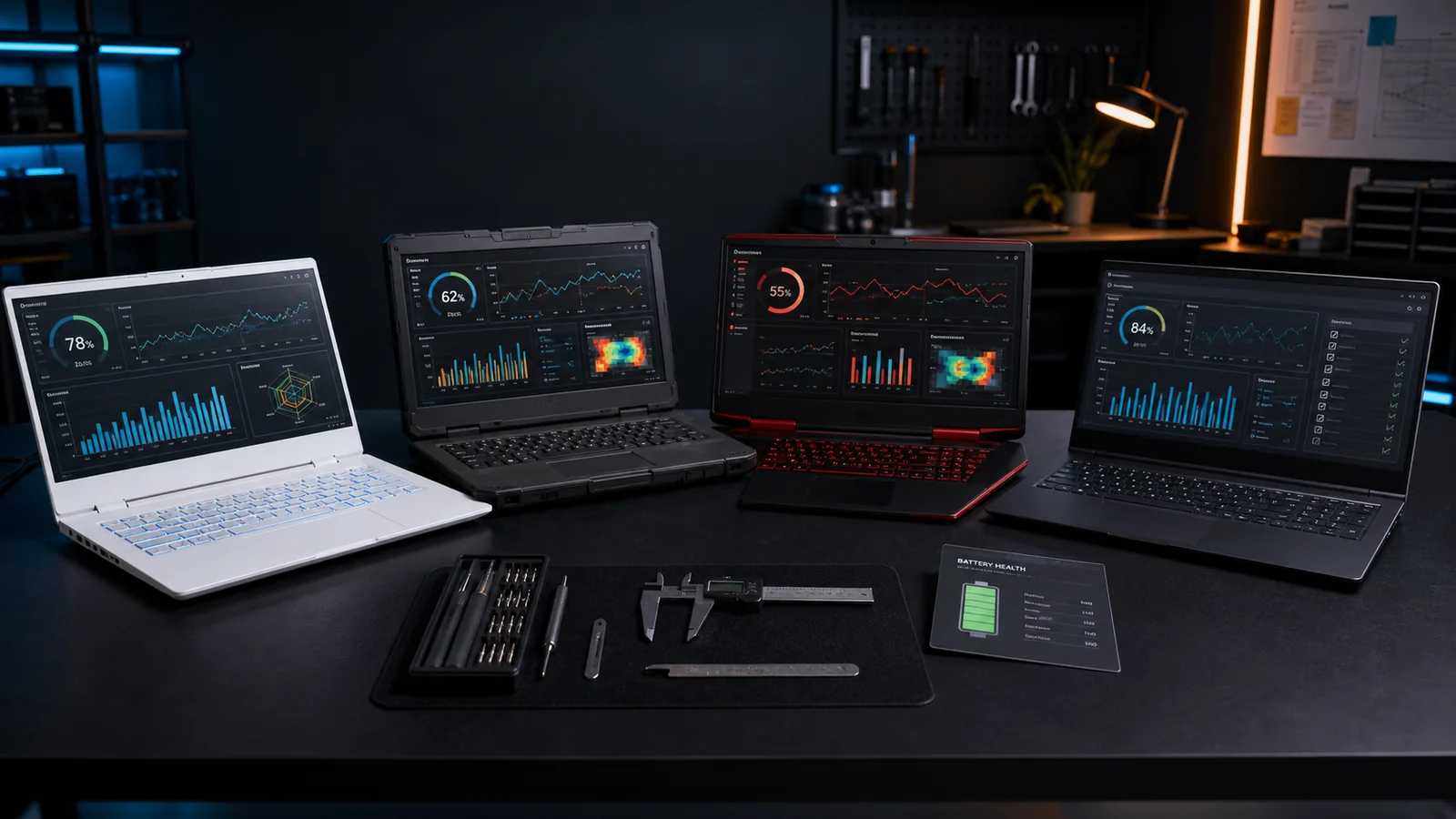
This URL used to recommend four gaming laptops: an Alienware m15 R2, ASUS TUF505DU-EB74, HP OMEN 15-dc1030nr and Razer Blade 15 Advanced. The page disappeared, but an ArticleCity syndication and two Internet Archive index records preserve enough of the article to identify its order and outbound links. Those shortened Amazon links still resolve to exact ASINs, so the update can evaluate configurations instead of vague product families.
The old article was a launch-era roundup, not a 2026 buying guide. Its Alienware section displayed 4.4/5 from 1,347 “Real Reviews,” and its ASUS section displayed 4.7/5 from 1,158, plus score panels in the mid-90s. No body corpus, source list, inclusion rule, collection window or calculation was recovered for either. Those ratings are withdrawn. The restored page keeps the history visible without presenting unsupported numbers as consensus.
Each old product now has a canonical national profile with a seven-dimension used-buy score. Identity, current 1080p usefulness, display and ports, heat/noise/battery, upgrade and support paths, bounded owner evidence, and price/remedies all count. This is deliberately different from awarding points for how exciting an RTX badge looked in 2019. An eight-year-old laptop is partly a specification and partly the condition of one battery, cooling system, board, display, drive set and charger.
The short version is not that the four machines became useless. All can still serve a narrower game library when healthy. The Razer earns the highest current score at 6.3/10, followed by the HP at 5.9, ASUS at 5.8 and Alienware at 5.5. None receives an unconditional recommendation. Their value begins only after exact configuration verification, sustained testing, a battery and storage check, a condition-adjusted price and a remedy if the seller's description proves wrong.
The recovered list had four specific 2019 configurations
The old order was Alienware m15 R2 first, ASUS TUF505DU-EB74 second, HP OMEN 15-dc1030nr third and Razer Blade 15 Advanced fourth. The ranking is preserved as history, not repeated as a current recommendation. All four are now discontinued, configuration-sensitive used purchases.
The recoverable ArticleCity copy identifies the original RealReviews page and dates the article to December 11, 2019. It preserves the Alienware “Voted #1” badge, the ASUS “Editor's Choice” badge, the four descriptions and the shortened Amazon links. Internet Archive's CDX index records successful captures of the exact RealReviews URL on September 21 and November 24, 2020. The replay is asset-heavy and truncated before the body, but the capture digests and the readable syndicated copy form a coherent historical record.
Resolving the old links turns a generic list into four reviewable objects. Alienware's link maps to B07TK52FR6 and AWYA15-7947BLK-PUS. ASUS maps to B07QQB6DC1 and TUF505DU-EB74. HP maps to B07NDYBX4G and 15-dc1030nr/6FE64UA#ABA. Razer maps to B07QX9D69S and the ninth-generation RZ09-0301 family configuration with RTX 2070 Max-Q and a 240 Hz panel. Those identifiers prevent a neighboring screen or GPU from silently entering the grade.
Preserving the old order does not mean honoring its judgment. In 2019, buyers compared new machines with launch warranties and current batteries. In 2026, they compare used units with unknown repair histories against newer used RTX systems and current laptops. The relevant question is no longer which brochure looks best. It is whether the exact machine can complete the buyer's game library, survive a long load, run a supported operating system, accept needed upgrades and leave the buyer a remedy when an intermittent defect appears.
Sources for recovered model and link record
The 1,347- and 1,158-review claims are withdrawn
No recoverable evidence connects 1,347 reviews to the Alienware score or 1,158 reviews to the ASUS score. The old page preserved no bodies, platforms, inclusion rules, dates, deduplication method or arithmetic. RealReviews therefore withdraws both star ratings and every unexplained percentage panel.
A large review count creates a strong impression of consensus. To deserve that impression, a publisher needs at least a source list, product-identity rule, collection period, inclusion and exclusion criteria, treatment of retailer variations, and calculation. None was recovered. The ArticleCity copy repeats the numbers but does not supply their foundation. The ASUS panel also appears malformed, with an extra percentage after the four named categories. Repeating the display now would turn a missing method into false continuity.
The replacement does not manufacture a new giant aggregate. RealReviews inspected 76 bodies across the four research records: 24 keyed to the Alienware ASIN, three exact-model ASUS comments, 26 HP Amazon-corpus bodies plus five separate Best Buy bodies, and 18 keyed to the Razer ASIN. The Amazon variation pools are disclosed where comments name neighboring GPUs. Verified-purchase flags are counted where the data preserve them. Platforms and products are not averaged together.
This narrower record produces less dramatic language and better decisions. Owners do praise performance, screens, keyboards, construction and upgrades. They also report heat, short batteries, fan, audio, display, Wi-Fi, lag, hinge, keyboard and early-death failures. A complaint identifies a testable failure mode; it does not establish the failure rate. A positive body supplies a counterexample; it does not certify the used unit for sale today. Condition evidence now outranks an unexplained historical star.
Sources for old-rating correction
The current scores are 5.5 to 6.3—not launch-era 9s
Razer Blade 15 Advanced leads at 6.3/10, HP OMEN 15-dc1030nr follows at 5.9, ASUS TUF505DU-EB74 earns 5.8 and Alienware m15 R2 earns 5.5. Each is conditional. The difference is smaller than model reputations suggest because battery, heat, repair and seller remedies now carry real weight.
Current 1080p performance receives 25 percent of the score. Identity receives 10 percent; display, inputs and connectivity 15; thermals, noise and battery 15; upgrades, repair and support 15; owner evidence and reliability 10; and used price and remedies 10. This makes the math transparent while resisting benchmark tunnel vision. A fast GPU cannot buy its way out of a swollen battery, soldered failed memory or a no-return sale.
The Razer's 240 Hz, 100% sRGB panel, 8 GB RTX 2070 Max-Q and removable memory create the strongest package, but its variation-level quality-control record and premium used pricing hold it to C+. The HP and ASUS both earn C for different reasons: HP has a stronger exact-owner record and RTX hardware but a 60 Hz screen and recurring heat concerns; ASUS is easier to upgrade and may cost less but has a weaker CPU, dim narrow-gamut panel and almost no verified owner corpus.
Alienware's 144 Hz screen, RTX 2060 and dual-M.2 storage remain attractive. Its m15 R2 test behavior near 100 C and the permanent 16 GB memory ceiling are expensive constraints in 2026, pushing the score to C-. None of these grades predicts how long an individual laptop will last. They define the quality of the purchase proposition before the unit-level inspection. Passing the inspection can make a conditional buy rational; failing it ends the comparison.
The recovered 2019 list, rescored as 2026 used purchases
| Factor | Exact configuration | Current decision |
|---|---|---|
| Alienware m15 R2 AWYA15-7947BLK-PUS | i7-9750H · RTX 2060 6 GB · 16 GB soldered · 512 GB · 144 Hz | 5.5/10 (C-) · Useful 1080p lane; heat and permanent memory ceiling demand a deep discount |
| ASUS TUF505DU-EB74 | Ryzen 7 3750H · GTX 1660 Ti 6 GB · 16 GB removable · 256 GB + 1 TB · 120 Hz | 5.8/10 (C) · Repairable budget esports/older-game machine; dim panel and thin owner record |
| HP OMEN 15-dc1030nr | i7-8750H · RTX 2060 6 GB · 16 GB removable · 128 GB + 1 TB · 60 Hz | 5.9/10 (C) · Capable low-cost desk substitute if heat, stability and SSD needs check out |
| Razer Blade 15 Advanced RZ09-0301 | i7-9750H · RTX 2070 Max-Q 8 GB · 16 GB removable · 512 GB · 240 Hz | 6.3/10 (C+) · Strongest display/chassis package; battery, QC and no-return pricing remain decisive |
Alienware m15 R2: fast screen, hot CPU, permanent 16 GB
The exact AWYA15-7947BLK-PUS earns 5.5/10. Its 144 Hz FHD display, RTX 2060 and two M.2 storage positions still suit a tested 1080p library. Near-100 C independent test behavior, loud-fan and battery reports, and soldered 16 GB memory make it the least forgiving old-list purchase.
Dell's records confirm what matters. The m15 R2 supports the RTX 2060 with 6 GB GDDR6, and its FHD display family includes a 144 Hz, 300-nit option matching the linked title. It has Ethernet, Thunderbolt 3, HDMI, mini DisplayPort and two M.2 storage positions. The drawback is structural: Dell states that the dual-channel DDR4 is integrated on the system board and cannot be upgraded after purchase, with 16 GB as the maximum configuration.
Notebookcheck found the larger concern under load. In its m15 R2 test, the CPU jumped to 100 C under Prime95 and stayed in the 90 C range after clocks fell. During Witcher 3, CPU temperature again approached 100 C while clock rates fluctuated. The review unit was not the exact Amazon configuration in every component, so its frame rates are not copied here. The chassis-level heat behavior is still directly relevant to a sustained inspection of the RTX 2060 unit.
The owner pool contains both strong and troubling examples. People praise speed, the screen, keyboard and portable power. Others report less than two hours on battery, loud fans, a ticking fan, black-screen boots, Wi-Fi loss, a failed GPU, hinge trouble, trackpad faults and a dead machine. Variation mixing prevents a defect rate. It does not prevent a buyer from testing every one of those modes and refusing a price that assumes the machine is repair-free.
Sources for alienware condition test
Outside ratings
| Source | Rating | Reviews | Checked |
|---|---|---|---|
| Historical Amazon bodies keyed to B07TK52FR6 | 4.0/5 | 24 | 2026-08-17 |
Historical owner-body means remain on the product profiles with their exact source and variation boundaries. They are not combined into the RealReviews score, and no cross-product star ranking is published.
Consensus coverage
moderate confidence. We coded 24 content-bearing bodies across 3 eligible sources. Product specificity was mixed.
Eligible: Dell m15 R2 setup and specifications, Notebookcheck Alienware m15 R2 test, Historical ASIN review-body dataset.
- Excluded Old RealReviews rating and review-count display — No source list, bodies, inclusion rule, collection period or calculation was recovered.
- Excluded Retailer Q&A, search snippets and non-owner forum recommendations — They can clarify identity or buyer questions but are not product-owner outcome evidence.
- Excluded Bodies that explicitly name a neighboring configuration — Useful only as disclosed family-level context; they cannot establish exact-configuration performance or incidence.
What reviewers repeatedly said
Recurring positives: Owners repeatedly praise plugged-in speed, the screen, keyboard, design and portability for the performance class.; Notebookcheck's m15 R2 test found strong gaming performance but unusually hot and variable CPU behavior; the exact RTX 2060 is a capable first-generation mobile RTX part with 6 GB of graphics memory.; Dell says the 16 GB dual-channel DDR4 is integrated on the system board and cannot be upgraded, while storage can use two M.2 positions up to the documented interface limits..
Recurring negatives: The same pool includes short-battery, heat, fan-tick, boot, Wi-Fi, GPU, hinge, trackpad and early-death reports, with several owners describing difficult support or repair experiences.; Notebookcheck observed the CPU touching roughly 100 C under both Prime95 and a Witcher 3 gaming load, with clocks fluctuating as the system balanced temperature and performance; historical owners also mention loud fans, heat and fan defects.; Dell specified a 76 Wh battery, and Notebookcheck recorded about 5.5 hours in its launch-era Wi-Fi test, while owners in the ASIN pool repeatedly describe short real-world runtime; any original pack is now far beyond ordinary warranty age..
Counterexamples retained: A successful owner report does not prove that an eight-year-old unit offered today has the same battery, cooling, drive or repair history.; A severe defect report identifies a plausible failure mode but does not establish the percentage of units affected.; Historical game performance does not guarantee a current title, setting, driver or frame-rate target..
Twenty-four historical bodies keyed to ASIN B07TK52FR6 were inspected; twelve were marked verified purchase. The pool is variation-level because at least one body explicitly names a different 2070/240 Hz configuration.
ASUS TUF505DU-EB74: the budget tinker's conditional pick
The exact TUF505DU-EB74 earns 5.8/10. A GTX 1660 Ti, 120 Hz screen, two memory slots and two storage formats can still make sense for esports and older games. The four-core CPU, 250-nit 45% NTSC panel, 48 Wh battery and minimal owner evidence restrict the recommendation.
Newegg's surviving exact-model record is unusually useful. It identifies Ryzen 7 3750H, GTX 1660 Ti 6 GB, 16 GB as two 8 GB modules, a 256 GB M.2 SSD, 1 TB hard drive and 120 Hz FHD panel. It also supplies the less flattering details that round out the product: 250-nit brightness, 45% NTSC color, a 48 Wh battery, one USB 2.0 port, two USB 3.1 Gen 1 ports and no USB-C.
The GTX 1660 Ti Mobile was a good raster performer at launch and remains viable for a carefully chosen 1080p library. It lacks the ray-tracing and Tensor hardware found in the three RTX configurations, while the Ryzen 7 3750H's four cores can limit CPU-heavy new games. A 120 Hz desktop does not guarantee 120-fps play. The value is older and competitive titles, repairable memory and storage, and a price far below a current midrange machine.
Owner certainty is the weakest in the cohort. One self-described exact owner reports sudden frame drops, audio distortion, short battery and poor brightness after software troubleshooting failed; two anonymous exact-page comments describe satisfactory use and upgrades. No rating is calculated. Inspect the audio, both memory channels, both drives, current panel refresh, battery and a CPU-heavy game. An old-stock listing displayed $405.90 after coupon, so an ordinary used unit near that price has little room for risk.
Sources for asus value and upgrade test
Consensus coverage
low confidence. We coded 3 content-bearing bodies across 2 eligible sources. Product specificity was high.
Eligible: ASUS TUF505DU support and manuals, Newegg exact TUF505DU-EB74 specifications.
- Excluded Old RealReviews rating and review-count display — No source list, bodies, inclusion rule, collection period or calculation was recovered.
- Excluded Retailer Q&A, search snippets and non-owner forum recommendations — They can clarify identity or buyer questions but are not product-owner outcome evidence.
- Excluded Bodies that explicitly name a neighboring configuration — Useful only as disclosed family-level context; they cannot establish exact-configuration performance or incidence.
What reviewers repeatedly said
Recurring positives: The brief positive comments describe adequate gaming, sufficient memory and ports, and successful upgrades to 32 GB and SSD storage.; The GTX 1660 Ti Mobile was a strong 1080p raster GPU at launch, and the full-power family compared favorably with older GTX 1070-class hardware; the Ryzen 7 3750H is a four-core/eight-thread Zen+ processor and can be the limiting component.; The exact listing shows 16 GB as two 8 GB modules across two slots with a 32 GB stated maximum, plus an M.2 SSD and 2.5-inch hard drive, making memory and storage more serviceable than the Alienware's onboard RAM..
Recurring negatives: The detailed owner reports frame drops, audio distortion, short battery life and poor screen brightness and believed the unit required an RMA after software fixes failed.; The family uses dual fans and anti-dust marketing, but public exact-owner evidence includes sudden frame drops and an attempted troubleshooting path; without a controlled exact-EB74 thermal test, RealReviews treats sustained performance as unit-specific.; The exact record lists a small 48 Wh battery, and the one detailed exact owner calls battery life short; a 2026 unit should be expected to need mains power for gaming and may need a replacement pack..
Counterexamples retained: A successful owner report does not prove that an eight-year-old unit offered today has the same battery, cooling, drive or repair history.; A severe defect report identifies a plausible failure mode but does not establish the percentage of units affected.; Historical game performance does not guarantee a current title, setting, driver or frame-rate target..
Three exact-model public bodies were inspected: one self-identified exact owner on Reddit and two anonymous 2024 comments on an exact-model page. None provides verified-purchase evidence, so no owner star average is calculated.
HP OMEN 15-dc1030nr: capable RTX hardware behind a 60 Hz screen
The exact 15-dc1030nr earns 5.9/10. Its RTX 2060, six-core i7, removable memory and dual drives can support low-cost 1080p use. The built-in display is 60 Hz, the system SSD is only 128 GB, and exact owners repeatedly raise heat, battery and stability concerns.
HP's official sheet anchors the model: Core i7-8750H, 16 GB as two 8 GB modules, a 128 GB M.2 SSD, 1 TB 7200 RPM hard drive, FHD IPS anti-glare display, 70 Wh battery and 200 W adapter. Retail records complete the graphics identity with an RTX 2060 6 GB. This is a useful plugged-in specification, but it is not the 144 Hz configuration buyers sometimes assume after seeing family-level marketing.
The exact owner record is larger and cleaner than the others. Twenty-six Amazon-corpus bodies repeatedly name this model, GPU and storage, with 24 verified-purchase flags; five Best Buy bodies sit on exact SKU 6344883. The pools stay separate. Owners praise performance, value, boot speed, construction and the number pad. They also report heat, thermal throttling, fan noise, short battery, lag, lockups, Wi-Fi trouble, a defective unit and a late keyboard/no-power failure.
A healthy OMEN can therefore be the cohort's practical low-price desktop substitute, especially after replacing the small SSD. The condition test must run long enough to expose heat-related frame drops and must include a warm restart, Wi-Fi, both drives, keyboard and battery. A cooling pad or undervolt anecdote is not a substitute for stable stock behavior. Compare the delivered price with newer RTX 3060- or 4050-class laptops before accepting an as-is sale.
Sources for hp exact-sku record
Outside ratings
| Source | Rating | Reviews | Checked |
|---|---|---|---|
| Historical Amazon bodies keyed to B07NDYBX4G | 4.2/5 | 26 | 2026-08-17 |
| Best Buy exact SKU 6344883 | 4.0/5 | 5 | 2026-08-17 |
Historical owner-body means remain on the product profiles with their exact source and variation boundaries. They are not combined into the RealReviews score, and no cross-product star ranking is published.
Consensus coverage
moderate-high confidence. We coded 31 content-bearing bodies across 4 eligible sources. Product specificity was high.
Eligible: HP OMEN 15-dc1030nr official data sheet, HP exact model support page, Notebookcheck HP OMEN 15 RTX 2060 test, Best Buy exact model owner reviews.
- Excluded Old RealReviews rating and review-count display — No source list, bodies, inclusion rule, collection period or calculation was recovered.
- Excluded Retailer Q&A, search snippets and non-owner forum recommendations — They can clarify identity or buyer questions but are not product-owner outcome evidence.
- Excluded Bodies that explicitly name a neighboring configuration — Useful only as disclosed family-level context; they cannot establish exact-configuration performance or incidence.
What reviewers repeatedly said
Recurring positives: Owners repeatedly praise RTX 2060 gameplay, fast boot, value, construction and the number pad, with several describing reliable use across games and work.; The RTX 2060 and six-core i7-8750H delivered strong launch-era 1080p results, and independent OMEN-family testing found the combination smooth in tested FHD games with medium-to-high details.; HP's data sheet shows 16 GB as two 8 GB modules and two accessible memory slots, while the mixed 128 GB M.2 SSD and 1 TB hard drive can be replaced; the small system SSD is a practical upgrade priority..
Recurring negatives: Heat, fan noise, short battery life, a 60 Hz or dim display, lag, lockups, Wi-Fi trouble, keyboard failure and one late no-power report recur; Best Buy also contains a defective-unit counterexample.; Heat recurs across exact-owner bodies: some report ordinary warm operation, while others describe painfully hot surfaces, thermal throttling, lag, repasting or undervolting. One unit's success does not cancel another's stability failure.; HP specified a 70 Wh pack, but owners repeatedly describe only a few hours or heavy charger dependence. Calendar age, heat and the 200 W adapter requirement make current full-charge capacity more important than the launch figure..
Counterexamples retained: A successful owner report does not prove that an eight-year-old unit offered today has the same battery, cooling, drive or repair history.; A severe defect report identifies a plausible failure mode but does not establish the percentage of units affected.; Historical game performance does not guarantee a current title, setting, driver or frame-rate target..
Thirty-one exact-SKU bodies were inspected across two separate pools: 26 Amazon-corpus bodies keyed to B07NDYBX4G, 24 marked verified purchase, and five Best Buy SKU 6344883 bodies, three marked verified. The pools are not averaged together.
Razer Blade 15 Advanced: the best old package, not the safest transaction
The 2019 RZ09-0301 RTX 2070 Max-Q/240 Hz configuration earns 6.3/10, highest in the recovered list. Its fast calibrated display, 8 GB GPU, slim chassis and removable memory still stand out. Battery, quality-control, single-drive, no-Ethernet and repair-cost risk keep it conditional.
Razer documents the important configuration: ninth-generation i7-9750H, RTX 2070 Max-Q with 8 GB GDDR6, 16 GB in two removable slots, a 512 GB M.2 SSD, Thunderbolt 3, Wi-Fi 6 and a 240 Hz FHD display described as 100% sRGB and individually calibrated. No other old pick combines that panel, memory headroom and thin unibody proposition. It also lacks built-in Ethernet, an SD reader and a second drive position.
Independent testing of the closely related RTX 2070 Max-Q Blade praised the rigid chassis, display, upgrade access, gaming noise and cool WASD keys while criticizing CPU turbo behavior, warm palm rests, keyboard feedback and missing ports. The tested sibling used an earlier panel and processor generation, so its detailed frame rates are not assigned to this exact ASIN. Razer's own specification record, not the sibling review, supplies the 240 Hz identity.
Eighteen ASIN bodies add mixed ownership context. Many buyers love the screen, build and performance; others describe poor battery life, audio interference, display or GPU faults, overheating and repeated replacements. Several bodies name RTX 2080 variants, so the 3.94 mean belongs only to the inspected variation pool. A current exact-family listing asks $459.99 with no returns. At that price, battery flatness, trackpad movement, speakers, full panel modes and sustained load must be demonstrated.
Sources for razer premium-risk test
Outside ratings
| Source | Rating | Reviews | Checked |
|---|---|---|---|
| Historical Amazon bodies keyed to B07QX9D69S | 3.9/5 | 18 | 2026-08-17 |
Historical owner-body means remain on the product profiles with their exact source and variation boundaries. They are not combined into the RealReviews score, and no cross-product star ranking is published.
Consensus coverage
moderate confidence. We coded 18 content-bearing bodies across 3 eligible sources. Product specificity was mixed.
Eligible: Razer RZ09-0301 support specifications, Notebookcheck RTX 2070 Max-Q Blade test, Historical ASIN review-body dataset.
- Excluded Old RealReviews rating and review-count display — No source list, bodies, inclusion rule, collection period or calculation was recovered.
- Excluded Retailer Q&A, search snippets and non-owner forum recommendations — They can clarify identity or buyer questions but are not product-owner outcome evidence.
- Excluded Bodies that explicitly name a neighboring configuration — Useful only as disclosed family-level context; they cannot establish exact-configuration performance or incidence.
What reviewers repeatedly said
Recurring positives: Owners praise the rigid slim chassis, fast display, plugged-in game and editing performance, trackpad and portability, with many reporting an excellent unit.; The RTX 2070 Max-Q 8 GB was the strongest GPU in the recovered four-product list, and independent Blade testing found enthusiast-class launch performance in a thin chassis, with configuration-dependent CPU turbo behavior.; Razer documents two removable memory slots with support up to 64 GB and one M.2 2280 SSD position up to the stated limit. Memory serviceability is excellent for the cohort, but single-drive storage and expensive board repair remain constraints..
Recurring negatives: The same variation pool contains poor battery life, low storage, audio interference, screen or GPU faults, overheating and repeated replacement stories, plus a broad brand-level complaint that is not exact-model evidence.; Notebookcheck's earlier RTX 2070 Max-Q sibling test praised quieter gaming and cool WASD keys but found limited CPU turbo and warmer palm rests; variation-level owners range from satisfactory heat behavior to overheating and repeated replacement units.; The family uses an 80 Wh battery, yet owner bodies repeatedly criticize unplugged runtime and gaming performance away from AC; battery swelling is a material inspection risk on any thin, heat-exposed eight-year-old unit even when no exact incidence rate is known..
Counterexamples retained: A successful owner report does not prove that an eight-year-old unit offered today has the same battery, cooling, drive or repair history.; A severe defect report identifies a plausible failure mode but does not establish the percentage of units affected.; Historical game performance does not guarantee a current title, setting, driver or frame-rate target..
Eighteen historical bodies keyed to ASIN B07QX9D69S were inspected and fifteen carry verified-purchase flags. Several explicitly name RTX 2080 Max-Q variants, so the pool supports variation-level ownership themes rather than an exact RTX 2070 aggregate.
Yes—inside a narrower, game-specific 1080p lane
Healthy GTX 1660 Ti, RTX 2060 and RTX 2070 Max-Q laptops can still run esports, older AAA games and many current titles at 1080p. They cannot promise one universal preset or frame rate. CPU age, 6-8 GB VRAM, laptop power limits, heat and game-specific requirements decide the result.
Launch benchmarks answer what the hardware did in its original test environment. They remain a baseline, not a current warranty. Notebookcheck's GTX 1660 Ti Mobile review found strong 2019 FHD performance, while its HP and Razer family tests demonstrate the useful launch capability of RTX 2060 and 2070 Max-Q systems. Modern engines, larger texture sets, shader compilation, ray tracing and CPU-heavy simulation can change the bottleneck. The exact laptop's cooling condition can move it again.
The right purchase test begins with the buyer's actual games. Check official minimum and recommended requirements, then find configuration-matched testing where possible. Run the chosen game at native 1080p on AC power for at least twenty minutes, watching settled frame time, clocks, graphics-memory use and temperature. Competitive titles may exploit 120, 144 or 240 Hz screens. A demanding new release may need medium or low settings, upscaling where available, and a 30-to-60-fps target.
Feature names can mislead. The GTX 1660 Ti uses Turing architecture but lacks RT and Tensor cores. RTX 2060 and 2070 Max-Q support first-generation ray tracing and DLSS-era features, yet enabling ray tracing may be a poor trade on a laptop already near its performance limit. Newer frame-generation and encoder features are not implied by the RTX prefix. Buy for demonstrated play in the intended library, not for a promise that every future release will launch comfortably.
Sources for 1080p use boundary
A supported operating-system path is part of the hardware grade
Windows 10 ordinary support ended October 14, 2025. These CPU generations can have a normal Windows 11 path, and Microsoft explicitly lists Ryzen 7 3750H in supported AMD records. The individual laptop still needs TPM, Secure Boot, compatible firmware, drivers and a clean activation state.
A familiar Windows 10 desktop can hide a security and maintenance problem. Microsoft says ordinary Windows 10 assistance, feature updates and security updates ended on October 14, 2025, with Extended Security Updates as a limited bridge for eligible users. A seller should not present an unchanged Windows 10 installation as permanently supported. Check Windows 11 eligibility, activation and update status before treating the machine as ready for ordinary connected use.
Processor-list eligibility is not the entire test. Firmware must expose an acceptable TPM and Secure Boot configuration; storage must be healthy; graphics switching, audio, Wi-Fi, brightness and vendor control utilities need working drivers. The GTX 16 and RTX 20 notebook families appear in NVIDIA's Game Ready supported-product records, while NVIDIA notes that notebook manufacturers provide certified drivers for their systems. Generic and OEM packages may therefore play different roles.
Test sleep, wake, performance modes, fan controls, keyboard lighting and external displays after updating. Record the BIOS version and follow vendor instructions rather than flashing casually. A seller-installed unsupported bypass is not equivalent to an ordinary supported configuration. Buyers who plan Linux should check wireless, hybrid graphics, suspend, fan controls and the exact games or anti-cheat systems they need. The score rewards documented manuals and ordinary upgrade paths, not merely the ability to reach a desktop.
Sources for software-support path
A twenty-minute screenshot is not a used-laptop inspection
Start cold, verify the exact model and charger, inspect the chassis and battery, test every input and port, check memory and drive health, then run a combined CPU/GPU load for twenty to thirty minutes and restart while warm. Finish with written condition and return terms.
Begin with identity because every later conclusion depends on it. Photograph the bottom label, serial or service tag and adapter wattage. In firmware and the operating system, confirm CPU, GPU, installed memory, storage models, native resolution and maximum refresh. Look for firmware passwords, activation issues and unknown devices. Compare the result with the exact canonical profile, not a family listing. A replacement lower-refresh panel or lower-watt charger materially changes value.
Then inspect age-sensitive parts. Set the closed and open laptop on a flat surface, examine gaps, hinge movement and screw heads, and test the trackpad across its full area. A lifted pad or bowed cover can indicate a swollen battery. Generate a battery report, check full-charge capacity and cycles, and unplug during ordinary work. Inspect SMART data on every drive. Test every key, speaker, microphone, webcam, jack, USB port, display output, Ethernet where present, Wi-Fi and Bluetooth.
End with sustained load. Run a repeatable benchmark or demanding familiar game long enough for temperature and clocks to settle. Watch frame time, fan sound, errors, charging and performance, then restart while warm and test sleep/wake. Mechanical ticking, artifacts, abrupt clock collapse, shutdowns or recurring device loss are not cosmetic. Save seller statements and test results. A return window that covers hidden instability can be worth more than a small benchmark lead or cosmetic grade.
Sources for condition-first inspection protocol
Compare newer used and current machines before paying nostalgia prices
A newer used RTX 30- or 40-series laptop can beat these deals once battery, repairs and return rights are priced. Current 2026 options add newer processors, GPUs, displays and warranties. The comparison still must use exact GPU wattage, panel, memory layout, storage, battery and delivered price.
The useful alternative is not one universal “best laptop.” A portable buyer can compare current thin systems such as the 2026 Zephyrus G14 or premium Blade 16. A desk-bound value buyer should include current and prior-generation Legion, LOQ, Victus, TUF, Nitro and Dell G-series configurations. RealReviews does not transfer a recommendation from a family name. Manufacturers sell different displays, GPU power limits, memory layouts and warranties under the same line.
Newer used systems deserve equal attention. An RTX 3060, 4050 or 4060 laptop with a healthy battery and return window may cost near a premium 2019 Blade or a fully repaired OMEN. Newer media engines, upscaling, efficiency and CPU performance can matter more than a 2019 chassis advantage. Conversely, some current budget laptops use dim panels or soldered memory. Compare the exact configuration and total ownership cost, not release year alone.
A simple rule helps: do not pay enough for an old machine that one expected battery, fan, SSD or charger replacement would push it above a healthier newer option. Give value to a written warranty and ordinary returns. Match the display to the work, the ports to the desk and the GPU to the actual library. The restored profiles are evidence records for the four old links; the current market should remain open until those checks are complete.
Sources for old versus newer ownership cost
Choose the use case first, then require the unit to earn the sale
Choose Razer for display and chassis, HP for a low-cost RTX desk machine, ASUS for upgradeable budget esports use, and Alienware only for a deeply tested 144 Hz deal. Those are fit statements, not endorsements. A failed battery, thermal, storage or return test makes the right answer none.
The Razer is the most coherent premium package, with its 240 Hz 100% sRGB panel, 8 GB RTX 2070 Max-Q and removable memory. Its no-Ethernet, one-drive layout, battery risk and quality-control stories make return protection essential. The HP is easier to justify as a stationary value machine when its 60 Hz screen is acceptable and its heat behavior is stable. The ASUS fits a tinkerer who wants removable memory and two storage formats at a genuinely low price.
Alienware's display, RTX 2060 and ports can still be satisfying, but its thermal test record and soldered 16 GB make condition and price unusually important. A buyer who already knows 16 GB is insufficient should not plan around an impossible upgrade. A buyer who needs silence, long battery life or risk-free travel should not force any of the four into the job simply because an old article called them the best.
The restored URL now does what the missing article should have done: identifies each product, shows what evidence is old or current, names what was not recovered, publishes the score arithmetic and sends the reader to a canonical updateable profile. The old star displays are gone. The decision survives. Verify the exact unit, run the test, price every near-term repair, secure the remedy and remain willing to buy a newer machine—or nothing at all.
The backlinks point to a 2019 article, so the restored page keeps the four products and their old order visible. It does not pretend that an Alienware, ASUS, HP or Razer bought today is the same proposition as a sealed launch unit. Batteries age. Cooling accumulates dust. Drives wear. Panels and chargers get replaced. Warranties expire. New games and supported operating systems move the target.
The recovered evidence also changes how the old consensus should be read. Two impressive review counts and their score panels had no recoverable method, so they are withdrawn. The replacement is smaller and explicit: 76 inspected bodies with verified-purchase flags and retailer-variation problems disclosed, independent tests attributed to the configurations they actually measured, and current marketplace listings treated as dated price signals rather than universal value.
Razer's 6.3 is the best score in the cohort; Alienware's 5.5 is the lowest. The spread is narrow because every machine carries eight years of transaction risk. HP and ASUS can be better deals than the ranking suggests at the right price. Alienware can be worse than its GPU suggests if the 16 GB ceiling or thermal behavior conflicts with the job. Razer can lose its lead when the premium buys no return rights.
Use the canonical profiles to inspect the exact configuration and score arithmetic. Use this restored article to understand the historical list and the common buying protocol. Then make the individual laptop prove itself: cold identity check, chassis and battery inspection, every port and input, memory and drive health, long CPU/GPU load, warm restart, supported software path and written remedy. If it cannot pass, the backlink has done its job by sending you somewhere more honest than the old endorsement.
A model score cannot certify the unit in front of you. Seller history, service records, a serial-number check, photographs taken that day and a payment method with a real dispute path are unit-level evidence. Save the listing and test results before money changes hands, because an eight-year-old laptop can shift from fair value to uneconomic repair with one hidden fault.
Final verdict
The old four-laptop ranking is preserved but not renewed. As 2026 used purchases, the Razer Blade 15 Advanced scores 6.3/10, HP OMEN 15-dc1030nr 5.9, ASUS TUF505DU-EB74 5.8 and Alienware m15 R2 RTX 2060 5.5. All four are conditional, not broadly recommended. The old 4.4/5 and 4.7/5 ratings, claimed 1,347- and 1,158-review pools, and unexplained percentage panels are withdrawn. Buy only after exact-model verification, sustained thermal and stability testing, battery and storage checks, condition-adjusted pricing and written return protection.