
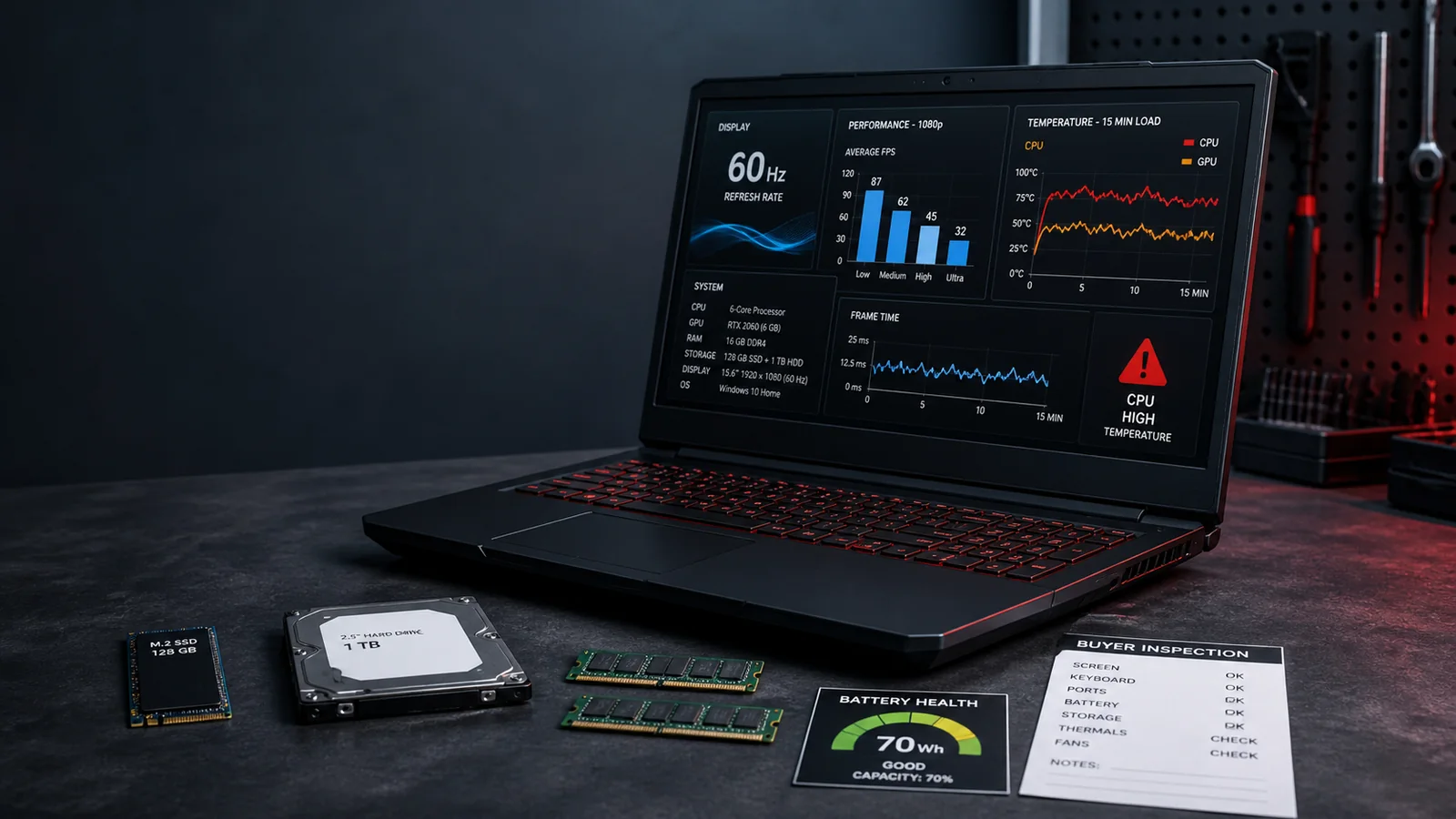
The recovered short link identifies ASIN B07NDYBX4G, HP model 15-dc1030nr and product 6FE64UA#ABA: Core i7-8750H, RTX 2060 6 GB, 16 GB in two modules, 128 GB M.2 SSD, 1 TB 7200 RPM hard drive and a 70 Wh battery.
This exact SKU uses a 60 Hz FHD IPS display. That correction matters because surrounding family marketing and old listings sometimes mention 144 Hz. The RTX 2060 can still support a useful 1080p library, but high-refresh claims do not belong to the built-in panel and the small system SSD is a practical upgrade target.
Thirty-one exact-SKU bodies were inspected in two separate pools: 26 historical Amazon bodies, 24 marked verified purchase, and five Best Buy bodies, three marked verified. Praise for game performance and value coexists with recurring heat, battery, lag, lockup, Wi-Fi, keyboard and no-power reports. The pools are not merged.
At 5.9/10 (C), the OMEN can work as a cheap plugged-in desktop substitute after a long heat and stability test. It is not recommended on specs alone. The price must leave room for battery and SSD work, and the seller should provide a return path for intermittent faults.
HP OMEN 15-dc1030nr review: 5.9/10 (C)
HP OMEN 15-dc1030nr earns 5.9/10, or C, as a 2026 used purchase. capable low-cost desktop substitute, conditional on heat and stability It can work as an inexpensive plugged-in 1080p desktop substitute when the exact unit is stable, the small SSD has been upgraded or priced in, and a return window covers hidden faults.
This is not a rerun of a 2019 launch review. RealReviews scored the exact configuration behind the old Amazon link for the decision a buyer faces now: whether an eight-year-old machine is worth acquiring without a new-product warranty. The identity is a 15.6-inch FHD IPS HP OMEN 15-dc1030nr with Core i7-8750H, GeForce RTX 2060 6 GB, 16 GB DDR4, a 128 GB M.2 SSD, 1 TB 7200 RPM hard drive and 70 Wh battery. That boundary matters because the same chassis name was sold with different processors, graphics chips, panels, memory layouts and storage. A review that drifts across those variants can make a 60 Hz screen look like a 240 Hz one or turn removable memory into soldered memory. The old RealReviews endorsement and its unexplained review count are not inputs to this grade.
The score uses seven disclosed dimensions. Current 1080p usefulness carries the most weight, but it is not allowed to erase heat, battery, repair or transaction risk. The RTX 2060 and six-core i7-8750H delivered strong launch-era 1080p results, and independent OMEN-family testing found the combination smooth in tested FHD games with medium-to-high details. it remains useful for esports, older AAA games and many newer games after settings adjustment, but the exact 6 GB GPU, older CPU and cooling behavior make high-refresh or maximum-setting promises inappropriate. Those statements describe capability, not a promise that every current game will run at a chosen preset. Laptop power limits, cooling condition, memory mode, driver version and the exact game can move results sharply. A seller's ten-minute demo also says little about intermittent faults or battery behavior.
Thirty-one exact-SKU bodies were inspected across two separate pools: 26 Amazon-corpus bodies keyed to B07NDYBX4G, 24 marked verified purchase, and five Best Buy SKU 6344883 bodies, three marked verified. The pools are not averaged together. Owners repeatedly praise RTX 2060 gameplay, fast boot, value, construction and the number pad, with several describing reliable use across games and work. The counterweight is equally important: Heat, fan noise, short battery life, a 60 Hz or dim display, lag, lockups, Wi-Fi trouble, keyboard failure and one late no-power report recur; Best Buy also contains a defective-unit counterexample. In a used transaction, those reports are a checklist of plausible failure modes, not a model-wide defect rate. The verdict is therefore conditional. Verify the screen is 60 Hz, stress the CPU and GPU long enough to expose lag or throttling, test Wi-Fi and warm restarts, check both drives, inspect keyboard reliability and generate a battery report. A return window and a price low enough to survive a battery, fan or storage replacement are part of the product, not afterthoughts.
The old link resolves to one specific configuration
The reviewed unit is a 15.6-inch FHD IPS HP OMEN 15-dc1030nr with Core i7-8750H, GeForce RTX 2060 6 GB, 16 GB DDR4, a 128 GB M.2 SSD, 1 TB 7200 RPM hard drive and 70 Wh battery. RealReviews uses ASIN B07NDYBX4G and manufacturer identifier 15-dc1030nr / 6FE64UA#ABA to keep neighboring configurations out of the factual core.
The restored article linked through a shortened Amazon URL. Resolving that redirect produced ASIN B07NDYBX4G; surviving catalog, manufacturer and support records then supplied the model boundary. The old short link resolves to ASIN B07NDYBX4G, and HP's official data sheet names 15-dc1030nr and product 6FE64UA#ABA with matching processor, memory, dual-drive storage, display and power details. This chain is more dependable than repeating a family name from memory. It also explains why some historical owner pages contain comments about adjacent GPUs or screens: Amazon commonly groups variations. Those bodies can still reveal family-level ownership themes, but they cannot silently rewrite this specification.
a 15.6-inch FHD IPS HP OMEN 15-dc1030nr with Core i7-8750H, GeForce RTX 2060 6 GB, 16 GB DDR4, a 128 GB M.2 SSD, 1 TB 7200 RPM hard drive and 70 Wh battery Manufacturer records are treated as specification evidence, not as performance proof. A listed refresh rate tells us what the panel accepts; it does not prove response time, brightness uniformity or freedom from dead pixels. A maximum memory statement tells us the designed limit; it does not show the used machine actually contains healthy modules. The buyer should confirm the CPU, GPU, display mode, installed memory and drives in the operating system and, when possible, against the service tag or model label.
This profile also refuses a common marketplace shortcut: a title containing the right family name is not enough. Sellers may reuse stock photos, omit the exact GPU, replace drives, install a different panel, or describe a similar regional SKU. Ask for a current BIOS or system-information photo, a GPU utility screenshot under load, the display's active resolution and refresh rate, the storage-device model numbers, and a photograph of the bottom label. If those pieces disagree with ASIN B07NDYBX4G or 15-dc1030nr / 6FE64UA#ABA, price the machine as an unknown configuration until the mismatch is resolved.
Its useful lane is 1080p with game-specific compromises
The RTX 2060 and six-core i7-8750H delivered strong launch-era 1080p results, and independent OMEN-family testing found the combination smooth in tested FHD games with medium-to-high details. In 2026, it remains useful for esports, older AAA games and many newer games after settings adjustment, but the exact 6 GB GPU, older CPU and cooling behavior make high-refresh or maximum-setting promises inappropriate. It should be bought for a tested game library, not for the assumption that an old high-end label guarantees new-release settings.
Independent launch-era testing remains useful when its date is explicit. It shows how the CPU, GPU and cooling package behaved in a controlled system before years of dust, paste aging and battery wear. It does not answer a 2026 game's shader compilation, memory demand, anti-cheat, operating-system or driver behavior by itself. RealReviews therefore uses historical frame-rate tests as a baseline and current requirements as a ceiling check. We do not invent a modern benchmark result for a unit we did not physically test.
it remains useful for esports, older AAA games and many newer games after settings adjustment, but the exact 6 GB GPU, older CPU and cooling behavior make high-refresh or maximum-setting promises inappropriate. The practical target is usually native 1920 by 1080, plugged into the correct-wattage adapter, with settings chosen after watching frame time, GPU memory use and temperature. Competitive titles and older games may exploit the panel well. New visually dense releases can require lower textures, reduced effects, upscaling where available, or a 30-to-60-fps expectation. Ray-tracing labels deserve particular caution: first-generation laptop RTX hardware may support the feature while delivering an unattractive result at the desired resolution and preset.
A pre-purchase test should be repeatable. Use the same game or benchmark for at least twenty to thirty minutes, record initial and settled frame rates, watch CPU and GPU clocks, and look for abrupt drops rather than celebrating one peak number. Test both internal and external displays if that matters. Run on AC power, then verify ordinary battery mode separately; gaming laptops intentionally cut performance away from the charger. If a seller will not permit a sustained load, treat the missing test as risk and lower the price or walk away.
The panel and ports define what the old GPU can still do well
The exact 15-dc1030nr retailer and owner records identify a 60 Hz FHD IPS panel; owners explicitly warn that it is not the 144 Hz display shown in some surrounding marketing and describe modest brightness. The official and retail records provide Ethernet, USB-A, USB-C, HDMI and mini DisplayPort-class connectivity for a desk setup, but the exact capabilities and every jack should be tested on the used unit. Those facts create a different use case from the product name alone and should be verified on the exact unit.
The exact 15-dc1030nr retailer and owner records identify a 60 Hz FHD IPS panel; owners explicitly warn that it is not the 144 Hz display shown in some surrounding marketing and describe modest brightness. Refresh rate is only one part of the viewing experience. Brightness, color coverage, contrast, pixel response, backlight bleed and adaptive-sync behavior can matter more for creative work or visually dark games. A high-refresh panel is valuable when the GPU can actually deliver high and stable frame rates; it does not make a demanding 45-fps game feel like 144 or 240 fps. Conversely, a 60 Hz panel can be adequate for slower games but caps the visible benefit of higher rendered frame rates and changes the value proposition.
The official and retail records provide Ethernet, USB-A, USB-C, HDMI and mini DisplayPort-class connectivity for a desk setup, but the exact capabilities and every jack should be tested on the used unit. Port selection should be tested with the devices the buyer intends to use. A connector's shape does not prove every feature: USB-C may or may not provide charging, display output or Thunderbolt; HDMI and DisplayPort versions affect external resolution and refresh; and an aging jack can disconnect under movement. Bring a known USB device, headphones, an Ethernet cable where supported, and an external monitor if docking is important. Verify Wi-Fi and Bluetooth rather than assuming a successful boot proves the radios.
Panel replacement history is also relevant. Used laptops can contain compatible but lower-spec displays after repair. In the operating system, confirm the maximum refresh rate and native resolution. Inspect solid colors for stuck pixels, pressure marks, uneven backlight and image retention; use scrolling text or a pursuit test to look for obvious ghosting. Check the webcam, microphone and brightness controls. A replacement display can be perfectly serviceable, but a seller who advertises the original high-refresh or wide-gamut panel should be able to demonstrate it.
Outside ratings
| Source | Rating | Reviews | Checked |
|---|---|---|---|
| Historical Amazon bodies keyed to B07NDYBX4G | 4.2/5 | 26 | 2026-08-17 |
| Best Buy exact SKU 6344883 | 4.0/5 | 5 | 2026-08-17 |
Ratings are reported exactly as displayed by each platform on the capture date. RealReviews does not combine, rescale, or treat a one-review page as representative.
Consensus coverage
moderate-high confidence. We coded 31 content-bearing bodies across 4 eligible sources. Product specificity was high.
Eligible: HP OMEN 15-dc1030nr official data sheet, HP exact model support page, Notebookcheck HP OMEN 15 RTX 2060 test, Best Buy exact model owner reviews.
- Excluded Old RealReviews rating and review-count display — No source list, bodies, inclusion rule, collection period or calculation was recovered.
- Excluded Retailer Q&A, search snippets and non-owner forum recommendations — They can clarify identity or buyer questions but are not product-owner outcome evidence.
- Excluded Bodies that explicitly name a neighboring configuration — Useful only as disclosed family-level context; they cannot establish exact-configuration performance or incidence.
What reviewers repeatedly said
Recurring positives: Owners repeatedly praise RTX 2060 gameplay, fast boot, value, construction and the number pad, with several describing reliable use across games and work.; The RTX 2060 and six-core i7-8750H delivered strong launch-era 1080p results, and independent OMEN-family testing found the combination smooth in tested FHD games with medium-to-high details.; HP's data sheet shows 16 GB as two 8 GB modules and two accessible memory slots, while the mixed 128 GB M.2 SSD and 1 TB hard drive can be replaced; the small system SSD is a practical upgrade priority..
Recurring negatives: Heat, fan noise, short battery life, a 60 Hz or dim display, lag, lockups, Wi-Fi trouble, keyboard failure and one late no-power report recur; Best Buy also contains a defective-unit counterexample.; Heat recurs across exact-owner bodies: some report ordinary warm operation, while others describe painfully hot surfaces, thermal throttling, lag, repasting or undervolting. One unit's success does not cancel another's stability failure.; HP specified a 70 Wh pack, but owners repeatedly describe only a few hours or heavy charger dependence. Calendar age, heat and the 200 W adapter requirement make current full-charge capacity more important than the launch figure..
Counterexamples retained: A successful owner report does not prove that an eight-year-old unit offered today has the same battery, cooling, drive or repair history.; A severe defect report identifies a plausible failure mode but does not establish the percentage of units affected.; Historical game performance does not guarantee a current title, setting, driver or frame-rate target..
Thirty-one exact-SKU bodies were inspected across two separate pools: 26 Amazon-corpus bodies keyed to B07NDYBX4G, 24 marked verified purchase, and five Best Buy SKU 6344883 bodies, three marked verified. The pools are not averaged together.
Heat is a performance and longevity question, not a cosmetic one
Heat recurs across exact-owner bodies: some report ordinary warm operation, while others describe painfully hot surfaces, thermal throttling, lag, repasting or undervolting. One unit's success does not cancel another's stability failure. On an older unit, dust, fan wear, dried thermal material and a blocked intake can make the original behavior worse, so a sustained thermal test is mandatory.
Heat recurs across exact-owner bodies: some report ordinary warm operation, while others describe painfully hot surfaces, thermal throttling, lag, repasting or undervolting. One unit's success does not cancel another's stability failure. Instrumented review findings are more useful than a seller saying that gaming laptops normally run hot, but even a laboratory result belongs to the tested configuration and room. What matters for the individual used machine is whether clocks settle predictably, temperatures remain within the system's control, fans sound smooth, and the keyboard or palm rest stays usable. Repeated oscillation, sudden frame-time spikes, shutdowns or a mechanical tick deserve more weight than a single maximum-temperature screenshot.
Inspect the air path before load testing. Look for compressed dust at exhaust fins, missing screws, warped vents, damaged fan blades and evidence that the bottom cover has been opened carelessly. Listen at idle and under load for scraping, pulsing or bearing noise. A recent cleaning claim is not proof of correct work; ask what was removed, whether pads were disturbed, and whether thermal material was replaced. Aggressive repasting or undervolting can help some systems, but it can also conceal a marginal unit or create instability.
The score does not assume that every warm laptop is failing. Compact gaming notebooks trade noise and temperature against size, and many owners used these machines successfully. The deduction reflects reduced margin in 2026. A replacement fan may be inexpensive while a board-level power fault is not. The buyer should price the machine only after it completes a cold start, a long combined CPU/GPU load, a restart while warm, sleep and wake, and an ordinary game session without artifacts, clock collapse or unexpected errors.
An original battery is now a consumable with uncertain history
HP specified a 70 Wh pack, but owners repeatedly describe only a few hours or heavy charger dependence. Calendar age, heat and the 200 W adapter requirement make current full-charge capacity more important than the launch figure. Any 2019 battery should be judged by current full-charge capacity, cycle history, swelling and behavior under load—not by its launch specification or an old runtime result.
HP specified a 70 Wh pack, but owners repeatedly describe only a few hours or heavy charger dependence. Calendar age, heat and the 200 W adapter requirement make current full-charge capacity more important than the launch figure. Historical runtime provides context, but lithium-ion capacity falls with calendar age, heat, charge level and cycles. A machine that lived on a charger in a hot chassis can have low usable capacity even with a modest cycle count. Windows' battery report can show design capacity, recent full-charge capacity and usage history when the firmware exposes them. Compare that report with an unplugged video or browsing test. A percentage icon alone can fall rapidly after the charger is removed.
Physical inspection matters because a swelling pack can lift the trackpad, bow the chassis or stress internal parts. Set the laptop on a flat surface, examine gaps, press the trackpad across its area, and compare the bottom cover with reference photographs. Do not puncture or compress a swollen pack, and do not continue charging a visibly deformed unit. A seller's promise that it only needs a battery is acceptable only when the price, part availability and return rights leave room for the possibility that charging circuitry is also involved.
Gaming on battery is not a fair measure of plugged-in performance because firmware and GPU software reduce power. It is still a useful stability and health check. Verify that the machine charges from the included adapter, reports the adapter correctly, reaches a full state without extreme heat, and can survive ordinary portable work. Confirm the adapter wattage and connector; a lower-wattage replacement can produce discharge during play or unexplained throttling. RealReviews treats a healthy replacement battery and correct charger as part of the purchase price.
Upgrade headroom differs sharply among the four old picks
HP's data sheet shows 16 GB as two 8 GB modules and two accessible memory slots, while the mixed 128 GB M.2 SSD and 1 TB hard drive can be replaced; the small system SSD is a practical upgrade priority. That architecture affects both useful life and repair economics; it should be confirmed before paying for memory or storage the chassis cannot accept.
HP's data sheet shows 16 GB as two 8 GB modules and two accessible memory slots, while the mixed 128 GB M.2 SSD and 1 TB hard drive can be replaced; the small system SSD is a practical upgrade priority. Replaceable memory can extend the useful life of a system that shipped with 16 GB, while soldered memory makes the original capacity a permanent ceiling and turns a memory fault into a board repair. Storage upgrades are generally more forgiving, but slot count and interface matter. A second M.2 position, a 2.5-inch bay, the correct screw and bracket, and a compatible drive length should be confirmed in the service record and on the individual machine.
Before upgrading, capture the current configuration and health. Run a memory test, inspect SMART data, note encryption keys, and verify that recovery media or a clean operating-system installer is available. An old hard drive can be the slowest and least reliable component even when the GPU remains adequate. Moving games and the operating system to a healthy SSD can improve load time and responsiveness, but it will not cure thermal throttling, a weak CPU or insufficient graphics memory.
Repairability is not the same as cheap repair. Replacement boards combine the CPU and GPU and can approach the value of the complete laptop. Proprietary batteries, display cables, hinges and fans vary by sub-model. Ask whether prior repairs used original or compatible parts and whether firmware recognizes them. A documented service manual and a marketplace full of components improve the odds, but return rights still matter because intermittent faults can survive a quick bench test.
Windows 10 is no longer the safe default
HP maintains the exact model support page and manuals. The eighth-generation Core i7 belongs to the Windows 11-era supported processor floor, but TPM, firmware, Secure Boot, graphics switching and device drivers must be verified on the individual unit. Because Microsoft ended ordinary Windows 10 support on October 14, 2025, a 2026 purchase should include a clean, supported Windows 11 path or a deliberate alternative operating-system plan.
HP maintains the exact model support page and manuals. The eighth-generation Core i7 belongs to the Windows 11-era supported processor floor, but TPM, firmware, Secure Boot, graphics switching and device drivers must be verified on the individual unit. Processor eligibility is necessary but not sufficient. Windows 11 also depends on enabled TPM, Secure Boot, firmware settings, storage health and drivers. Run Microsoft's health check or verify those requirements directly, then confirm activation status. Do not accept a seller's unsupported bypass as equivalent to an ordinary supported installation. If the laptop remains on Windows 10, understand the security-update status and any Extended Security Updates enrollment rather than assuming familiar software is still maintained.
Graphics support is another layer. The GTX 16 and RTX 20 notebook families appear in NVIDIA's Game Ready product lists, while NVIDIA notes that notebook makers provide the certified drivers for specific systems. A current generic driver can work while an OEM package remains necessary for switching graphics, display brightness or power modes. Test the manufacturer's control utility, performance profiles, keyboard lighting and fan controls. Missing utilities should not block basic use, but broken power-management integration can materially change battery and thermal behavior.
Firmware history should be approached conservatively. Record the current BIOS version, read the vendor instructions and use stable AC power before updating. A used machine that works does not need every optional experiment. Check Device Manager for unknown devices, review system logs for display-driver or hardware errors, and test sleep, wake, webcam, audio and wireless after updates. Software cleanup can remove launch-era bloat, but it cannot make unsupported hardware new or erase a recurring hardware error.
The owner record is useful only when its boundaries stay visible
Thirty-one exact-SKU bodies were inspected across two separate pools: 26 Amazon-corpus bodies keyed to B07NDYBX4G, 24 marked verified purchase, and five Best Buy SKU 6344883 bodies, three marked verified. The pools are not averaged together. Owners repeatedly praise RTX 2060 gameplay, fast boot, value, construction and the number pad, with several describing reliable use across games and work. Heat, fan noise, short battery life, a 60 Hz or dim display, lag, lockups, Wi-Fi trouble, keyboard failure and one late no-power report recur; Best Buy also contains a defective-unit counterexample. These bodies map benefits and failure modes; they do not establish a current defect rate.
Thirty-one exact-SKU bodies were inspected across two separate pools: 26 Amazon-corpus bodies keyed to B07NDYBX4G, 24 marked verified purchase, and five Best Buy SKU 6344883 bodies, three marked verified. The pools are not averaged together. Review evidence is separated by host and product specificity. An exact ASIN can still contain neighboring configurations because retailers merge variations. A self-identified exact owner can supply a detailed failure story without supplying verification. A five-review retailer page can show both satisfaction and defects without representing the installed base. RealReviews reports body counts and variation problems rather than inflating the evidence into a single star number.
Owners repeatedly praise RTX 2060 gameplay, fast boot, value, construction and the number pad, with several describing reliable use across games and work. Positive experiences are not dismissed because the machines are old. They explain why the products remain attractive: substantial plugged-in performance, useful displays, familiar keyboards, upgrade paths and a lower acquisition price than a current premium gaming laptop. They also provide counterexamples to any claim that every unit fails. What they cannot do is prove the health of the unit now being offered or recreate the response rate of buyers who never posted.
Heat, fan noise, short battery life, a 60 Hz or dim display, lag, lockups, Wi-Fi trouble, keyboard failure and one late no-power report recur; Best Buy also contains a defective-unit counterexample. Negative bodies deserve the same restraint. A dead GPU, failed fan, distorted audio, bad hinge or swelling battery can be real without being typical. The buyer should convert repeated themes into tests and price protection. A seller with a written return window, clear serial photos and a successful long test offers a materially different proposition from an as-is marketplace listing using stock images. That transaction difference is reflected in the score.
There is no responsible one-number used price
Current exact-model whole-unit price evidence was sparse, while replacement batteries and 200 W adapters remain listed. That scarcity means a seller's asking price needs comparison against newer RTX 3060/4050-class used systems, not the 2019 MSRP. Treat that evidence as a dated signal. A fair offer must subtract for battery wear, cosmetic or display defects, missing charger capacity, weak return rights and any failed stress test.
Current exact-model whole-unit price evidence was sparse, while replacement batteries and 200 W adapters remain listed. That scarcity means a seller's asking price needs comparison against newer RTX 3060/4050-class used systems, not the 2019 MSRP. Listings are not completed-sale averages, and even completed sales can hide condition. Storage upgrades, memory, finish and screen can move the number; so can a seller who provides a warranty. Compare the total delivered price with newer used laptops, not the product's original MSRP. A machine that needs a battery, fan, SSD and charger can become more expensive than a newer system before labor or downtime is counted.
Write the condition into the offer. Record full-charge capacity, cycle count, drive health, included adapter wattage, memory amount, screen defects, keyboard and port results, benchmark duration, peak and settled temperatures, and return period. Ask who pays return shipping and whether a stability fault discovered after installation is covered. Marketplace protection may help with a materially inaccurate description, but it is not the same as an unconditional trial. Avoid payment methods that remove the stated buyer remedy.
Value also depends on the intended game library. A low price is not value if the CPU or GPU misses a required feature, if 6 GB of graphics memory forces unacceptable settings, or if the panel does not suit the buyer's work. Conversely, an inexpensive tested machine can be rational for esports, older games, a fixed dorm-room desk or a secondary system. It can work as an inexpensive plugged-in 1080p desktop substitute when the exact unit is stable, the small SSD has been upgraded or priced in, and a return window covers hidden faults. Skip it if 60 Hz is a deal-breaker, heat and fan noise are unacceptable, portability is central, or the price overlaps a healthier newer system with stronger remedies.
Inspect the unit in an order that exposes expensive faults first
Verify the screen is 60 Hz, stress the CPU and GPU long enough to expose lag or throttling, test Wi-Fi and warm restarts, check both drives, inspect keyboard reliability and generate a battery report. Finish with a written condition record and return terms; a clean exterior or one benchmark score is not enough.
Start cold. Confirm the model label, serial or service tag, original configuration and correct-wattage charger. Enter firmware, verify the CPU and memory, then boot a supported operating system and inspect the dedicated GPU, panel modes and drives. Look for firmware passwords, activation problems, unknown devices and storage warnings. Check the chassis on a flat surface, hinge resistance, screw heads, bottom gaps, trackpad movement and signs of liquid or impact.
Next test every human interface: all keys, backlight zones, trackpad click and gestures, speakers, headphone jack, microphone, webcam, Wi-Fi, Bluetooth and each physical port. Use solid colors and motion to inspect the display. Generate a battery report and unplug the machine during ordinary work. Reconnect and confirm the adapter is recognized. If the battery or case is swollen, stop; do not keep charging to finish the transaction.
End with sustained load, not a screenshot. Run a repeatable CPU and GPU test or a demanding familiar game for twenty to thirty minutes, then restart while warm. Watch frame time, clocks, fan sound, temperature, charging behavior and errors. Test sleep and wake. Verify the screen is 60 Hz, stress the CPU and GPU long enough to expose lag or throttling, test Wi-Fi and warm restarts, check both drives, inspect keyboard reliability and generate a battery report. Save the results and seller statements in the listing or receipt. If the seller refuses the tests, assume the uncertainty belongs in the price—or choose a machine with better remedies.
A newer machine may be cheaper after risk is priced
A newer HP Victus or OMEN, Lenovo LOQ or Legion, Dell G-series, or ASUS TUF with RTX 3060/4050-class graphics can add a higher-refresh panel, newer CPU and modern feature support; exact wattage, panel and memory still require verification. Compare the exact GPU power limit, panel, memory architecture, storage slots, battery, warranty and delivered price rather than substituting a newer model name for research.
A newer HP Victus or OMEN, Lenovo LOQ or Legion, Dell G-series, or ASUS TUF with RTX 3060/4050-class graphics can add a higher-refresh panel, newer CPU and modern feature support; exact wattage, panel and memory still require verification. A current product is not automatically better value; new machines can also use dim panels, low-power GPUs, soldered memory or limited warranties. The advantage is that current configurations are easier to verify, security and driver support are clearer, batteries are younger, and an ordinary return period gives the buyer time to discover problems. Those protections have monetary value when the alternative is an eight-year-old as-is unit.
For a used comparison, include newer RTX 30-, 40- and 50-series laptops at the same total budget. Check real laptop GPU wattage because a model number alone does not determine performance. Give extra weight to a healthy battery, two memory slots where needed, a bright color-appropriate panel, modern USB-C or display support, and a seller who permits a load test. A slightly slower but well-supported machine can be the better ownership decision.
It can work as an inexpensive plugged-in 1080p desktop substitute when the exact unit is stable, the small SSD has been upgraded or priced in, and a return window covers hidden faults. Skip it if 60 Hz is a deal-breaker, heat and fan noise are unacceptable, portability is central, or the price overlaps a healthier newer system with stronger remedies. The restored 2019 roundup remains useful because it shows exactly what those old links meant and how the four designs differ. It should not trap a reader in the old shortlist. The canonical gaming-laptop category keeps the scored historical profiles together, while the restored article names current comparison paths and explains why no single replacement wins for every budget, game library and portability need.
Core sources for this score
- HP official 15-dc1030nr data sheet
- HP exact model support page
- Notebookcheck OMEN RTX 2060 family test
- Best Buy exact SKU owner bodies
- Recovered ArticleCity copy of the old RealReviews roundup
- Microsoft Windows 10 end-of-support guidance
- NVIDIA notebook driver product record
- Historical Amazon review-body dataset
Final verdict
The HP OMEN 15-dc1030nr earns 5.9/10 (C). Its RTX 2060, six-core CPU, removable memory and dual drives can still support low-cost 1080p use, but the exact 60 Hz panel, tiny 128 GB SSD, recurring heat and battery complaints, and unit-level lag or failure reports make condition testing and return rights essential.