
Independent Key West roofing guide
Key West Roofing Companies Compared: Repairs, Metal Roofs, Permits, Storm Claims, and Contracts
Compare Key West roofers by verified local presence, roof systems, license evidence, permit documents, storm-contract rules, estimate detail, and fit for repair, metal, TPO, and full replacement.
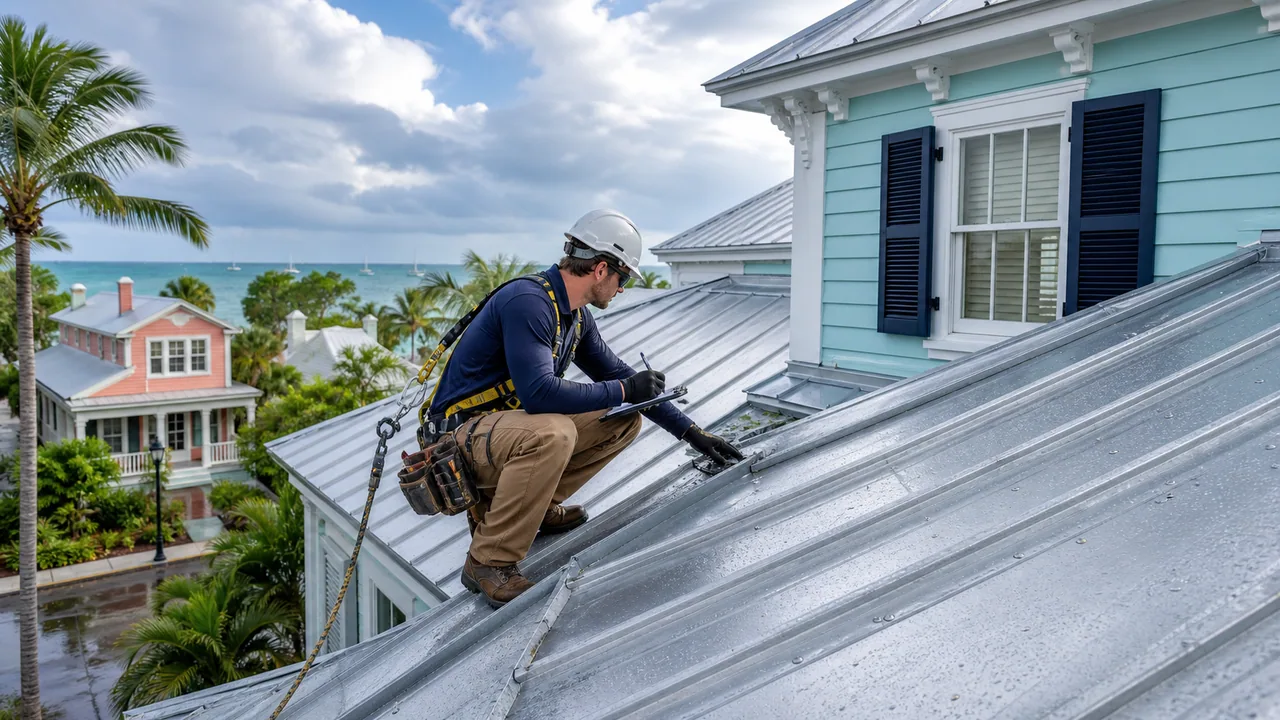
A Key West roof estimate is incomplete until it identifies the assembly, deck condition, design pressures, product approvals, water barrier, flashing, penetrations, permit work, and what happens when hidden damage appears. A price per square cannot answer those questions.
The current source-resolved comparison includes three distinct operators. Keys All Area Roofing & Construction publishes Key West and Marathon offices, state roofing and general-contractor licenses, flat, metal-shingle, metal, coating, repair, and maintenance work. Conch Construction & Roofing emphasizes Key West metal and TPO roofing plus historic restoration and broader construction. One Call Construction publishes an in-house multi-trade model with roofing, structural, electrical, plumbing, HVAC, window, mold, and emergency work. That breadth changes fit, but none should be hired without an exact license, permit, contract, and assembly review.
Leak, repair, coating, metal, TPO, or replacement
Before you call, write down what the roof is doing
Note the roof type and age, where water appears, when the leak started, earlier patches or coatings, safe-access limits, and whether a storm claim is open. Send the same photos and notes to every bidder.
Local businesses compared
These are identity-checked local profiles, not paid placements. The fit notes describe differences supported by current official information; ratings shown remain attributed to their outside source.
- Model
- The company presents itself first as a roofer, with Key West and Marathon offices and published work covering flat roofs, metal shingles, standing-seam metal, coatings, repairs, maintenance, homes, and commercial buildings.
- Best starting fit
- Put Keys All Area on the first-call list when the roof itself is the job and you want repair, coating, maintenance, and replacement discussed by the same roofing-led company.
- Why it is on this list
- Keys All Area publishes 5511 Fifth Avenue and 305-743-4400 for its Key West office. The same site prints CCC1331643 for roofing and CGC1528754 for general contracting, alongside its system and maintenance pages.
- Confirm before booking
- Its insurance help stops at documentation. The insurer decides coverage; the proposal still has to name the contracting entity, crew, and approved roof assembly.
- Model
- This is not presented as a roof-only shop. Conch places metal and TPO roofing beside historic wood and concrete restoration, renovations, additions, and new construction.
- Best starting fit
- Consider it when the roof and the old building are one problem—for example, a metal replacement that also touches historic fabric or deteriorated structure.
- Why it is on this list
- The company's current identity trail points to 1075 Duval Street and 305-304-4188. Its site claims state roofing, general-contractor, and home-inspector credentials and publishes both roof-system and restoration work.
- Confirm before booking
- Its own page gives inconsistent hurricane-speed figures. Ignore both marketing numbers. The job file needs the address-specific design pressures, approved product, any engineered detail, and the City's review.
- Model
- Key West multi-trade design-build contractor publishing roofing, structural, electrical, plumbing, HVAC, windows and doors, restoration, mold, and emergency-repair capabilities.
- Best starting fit
- Complex leaks or renovations that cross roofing, structure, MEP trades, windows, mold, and interior reconstruction.
- Why it is on this list
- The official site publishes a Flagler Avenue showroom, 305-294-0945, roofing license CCC1327352, separate electrical, plumbing, and AC licenses, and a detailed cross-trade service menu.
- Confirm before booking
- One Call can price several trades, but the first authorization can stay small: find the entry point and stop the water. A permanent roof, mold work, interior repairs, and upgrades can follow as separate decisions.
Start with a roof diagnosis, not a replacement assumption
Suppose the upstairs ceiling stains only during an east wind. That observation is more useful than simply writing “roof leak.” Note the room, stain, rain and wind, first known storm, roof age and material, and old patches. Add any attic or rooftop access problem and photographs of nearby penetrations. The opening may be uphill from the indoor stain.
What should come back is a photograph with a number on the suspected failure and a sentence explaining it. The number might land on a seam, fastener, flashing, valley, parapet, drain, scupper, equipment curb, skylight, vent, pipe boot, edge, deck, or area of movement. That evidence—not the size of the stain—should support patching, coating, partial work, or replacement.
If rain is coming, buy temporary protection as temporary protection. The small authorization names the area, material, attachment, price, removal, and any warranty or insurance consequence. It is not permission for an unpriced reroof.
Make every bidder price the same roof assembly
Lay two proposals side by side and circle every blank. Both should state tear-off, deck treatment and unit price, water barrier, flashing, penetrations, drainage, permit, cleanup, and warranty. After that the documents should diverge: metal needs the panel, metal, gauge, finish, and fastening method; a low-slope proposal needs the membrane and thickness, attachment, insulation or cover board, and drainage correction. If those details are absent, the totals do not describe the same roof.
The City of Key West roofing checklist requires the property and contractor information, qualifier, proof of ownership, complete valuation, square footage, materials, design pressures, site plan, and Notices of Acceptance for components including the water barrier and roof materials. It also notes a recorded Notice of Commencement for projects valued at $5,000 or more before the first inspection.
Ask each bidder to attach or identify the product approvals and limitations that support the proposed assembly. A brand name without the exact system, substrate, pressures, fastening, and edge conditions is not enough. If the existing structure or added weight requires design work, identify the architect or engineer, deliverable, fee, and responsibility for revisions.
Historic District work adds a design decision before installation
The City says exterior work in the Historic District requires a Certificate of Appropriateness as part of the approval path. Roof material, profile, visibility, flashing, gutters, penetrations, rooftop equipment, and related exterior changes can affect HARC review. Ask the contractor to identify whether the property is inside a district and which parts of the proposal require preservation review.
Do not assume a product acceptable elsewhere is acceptable on a specific historic resource. Obtain photographs, existing and proposed material descriptions, profiles, finish or color, visible details, and drawings required by staff. If a roof is part of an addition, dormer, elevation, solar, equipment, or structural project, coordinate the HARC and building scopes rather than filing inconsistent packages.
Put the HARC decision ahead of nonreturnable material orders. For a major project, the proposal should name the person assembling the City submission, the person answering staff comments, and who pays if review changes the roof system. It should also say whether an agenda delay pauses ordering or leaves the owner paying storage or escalation.
Storm and insurance work needs a contract that stands on its own
Keep the claim file and the construction contract as separate records. The claim file starts with the insurer's reporting channel and dated photographs of the elevations, safely visible roof areas, interior damage, temporary work, and affected contents; add invoices and messages as they arrive. The roofer can use a copy to measure and price damage. It cannot decide what the policy covers.
The contract should carry Florida's required warning about inducements. The Department of Financial Services says a roofer may not trade rebates, gifts, cash, coupons, or a waived deductible for an inspection or insurance claim. The same agency describes cancellation rights that can apply to certain residential roof contracts after a governor-declared emergency. Check the current language on the signed document, not a sales explanation.
A common mismatch is that one document prices shingles or membrane while the other also carries dry-in, deck work, code upgrades, gutters, or rooftop-equipment handling. Mark those differences on the two documents instead of arguing from the totals. Separately, pause on any direction-to-pay, assignment, lien, financing, or broad authorization clause and get independent advice if its effect is unclear.
Control deposits, progress payments, liens, and hidden damage
For example, “30% on Friday” says nothing about value delivered. “Payment after permit approval and delivery of the identified panels” can be checked—provided the order record says who owns the panels, where they sit, whether they are insured, and what happens if City review changes the product. Later payments can attach to dry-in, inspection, completion, and the warranty file.
Do not treat payment to the roofer as proof that suppliers and subcontractors were paid. Florida's statutory permit warning explains the Notice of Commencement and the possibility of paying twice under the Construction Lien Law. Track Notices to Owner and pair draws with the legally appropriate partial or final releases. A Florida construction attorney or experienced draw administrator can set the sequence for a material project.
When tear-off exposes bad sheathing, the crew should not have to invent the price on an open roof. The signed bid already supplies the unit price or change formula. The field record adds a photograph, quantity, and owner decision; only a small stabilization allowance proceeds without it. If the parties disagree, the contract still assigns dry protection.
Verify the exact roofer, qualifier, and license status
Save the DBPR page that joins the roofing license to its individual qualifier and qualified business. The business on that record should be the legal party named in the proposal. A Key West branch or map address may differ from the license address, but the company should explain the connection before taking a deposit.
DBPR uses CCC for a certified roofing contractor. “Certified” means statewide authority; a registered license is geographically limited. A general-contractor number, corporate filing, or familiar company name does not by itself replace the roofing classification and qualification for this job.
The license page does not tell you who will climb onto the roof. Ask who employs the crew, who supervises it, who applies for the permit, and who handles a callback after temporary storm labor leaves. Confirm that answer against liability and workers' compensation certificates and the subcontractor list.
Sources and verification
Rules and public requirements link to the responsible agency. Business-specific service claims are checked against privately retained official material, while public ratings remain attributed to their original source. RealReviews does not turn outside reviews into invented testimonials, blend unrelated platforms into a house score, or sell placement in these comparisons. Recheck licenses, availability, scope, and price before hiring.
Frequently asked questions
What should a Key West roof estimate include?
At minimum: measured roof areas; tear-off layers; deck inspection and replacement price; water barrier; insulation or ventilation; exact covering system; attachment; flashing; edge metal; penetrations; drainage; approved products; design pressures; permits; inspections; debris; protection; warranty; exclusions; and a written hidden-damage change method. The City roofing checklist also calls for design pressures, a site plan, and Notices of Acceptance for components.
Which Key West roofer is best for a metal roof?
Conch Construction & Roofing explicitly positions itself around metal and TPO work in Key West and historic-building restoration. Keys All Area also publishes metal and metal-shingle systems and has a Key West office. Compare the exact panel or system, metal and finish, attachment, flashing, approved assembly, design pressures, installer credentials, and warranty rather than selecting from the word 'metal' alone.
Do I need a permit to replace a roof in Key West?
Yes, roof replacement is a permitted scope. The City publishes a dedicated roofing and reroofing checklist requiring contractor and qualifier details, complete valuation, roof area and materials, design pressures, site plan, and component approvals. Historic District work may also require a Certificate of Appropriateness.
Can a Florida roofer waive my insurance deductible?
No. Florida's Department of Financial Services says roof-repair and replacement contracts must warn that contractors may not offer rebates, gifts, cash, coupons, waived deductibles, or other value in exchange for allowing an inspection or making an insurance claim. Treat an offer to absorb the deductible as a red flag and check the current contract rule. Ask the contractor to itemize the actual work, compare that scope with the insurer's estimate, and resolve legitimate omissions through documented supplemental review rather than disguising the policyholder's share of the loss.
How much does a Key West roof cost?
Angi's 2026 national data puts professional roof replacement around $4-$11 per square foot, with a $9,605 average and a broad $5,901-$46,000 range. Those are context figures, not Key West pricing. Island bids can move with tear-off and deck condition, wind pressures and the approved assembly, metal or membrane choice, drainage and flashing, HARC or permit review, freight, staging, access, and engineering. Compare measured roof area and the exact system—not interior area or a brand name. Each quote should state deck unit prices, underlayment and attachment, penetrations, permits, disposal, equipment or solar handling, dry-in, inspections, cleanup, and warranty. For metal, confirm panel, gauge, coating, and fasteners; for low-slope roofs, isolate drainage and attachment. A bargain bid is not comparable until its missing layer is found.