
Key West mold-remediation decisions
Key West Mold Remediation: Assessment, Cleanup, Cost, and License Checks
A Key West mold-remediation plan covering moisture control, Florida assessor and remediator licenses, the 12-month independence rule, containment, clearance, cost scopes, and provider verification.
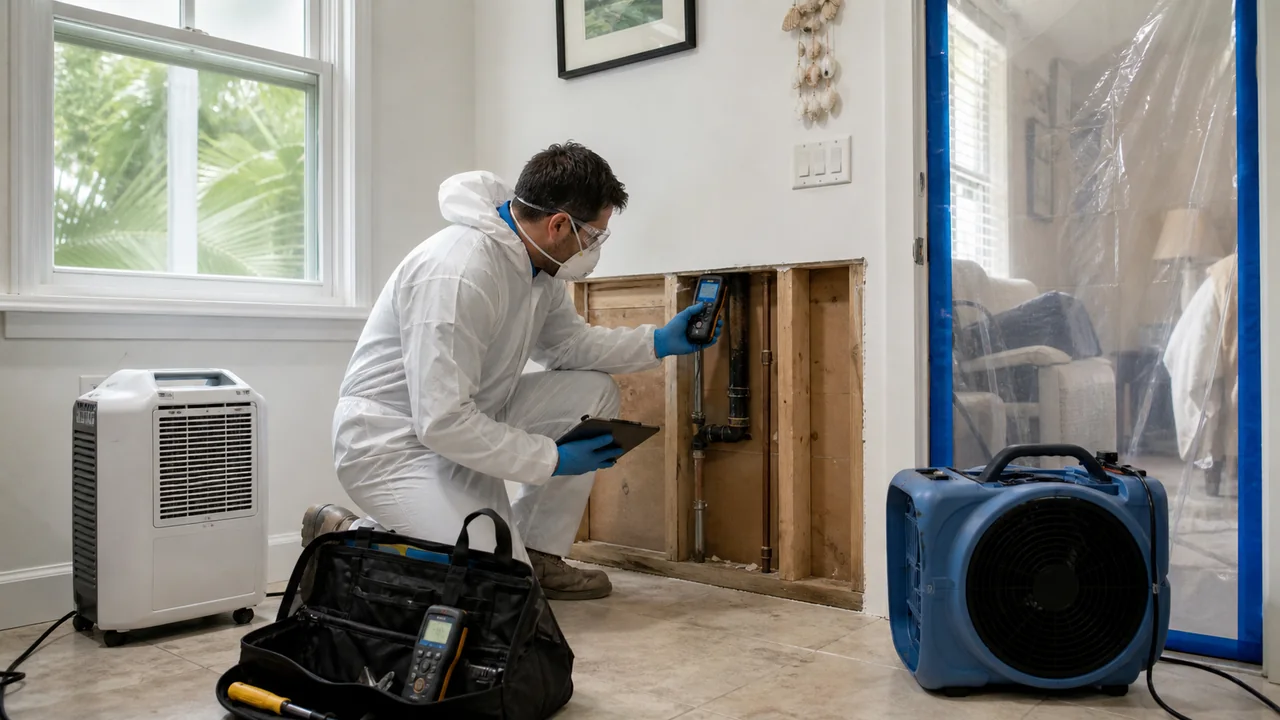
Visible mold is evidence of a moisture problem, not a reason to begin with an expensive air test or a coat of paint. Stop the water source, protect occupants, document the condition, and decide whether the affected area, material, contamination, and HVAC involvement require professional assessment and remediation.
Florida separately licenses mold assessors and mold remediators. State guidance also restricts the same assessor, company, or employee from remediating a structure it assessed within the previous 12 months, and applies the corresponding restriction in reverse. That separation should shape the hiring sequence before a property owner signs one bundled inspection-and-cleanup proposal.
For an active moisture or mold problem
Describe the source, area, materials, and urgency
Send photographs, when the condition began, active-water status, affected rooms, approximate area, HVAC involvement, and occupancy concerns. RealReviews will not pretend an unverified provider set is a ranked local list.
Local businesses compared
These are identity-checked local profiles, not paid placements. The fit notes describe differences supported by current official information; ratings shown remain attributed to their outside source.
- Model
- Florida Keys franchise advertising water, mold, fire, storm, and construction services with 24-hour response.
- Best starting fit
- A property owner seeking one dispatch conversation for emergency water mitigation and a separately verified mold-remediation scope.
- Why it is on this list
- The current corporate location page supports Florida Keys water and mold services; the RealReviews profile and local directory evidence associate the operation with Key West contact information.
- Confirm before booking
- The corporate page emphasizes Key Largo while other records reference Key West. Confirm the responding legal entity, actual dispatch area, individual Florida remediator license, insurance, and an independent assessor when assessment is required.
- Model
- Patriot's published Keys service menu pairs emergency water and mold work with fire, storm, reconstruction, and insurance-claim coordination; the company advertises round-the-clock response.
- Best starting fit
- Start here when the same loss may need a later rebuild, but ask for mitigation and reconstruction as two named scopes after the moisture cause and independent remediation protocol are known.
- Why it is on this list
- Its current official service pages identify water and mold restoration plus reconstruction work across the Florida Keys.
- Confirm before booking
- Official pages give inconsistent Big Pine Key and Marathon office details while the RealReviews record lists Key West. Resolve the contracting office, legal entity, service area, responding licensee, insurance, and assessor-remediator separation.
What to do during the first hour
Start with the hazard that can hurt someone now. Keep people away from live electrical risks, unstable material, sewage, and slick floors. Shut off the leak only if the shutoff can be reached safely. Then take wide photographs, note the discovery time, and call the trade that owns the source: that may be a plumber, roofer, HVAC contractor, building manager, restoration crew, or emergency service. A mold test is not a prerequisite for stopping known water.
EPA's useful clock is a drying target: wet or damp material should be dried within 24 to 48 hours when possible. It is not a countdown to a guaranteed mold event. A dry-looking floor can sit over a wet underlayment, just as an opened wall can expose damp insulation or framing after the room itself appears normal.
Leave suspected growth undisturbed while the response is being organized. A fan aimed through it, an operating contaminated air handler, or dry brushing can move material toward clean rooms. Limit entry and tell the responder if an occupant is medically vulnerable. A clinician—not the cleanup salesperson—should address symptoms.
- Protect occupants and identify electrical, structural, sewage, and access hazards.
- Stop the moisture source safely and begin drying without waiting for test results.
- Photograph the initial condition before demolition or broad cleaning.
- Limit disturbance and air movement from suspect areas.
- Escalate occupant health concerns to a healthcare professional.
The 3-by-3-foot rule has exceptions
EPA materials put the ordinary do-it-yourself dividing line at about 10 square feet—roughly a 3-by-3-foot patch. Cross that line and professional guidance is the safer default. Stay on the professional side even below it when the water was sewage or otherwise contaminated, the air-conditioning system is involved, moisture is hidden or recurring, porous damage extends beyond the visible patch, the structure is affected, or a vulnerable person occupies the property.
Material changes the answer. A hard, nonporous surface may be cleanable once the leak is fixed. Ceiling tile, insulation, carpet pad, and deeply affected wallboard can hold contamination through their thickness and may have to come out. Semi-porous assemblies require a closer look at depth and physical condition. Paint and caulk conceal a stain; they do not dry the assembly or remove growth.
A patch that returns in a Key West property is a source-tracing problem. Check the roof or window opening, plumbing, the air-conditioning drain and condensate path, humid-air entry, prior flooding, and what happened while the building was vacant. Blaming housekeeping without locating the moisture path leaves the repeat failure in place.
- Approximate visible area and number of rooms.
- Clean water, contaminated water, or unknown source.
- Porous, semi-porous, and nonporous materials affected.
- HVAC, wall cavity, ceiling, subfloor, or other hidden involvement.
- Recurring condition, vulnerable occupants, and structural concerns.
A mold sample needs a job
Visible growth ordinarily does not need a sample before the leak is corrected and the affected material is addressed; that is Florida Department of Health guidance. Nor is there a federal or Florida health number that declares a home's airborne mold count safe. A brief sample changes with weather, ventilation, timing, and collection method, and a list of familiar spores still does not locate the water.
Pay for a sample only after naming the decision it will settle. It may help investigate hidden growth where nothing is visible, resolve a disputed work boundary, test a written post-remediation criterion, or serve a medical or legal process directed by the appropriate professional. The proposal should say why each location and method was chosen, what control sample will be used, and how each possible result changes the assessment.
The useful deliverable is the assessment, not a laboratory page by itself. It should connect the visual inspection and moisture investigation to the affected materials, estimated boundary, known limitations, and—when remediation is warranted—a site-specific protocol. Evidence confined to one assembly does not support a boilerplate order to treat the entire building.
- Visible growth usually does not require sampling to justify moisture correction and cleanup.
- Every sample should answer a named decision question.
- Methods, locations, controls, limitations, and interpretation belong in the report.
- Assessment should connect moisture source, materials, boundaries, and remediation protocol.
Verify the individual licenses and the 12-month separation
Florida's mold program licenses individual assessors and remediators. A company name, franchise logo, general contractor license, restoration certification, chamber listing, or insurance claim relationship does not replace verification of the individual performing or supervising the regulated role. Search the current DBPR record, match the name and license type, and retain a dated copy.
DBPR states that a mold assessor, the assessor's company, and its employees may not perform remediation on a structure they assessed within the prior 12 months. A remediator, the remediator's company, and its employees face the corresponding restriction on assessment of a structure they remediated within that period. Ask about ownership, affiliates, subcontractors, referral fees, and shared employees rather than relying on two different brand names.
Florida mold licenses renew by July 31 in even-numbered years. Because publication is close to the 2026 renewal date, any named license must be checked when hired and refreshed after July 31, 2026. Also obtain current liability insurance and any separate contractor credential required for demolition, reconstruction, electrical, plumbing, mechanical, roofing, or structural work.
- Individual name, license type, number, status, and expiration.
- Company, employer, affiliate, subcontractor, and referral relationships.
- Assessor-remediator 12-month separation for the same structure.
- Current liability coverage and scope-specific contractor credentials.
- New verification after the July 31 even-year renewal deadline.
Read the protocol beside the contractor's quote
Put the assessor's protocol and the remediator's proposal side by side. If the protocol calls for a bedroom containment, removal of one wall assembly, protected contents, HVAC precautions, a cleaning sequence, documented drying, and independent verification, the proposal should show where each obligation is priced and performed. It should also identify the moisture finding, work boundary, pressure or air-control method when required, worker protection, equipment, disposal route, and completion test.
Circle every addition, omission, and assumption. Replace phrases such as “affected drywall as needed” with square feet of wallboard, linear feet of baseboard, named rooms under containment, equipment units and operating days, contents volume, disposal, and cleaning labor. Reconstruction belongs in its own allowance or proposal; it should not disappear inside the remediation total.
The contract also needs a discovery rule. If opening the wall reveals spread beyond the written boundary, the crew records it and stops at the agreed threshold. A material change in boundary or method goes back to the independent assessor before more demolition is authorized, rather than letting the contractor that benefits from added work redefine the project alone.
- Location, material, source, boundary, containment, and method.
- Contents, HVAC, demolition, cleaning, disposal, and documentation.
- Measurable quantities and equipment duration.
- Completion and post-remediation verification criteria.
- Independent review trigger for expanded hidden conditions.
Ask where the dust, exhaust, people, and contents will go
Walk the proposed route before work starts. The barrier should separate disturbed material from the clean side; if negative pressure is specified, ask how the crew will check it and where the exhaust terminates. Workers and bagged waste need an exit that does not cut through protected rooms. The amount of containment should follow the protocol, work method, affected area, and whether the property remains occupied.
In an occupied Key West home, comfort cannot override contamination control. Registers near demolition may need protection, and suspected system involvement requires qualified evaluation rather than simply running the air handler. Mark the crew entrance, work hours, noisy periods, usable bathroom or kitchen, pet location, emergency exit, and the condition that would require temporary relocation.
Contents need categories: unaffected and protected in place, cleaned in place, removed for cleaning, disposed with approval, or retained for insurance or owner decision. Photograph and inventory removed or discarded items. A broad disposal waiver should not replace item-level authorization for valuable or sentimental property.
- Barrier, pressure, exhaust, entry, and waste route.
- HVAC isolation or evaluation and occupied-area protection.
- Contents inventory, disposition, cleaning, and owner approval.
- Worker protection, communication, and daily condition checks.
- Emergency egress and safe property access.
Price the same measurable scope
A mold quote built from one total cannot be compared. Separate emergency water mitigation, assessment, sampling if justified, containment, demolition, cleaning, equipment and monitoring, contents, disposal, post-remediation verification, rebuild, permit work, storage, travel, and after-hours charges. Identify tax, deposits, payment milestones, cancellation, and change-order markup.
For illustration, a worksheet might contain $900 for assessment and protocol, $1,800 for containment and demolition, $1,200 for cleaning and equipment, $600 for independent verification, and $3,500 for reconstruction, totaling $8,000. Those are hypothetical comparison inputs, not a Key West market rate. Replace them with current, independently scoped proposals and actual quantities.
The insurer may request notice, photographs, mitigation records, estimates, or an inspection, but the contractor should not promise coverage. The owner should preserve the policy, claim communications, initial-condition evidence, moisture readings, invoices, discarded-material record, and payments. Emergency mitigation can proceed for safety and damage control while coverage and final reconstruction remain separate decisions.
- Assessment and justified sampling.
- Containment, demolition, cleaning, equipment, monitoring, and disposal.
- Contents, verification, reconstruction, permits, storage, and travel.
- Quantities, unit rates, equipment days, allowances, and change orders.
- Claim evidence without a contractor coverage guarantee.
Book the clearance visit before the walls are opened
The assessor's protocol should say what earns a pass before the remediator begins. The record may require proof that the source was corrected, the specified material was removed or cleaned, surfaces are visibly free of remaining dust and debris, containment held, and the assembly reached the stated dry condition. If sampling is part of the protocol, its pass criteria belong there too.
Arrange the independent visit while the containment and opened assembly can still be inspected—before barriers come down and reconstruction covers the work. A failed visit should produce an observed deficiency and a specific correction, not an invitation to buy another undefined treatment. Where the plan called for independence, the remediator does not certify its own work.
A pass closes this scope; it does not promise that the property can never grow mold again. Reoccupancy and rebuilding wait for the corrected source, required dryness, completed safety work, and any professional conditions in the report. Afterward, monitor the system that caused the loss, whether that was roofing, plumbing, condensate, ventilation, or flood entry.
- Written completion criteria in the assessment protocol.
- Independent verification before containment removal and rebuild.
- Moisture, visible cleanliness, scope completion, and sampling criteria if used.
- Specific correction list after a failed verification.
- Post-repair monitoring of the original moisture source.
After a storm, access comes before the dispatch promise
A crew's “24-hour response” does not override a Monroe County reentry stage, an unsafe road, or unavailable utilities. Once lawful access is restored, establish what entered the building: a clean supply-line release, wind-driven rain, groundwater or floodwater, sewage, or water that has sat long enough to be uncertain. That classification changes the safety precautions, material decisions, and cleaning method.
Take safe initial photographs, including water lines and affected rooms, but do not keep water in the building merely to perfect an insurance file. The daily record should show utility status, contents moved, material removed, moisture readings, equipment and monitoring, and disposal. A tarp or temporary opening closure is emergency protection; price the permanent roof or building repair separately.
Mold remediation may become one part of a larger restoration project, but its Florida license roles and independence still matter. Ask the project coordinator to identify which legal entity and licensed individual holds each scope. One branded truck can represent multiple subcontracted responsibilities.
- Lawful reentry and safe-access confirmation.
- Water-source category and affected-material record.
- Initial condition, mitigation, equipment, monitoring, and disposal evidence.
- Temporary protection separated from permanent repair.
- Named legal entity and licensed individual for every regulated scope.
Use the two current profiles as leads, not a ranking
RealReviews currently has two Key West-area profiles with enough identity and service evidence to name here: SERVPRO of Florida Keys and Patriot Disaster Specialist. That is not enough for a credible ranked local list, and neither profile replaces verification of the individual Florida mold licenses assigned to a job.
SERVPRO's corporate location material supports Florida Keys mold and water service, but its location language and other local records should be reconciled before assuming which office or crew will dispatch. Patriot's official pages support Keys restoration and reconstruction service, while its published office details vary. Ask both for the contracting legal entity, dispatch origin, responding assessor or remediator, license record, insurance, proposed scope, and independent verification plan.
A third company should appear only after its identity, current service area, individual remediator license, insurance, and official service model pass the same checks. A page padded with programmatic city names or an unrelated storm contractor would create more risk, not more choice.
- No rank order from two identity-checked starting points.
- Confirm contracting entity, crew, dispatch area, and individual licenses.
- Require assessor-remediator independence and written verification.
- Add another provider only after the same evidence gate.
Sources and verification
Rules and public requirements link to the responsible agency. Business-specific service claims are checked against privately retained official material, while public ratings remain attributed to their original source. RealReviews does not turn outside reviews into invented testimonials, blend unrelated platforms into a house score, or sell placement in these comparisons. Recheck licenses, availability, scope, and price before hiring.
Frequently asked questions
Do I need mold testing when mold is visible?
No, visible mold generally does not need sampling before moisture correction and cleanup. Testing should answer a defined question, such as suspected hidden growth, a disputed boundary, or written post-remediation criteria. Florida health guidance notes that no federal or state health standard defines a safe airborne mold number.
Can the same Florida company assess and remediate my mold?
No, not on the same structure within the restricted period. DBPR states that an assessor, the assessor's company, or its employees cannot remediate a structure assessed within the prior 12 months, and the corresponding restriction applies to a remediator performing assessment.
How much does Key West mold remediation cost?
Use $1,223 to $3,756 as a current national planning anchor, not a Key West quote; Angi's July 2026 data reports a $2,368 average. Key West proposals can move outside that band when concealed walls, HVAC, access, independent assessment or verification, contents, or reconstruction expand the measured scope. Compare those components separately.
When is a 10-square-foot mold patch not a DIY job?
Treat 10 square feet as a screening line, not permission. Even a smaller patch calls for professional help when sewage or another contaminated source is involved, growth reaches the HVAC system, porous damage or hidden moisture extends past the visible edge, the condition keeps returning, the structure is affected, or a vulnerable occupant is at risk. A capable owner may handle an isolated smaller area only after the clean-water source is fixed.
What does EPA's 24-to-48-hour drying target mean?
Begin drying immediately and aim to have wet or damp materials dry within 24 to 48 hours when possible. That EPA window is a response target, not a guarantee about the exact moment mold begins. Check the actual materials: wall cavities, underlayment, insulation, and other porous assemblies may remain wet after the exposed surface feels dry.
Whose Florida mold license should I look up?
Look up the individual who will assess or remediate the property—not only the franchise or contractor name. Match that person's license type, status, expiration, and employer, then confirm current insurance. Florida mold licenses renew by July 31 in even-numbered years; a credential saved before July 31, 2026 needs a fresh check after that date.
When should the independent clearance visit happen?
Schedule it after the remediation work is ready for review but before containment is removed or reconstruction conceals the assembly. The assessor should still be able to inspect dryness, visible cleanliness, and completion of the written scope, plus any sampling criterion the protocol required. A failed visit should name the deficiency and the correction needed.