
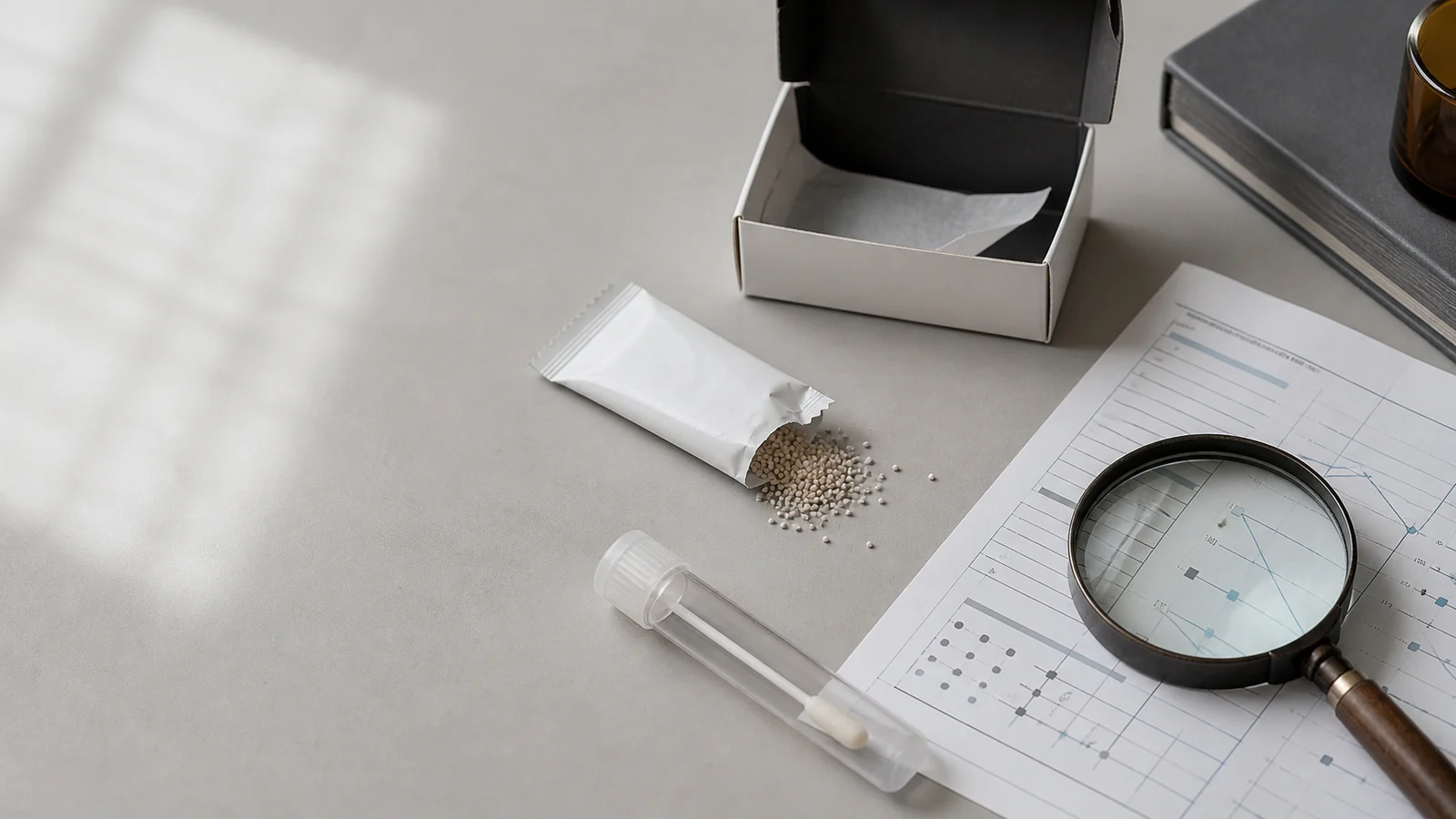
Rootine is no longer a normal shopping decision. The useful questions are whether the old program did what it claimed, what its small customer record actually shows, how its genetic and blood-data practices should be understood, and what a former customer or would-be buyer should do now. RealReviews did not use or clinically test Rootine. We inspected the operator's terms, privacy policy, FAQ, refund policy, science pages and discontinuation message; government and professional guidance; three scientific reviews; and 12 content-bearing customer or editorial bodies across seven eligible surfaces.
That record supports a narrower conclusion than many early reviews gave. Rootine's inputs were real and its delivery system was distinctive. Neither fact demonstrates that the finished algorithm improved a meaningful health outcome. The service then ceased to be available, turning availability, record access and data deletion into material parts of the present-day verdict. Historical prices and terms below are labeled as historical rather than presented as a live offer.
The short answer: clever system, unresolved evidence problem
Rootine scores 4.7/10, and the score is necessarily retrospective: its multivitamin and tests were discontinued in February 2025. Lifestyle answers, DNA and optional blood results made the program more substantial than a quiz-only packet, and reviewers liked parts of the experience. The missing piece is outcomes. We found no controlled trial of Rootine's finished program, while broader reviews of genotype-guided nutrition have not found consistent gains.
The 4.7 is not an average of the tiny Trustpilot and SmartCustomer samples. It comes from our weighted rubric, where direct clinical evidence carries the most weight because better individual fit was the reason for Rootine's premium. Traceable ownership, documented inputs and a practical interface add credit. Missing comparative outcomes, limited public proof about the finished packets and total loss of availability take more away.
The defensible part of Rootine's story is narrow but real. Lifestyle details, selected variants and optional blood values affected its recommendations. Some reviewers liked having those inputs in one dashboard and found the packets convenient, although the loose microbeads divided them. Neither point establishes that the complete algorithm improved health or that any benefit, side effect or satisfaction rate was typical.
February 16, 2025 is the cutoff that matters for availability. Rootine said it would take no more purchases of the reviewed multivitamin or tests after that date. Pages left online are not evidence that a checkout still works. The data record is less final: Rootine promised sample destruction and a route for deletion requests, but a published policy cannot confirm what happened to every derived file and backup.
An old customer has two practical chores. First, save reports that may be worth discussing with a clinician. Second, decide whether to ask Rootine for written deletion confirmation. A measured deficiency should not be handled by rebuilding an expired subscription. If another personalized service is under consideration, inspect the biomarkers, the person interpreting them, visible doses and finished-lot tests, the full-year bill, deletion mechanics and account closure. Looking like Rootine proves very little.
Documents behind the 4.7 verdict
Can you still buy Rootine? No verified offer remains
No current Rootine Smart Multivitamin or testing offer could be verified. Rootine's archived email named February 16, 2025 as the last purchase day and said both services were being discontinued. Old product, policy, and science pages remain accessible, but that shows only that the pages survived. It does not show that Rootine can take an order or fulfill one. Until the company publishes a dated relaunch with a working checkout, these pages are historical records.
The shutdown message was specific. Rootine said the Smart Multivitamin would end “as it is made today,” testing services would also end, and the brand expected to keep selling adaptogen drink mixes while developing other products. That is why a Rootine website can coexist with a discontinued Rootine vitamin program. A company may still exist and its FAQ may still load without the reviewed SKU being available. Only a real, current checkout would change the status of this review.
We would change that status only on evidence of a new offer, not on a rediscovered page. At minimum, Rootine would need a dated announcement naming the formula and service area, an official checkout with the entire price and renewal timing, a credible fulfillment estimate, and terms, refunds, privacy language and support contacts written for the new product. Former customers would also need an account notice about old formulas, tests and stored data. Any revived efficacy case would have to rest on current finished-product and recommendation evidence.
Leftover packets would not solve the problem. Each formula belonged to a particular customer, and Rootine's terms treated the customer's results and combinations as personal. A reseller cannot answer whose doses are in a packet, how it was stored or whether it has expired. We therefore treat the old pages as historical evidence and the product itself as discontinued.
The shutdown record
Did Rootine work? The inputs were plausible; the program was not proven
Rootine could deliver nutrients in customized doses. The missing piece is evidence that its complete program improved health outcomes more than ordinary nutrition care or targeted supplementation. Gene–nutrient relationships can be real, and a measured deficiency can matter, but neither fact validates Rootine's proprietary algorithm. Our search found no controlled, peer-reviewed trial of the finished program. Systematic reviews of genetic-information-based personalization report inconsistent benefits.
The evidence gap opens after the test result. A lab can read a variant or blood marker accurately without proving that it predicts the right dose for this person. And a dose can be logically connected to that result without improving a meaningful outcome. Rootine described its measurements and some of the reasoning that linked them to recommendations. What we did not locate was a controlled trial showing that the whole chain—from Rootine test to Rootine dose—helped people without avoidable harm.
A 2021 Academy of Nutrition and Dietetics consensus report reviewed 12 randomized trials and called the available evidence weak and insufficient to determine the effects of incorporating genetic testing into nutrition practice. A broader systematic review of nine randomized personalized-nutrition trials found no consistent improvements across dietary, physical-activity and health outcomes. Those conclusions do not mean genes never matter. They mean a commercial service must prove its specific leap from association to recommendation.
A scientific review of genotype-based supplementation describes plausible and sometimes important gene–nutrient relationships, particularly in rare inherited disorders. Rootine was a general consumer wellness service, not a specialist metabolic clinic. Evidence for a rare disorder or a specific variant cannot validate every ordinary-wellness dose in a proprietary 19-nutrient formula. The relevant comparator is also important: a person with low vitamin D may benefit from correcting it, but that does not show DNA-guided packets outperform clinician-directed vitamin D.
What would have changed this conclusion
- A preregistered, peer-reviewed trial of the finished Rootine program against a credible comparator.
- Predefined clinical or validated biomarker outcomes, not only satisfaction or adherence.
- Enough participants and follow-up to detect benefit, nonresponse and adverse effects.
- Published algorithm rules or an auditable method showing how evidence grades changed each dose.
- Independent replication and subgroup analysis that did not treat every genetic association as equally actionable.
Research used for the efficacy judgment
What Rootine actually personalized
Rootine used three kinds of information: an online lifestyle questionnaire, DNA data, and optional blood-nutrient results. Customers could buy Rootine tests or upload certain existing files and values. The program turned those inputs into nutrient choices and microbead doses packed by day; some recommendations could change when a customer added new blood results. That was real formula-level customization. The evidence does not show that this proprietary bundle beat a cheaper, clinically targeted approach.
What each input contributed
| Factor | What it described | Important limit |
|---|---|---|
| Lifestyle questionnaire | Age, weight, diet pattern, habits, and other self-reported context | Answers change and remain subjective; the quiz could not measure a deficiency |
| DNA | Selected inherited variants connected with nutrient handling | Predisposition is neither current nutrient status nor a diagnosis |
| Blood | Selected nutrient values from a Rootine test or an uploaded result | One small panel at one point in time still needs clinical context |
| Rootine algorithm | Turned the inputs into nutrient selections and microbead doses | Public materials did not expose every threshold or evidence grade for audit |
Rootine did not merely sort a quiz taker into a prebuilt packet. It could alter the amount of a nutrient, and its FAQ said customers could update certain blood values after enrollment. The formula therefore had a route to change with new information. That feature had practical value to at least some users: when Rootine shut down, former customers asked specifically for another service willing to use laboratory results.
The fine-grained dose did not make the underlying judgment equally exact. Blood concentrations change; questionnaire answers can be mistaken; genetic associations differ sharply in strength and effect size. The missing audit trail is what matters here. Public materials did not let us follow one input to one dose change, see the evidence grade behind it, learn when Rootine would refer a customer for clinical care, or observe how the system reconciled conflicting inputs.
Rootine's own descriptions used in this reconstruction
The Rootine DNA test supplied context, not a diagnosis
Rootine used the DNA test to add inherited-variant information to its formula and dashboard, and it sometimes accepted compatible raw files instead of a new swab. SelfDecode counted roughly 50 variants, which makes this a selective panel rather than a broad genetic analysis. None of those variants diagnosed a deficiency, measured nutrient status on that day or demonstrated that a changed dose improved an outcome. An upload also created a lasting privacy choice because genetic data cannot be replaced like a password.
The customer-facing procedure was a cheek swab sent to a laboratory, followed by results in the dashboard. Owners of some 23andMe or Ancestry files could upload those records instead. Rootine connected its chosen variants with nutrient absorption, distribution, metabolism and excretion. In SelfDecode's assessment, bringing DNA and blood information together was useful, while the number of variants and blood markers remained limited.
A variant may justify looking more closely at a pathway. By itself, it cannot say that a person is deficient now, that a higher dose is safe or that supplementation will improve a symptom. The Federal Trade Commission draws the commercial line at the product level: a seller making clinically proven claims needs sound studies of the actual kit and results that matter to consumers. Evidence about one variant does not validate Rootine's full recommendation.
Questions a DNA-based vitamin service should answer before upload
- Which variants are examined, and what evidence grade and effect size support each action?
- Does ancestry or population underrepresentation limit interpretation?
- Can the user download raw and interpreted data before account closure?
- Which laboratories and processors receive identifiers or samples?
- How are the physical sample, derived data, backups and legally retained records deleted?
- What happens to data if the product, company or laboratory relationship ends?
DNA-test sources
What did the Rootine blood test measure?
Rootine's finger-prick Vitamin Test measured B6, folate, B12, and vitamin D3 according to its FAQ, and the dashboard could also accept a broader set of manually entered laboratory values. Blood data was more directly tied to current status than DNA alone, but four markers do not replace a clinical evaluation. Abnormal results, symptoms, medication interactions, pregnancy, kidney disease, or high-dose plans belong with a qualified clinician.
Rootine said the finger-prick test was analyzed at a CLIA-certified, COLA-regulated laboratory and that repeat values could be plotted in the dashboard. It also listed a broader group of values that customers could enter from a physician or outside laboratory, including iron, magnesium, calcium, zinc and several vitamins. The product appeal was feedback: a new result could alter a subsequent formula rather than remain a static PDF.
Laboratory certification and clinical utility answer different questions. Certification provides important operational assurance about laboratory processes. It does not establish that Rootine's target range, dose change or complete subscription improved outcomes. A small home panel can also miss causes of symptoms that are unrelated to the measured nutrient. The company terms appropriately described results as informational and not a clinical diagnosis or treatment decision.
A current alternative should disclose specimen type, analytic method, marker list, reference interval, measurement limits and the credentials of whoever interprets the result. It should also have a plan for a dangerously high or low result. A dashboard that quietly converts every number into a supplement dose risks turning a medical boundary into an ecommerce setting.
What we checked for the blood-test account
The packets traveled well; the beads took practice
Rootine's daily packet cut down on bottles and fit easily in a bag. Swallowing the tiny beads was another matter. One tester needed several pours and swallows, then about a week before the routine felt normal; a second review warned that some people would struggle with the format. Microbeads allowed flexible amounts, but we found no public comparison verifying better absorption than an ordinary formulation.
The Who What Wear account is especially useful because it describes the awkward part. The questionnaire and swab were straightforward, and the packets traveled nicely. The tester poured the granules more than once per dose and needed multiple swallows at first. Neutral taste and a helpful dashboard were positives. After one month, though, there was no reported dramatic change. That tells us about onboarding, not efficacy.
1AND1 Life liked the custom dosing and still called out the swallowing problem. More importantly, its review acknowledged that independent research had not shown DNA- and lifestyle-personalized vitamins to outperform a generic formula. The five-star headline describes that publication's overall take; it cannot turn the article into a clinical trial.
Rootine promoted slow release and spatial separation as ways to mimic food and improve absorption. Those are testable product claims. The search located descriptions of the mechanism but no comparative human pharmacokinetic or clinical study of Rootine's finished microbeads against a conventional product. Flexible dosing and portability remain defensible advantages; enhanced absorption remains insufficiently verified.
What we checked about the packets
Rootine's historical cost: $69 a month before testing
SelfDecode's dated March 2023 capture priced Rootine vitamins at $69 per month with a three-month purchase. Tests added roughly $99 to $178, depending on the option. These numbers describe the old offer; they are not a current quote. Rootine's terms imposed at least a three-month initial commitment and recurring billing. The multivitamin and tests ended in 2025, so a page that still repeats those prices is not proof that anything can be ordered.
What the old first cycle could cost
| Factor | Dated amount or term | Decision consequence |
|---|---|---|
| Vitamins | $69 per month in SelfDecode's March 2023 record | At least $207 for the required three months, before any test |
| Testing | About $99 to $178 in the same dated record | The first cycle could cost substantially more than the vitamin packets alone |
| Renewal | The terms described recurring monthly or annual charges | Cancellation had to happen before the next term |
| Today | The multivitamin and tests ended in February 2025 | None of these old amounts is a live price |
Value looked different depending on the job. A person with a known deficiency could compare the total with a clinician visit, the relevant laboratory work, and a targeted product. Someone who simply wanted dietary insurance could compare it with a cheaper multivitamin that publishes its full label and independent quality verification. Rootine's dashboard was genuinely useful. At this price, though, a polished record of recommendations needed to deliver more than a feeling of precision.
A monthly figure by itself hides the test charge and the minimum term. It also becomes misleading when an old sale price is copied years later. Rootine's terms document the recurring charge and initial commitment; SelfDecode provides the dated price reference. We found no current amount worth quoting because we could not verify a current Rootine order path.
Records for the historical price and subscription term
Why an old cancellation could be due a month early
Rootine's old FAQ required a cancellation through the dashboard or by email at least 30 days before the next three-month term. Personalized vitamins became nonrefundable once production started, while DNA and blood tests crossed the same line after the customer returned them. Those dated rules may explain a historical charge; they do not supply a remedy today. A former customer should preserve the receipt, the policy that applied and the complete support correspondence.
In practical terms, the buyer assumed the fit risk early. The vitamin formula was already locked out of a refund when production began, before the customer could live with the finished routine. Returned test kits were likewise committed. And because notice was due 30 days before a three-month term ended, the real decision date arrived well ahead of the next shipment.
Evidence to assemble for an unresolved historical transaction
- Order confirmation, amount, subscription cadence and the checkout terms saved at purchase.
- Card statement, shipment tracking and the date production or test return occurred.
- Cancellation or refund request with timestamp, account email and company response.
- Any promise about service continuation, formula delivery or data deletion made directly to the customer.
- A copy of the policy version that applied on the transaction date, not only the currently accessible archive.
These materials help distinguish nonrefundable personalized production from an unfulfilled or incorrectly billed order. RealReviews cannot decide an individual contract or payment dispute. A former customer with a material unresolved charge should use the written company channel first and then the dispute route available through the payment provider or applicable consumer authority, observing any deadline.
The old cancellation record
Former customers should ask Rootine what data remains
A former customer who wants deletion should ask for it in writing and save the confirmation. Rootine's privacy policy said users owned their genetic information, physical samples were destroyed after analysis, data would not be sold, and genetic and personal information would be removed within 30 days after an account-termination request, except where law required retention. The terms also permitted results to be used for research, validation, commercial, and educational purposes within the privacy policy's confidentiality limits.
The policy identified personal details, lifestyle answers, payment information, DNA-derived information, uploaded test results and blood data. It said relevant information could be shared with laboratory and service partners to deliver the product, with confidentiality requirements. The FAQ further described coded samples, separated data sets, controlled access and sample destruction. Those commitments were meaningful, but they were company representations rather than an independent security audit available in the reviewed record.
The terms deserve equal attention. They said results could be used for research, test validation, commercial and educational purposes while remaining confidential under the privacy policy. FTC guidance warns genetic-testing companies to put uses and deletion limitations where consumers can understand them. Health data held by a consumer service also should not be casually described as HIPAA-covered; FTC tools explain that data in an app outside a covered entity or business associate may fall outside HIPAA.
A precise former-customer deletion request should cover
- The Rootine account and identifying personal information.
- Any uploaded raw DNA file and Rootine-derived genetic results.
- Blood-test results, manually entered laboratory values and lifestyle questionnaire answers.
- Whether the physical sample was destroyed and when.
- Which records must be retained by law, which processors received data and when backups expire.
- Written confirmation when deletion is complete, saved outside the Rootine account.
A former user may first want a copy of the reports for a clinician. Export and deletion are separate actions, and deleting first could remove information the user intended to retain. Genetic information is persistent and relevant to biological relatives, so a new service should receive it only after the buyer understands its evidence, access controls, secondary uses, breach obligations and shutdown plan.
Privacy sources
What did Rootine customers and testers repeatedly say?
The small historical body favored the convenience of testing, one dashboard, and portable daily packs. The repeated negatives were premium cost, a three-month commitment, polarizing microbeads, and doubt that personalization produced a measurable advantage. Trustpilot displayed only one review, so its positive score is not meaningful consensus. Across 12 inspected bodies, experience evidence was useful for usability and value questions, not for an efficacy rate.
Outside ratings
| Source | Rating | Reviews | Checked |
|---|---|---|---|
| Trustpilot | 3.7/5 | 1 | 2026-08-17 |
| SmartCustomer | 5.0/5 | 1 | 2026-08-17 |
Ratings are reported exactly as displayed by the named platforms on the capture date. RealReviews does not average, rescale or treat one-review profiles as representative.
Consensus coverage
moderate confidence. We coded 12 content-bearing bodies across 7 eligible sources. Product specificity was high.
Eligible: Trustpilot, SmartCustomer, Who What Wear, SelfDecode Labs, 1AND1 Life, Reddit r/Supplements, Reddit r/HubermanLab.
- Excluded Rootine founder testimonial — An executive's first-party account cannot stand in for independent customer evidence.
- Excluded ExpertBeacon — We excluded its unsupported superlatives and conflicting historical price statements.
- Excluded Greenlit Content — Its personal biomarker and outcome claims did not have transparent provenance.
What reviewers repeatedly said
Recurring positives: Testing, questionnaire data and recommendations were conveniently combined in one dashboard; At-home collection and portable daily packs were easy to fit into a routine; Some users valued dose changes after adding new information.
Recurring negatives: Microbeads were polarizing and could be less convenient than a pill; Test costs, monthly price and a three-month commitment weakened value; Reviewers repeatedly questioned whether algorithmic precision produced better outcomes.
Counterexamples retained: The only Trustpilot body was wholly positive; One editorial tester liked the experience without noticing a clear short-term effect; A negative former-user comment also promoted a competitor and received reduced weight; Shutdown posts show that some users valued lab-based personalization enough to seek a close replacement.
The 12-body sample is small, self-selected, mostly historical, and useful for usability and value themes only. It cannot establish clinical efficacy, safety or population-level complaint rates.
Who What Wear supplied the clearest first-person routine account: easy questionnaire, simple cheek swab, informative dashboard, portable packs and a learning curve for swallowing loose beads. SelfDecode supplied the clearest feature-and-limit audit: real DNA and blood inputs, but relatively few markers, United States availability and a high total price. The 1AND1 review explicitly separated customization appeal from missing independent outcome evidence.
Reddit was less tidy than the edited reviews, which made weighting important. A self-described former user criticized the beads and minimum commitment while also promoting a competitor; we kept the experience but reduced its weight. Two posts from 2025 asked for a replacement that could use blood work. That does not prove satisfaction, but it does show that the laboratory-input feature mattered to those posters. A separate thread challenged repeated promotional behavior. We recorded it as an authenticity caution only, not as evidence that Rootine itself had done something wrong.
The platform numbers are too small for claims about what customers usually experienced. Trustpilot showed a 3.7 trust score but only one review, and that review was five stars; the platform score is not simple star arithmetic. SmartCustomer also had one positive body. Two positive submissions do not amount to overwhelming support. They sit beside the detailed editorial accounts and Reddit discussions, and the conclusion stays limited to the themes that recur across that small set.
The seven places behind our consensus account
Do not replace Rootine until you name the job
There is no single Rootine substitute. Someone following up an abnormal result or a possible medicine interaction needs clinical interpretation, not a look-alike subscription. Someone seeking ordinary dietary insurance may be better served by a less expensive multivitamin with sensible doses, a complete label and independent quality verification. Only a buyer who truly needs data-driven adjustments should consider another personalized service, and then the algorithm, human oversight, testing, annual cost, exit terms and deletion process all matter.
For symptoms or an abnormal laboratory value, begin with a qualified clinician and the follow-up suited to that finding; causes, interactions and dose cannot be separated from clinical context. For basic dietary insurance, paying to maintain sensitive data may add burden without adding value. Appropriate doses, a transparent label and credible quality verification are the more relevant comparison points.
A new personalization company deserves scrutiny at the points where Rootine's record was weakest: which biomarkers actually change a recommendation, what evidence supports the algorithm, who reviews unusual results, and whether finished lots are tested. Old Rootine reports present a separate choice. Export anything that may help with continuity of care, then decide what personal or genetic data to ask the former service to delete.
This choice still sits inside ordinary supplement safety. FDA warns that supplements can interact with medicines, interfere with laboratory tests and cause problems around surgery, which is why a doctor, pharmacist or other health professional may need to be involved. NIH notes that multivitamin formulas differ widely, cannot replace a varied diet and have not reliably prevented chronic disease. Those cautions narrow what a replacement can reasonably promise; they are not a claim that every supplement is useless.
Before paying, identify the legal operator and confirm that the service is actually available. Ask which biomarkers are relevant to the decision, who interprets them and what happens when a result is abnormal. The product record should expose doses, ingredients, lot identity and finished-product quality work. The contract should expose the full annual price, test fees, renewal cadence and refund limits. The privacy record should cover access, secondary use, breaches, deletion, export and what happens to essential records when the account closes.
We are not naming a universal winner here because doing so without a separate current investigation would simply move Rootine's old marketing problem to another brand. A candidate first has to match the person's reason for buying; it then has to survive the evidence, privacy, quality, price and exit questions above. A polished interface and credible laboratory partner are useful, but neither one supplies missing outcome evidence for the finished recommendation.
Replacement-decision sources
Final verdict
Rootine's best case was its process: a traceable company gathered unusually varied inputs and organized them well. The public record never closes the loop from that process to a better health outcome. Add limited finished-product quality proof, a very small customer record, difficult old terms and a product that can no longer be bought, and 4.7/10 is where it lands. Former users should save useful reports and make an explicit decision about deletion. A replacement should earn trust on evidence, privacy, total cost and the ability to leave.