
Independent Key West electrician guide
Key West Electricians Compared: Repairs, Panels, Generators, Permits, and Quotes
Compare genuine Key West electrical contractors by verified identity, license evidence, service model, emergency path, generator and EV capability, permit handling, and estimate detail.
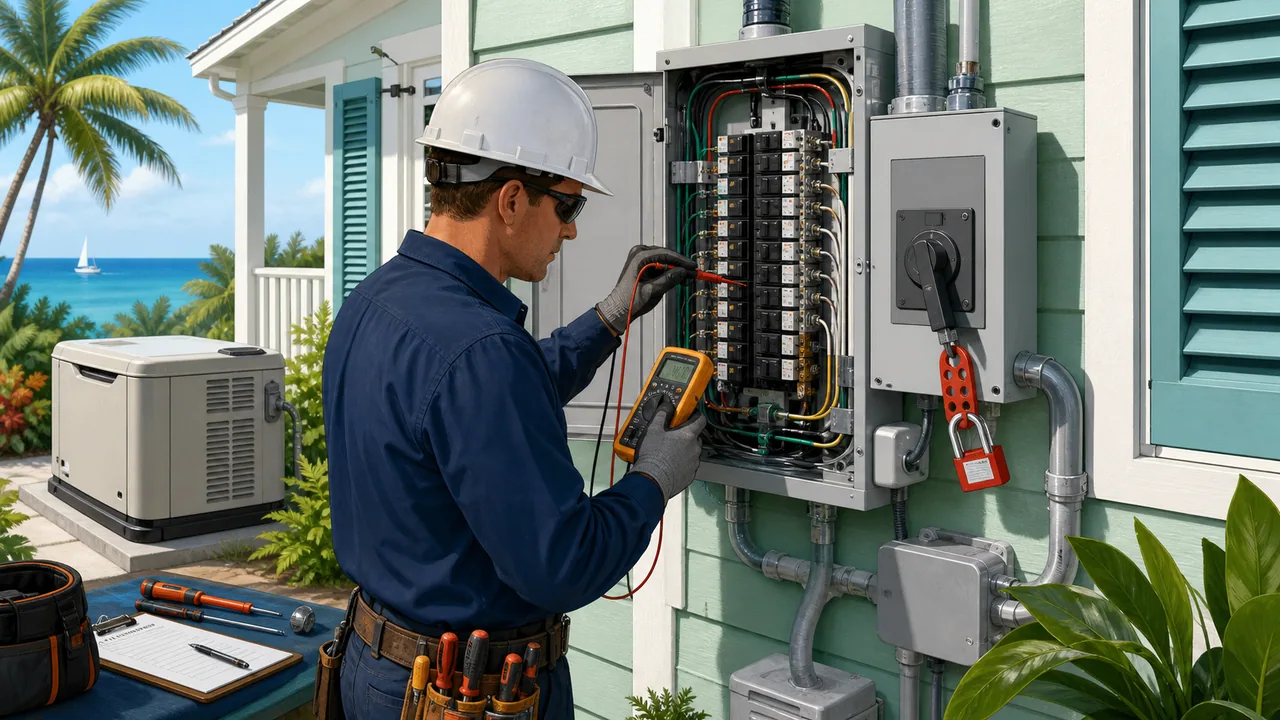
A hot panel, a dead restaurant circuit, a standby generator, and a historic-home renovation should not go to the same shortlist by default. Apollo Electric Solutions publishes the broadest electrical-only mix for residential, commercial, government, industrial, EV, and waterfront lighting work. Check Electric publishes the clearest troubleshooting, generator, low-voltage, thermal-imaging, locating, and bucket-truck menu. Florida Keys Electric publishes the strongest long-established construction, industrial, fire-alarm, security, and data-network model. One Call Construction makes more sense when electrical work is one part of a renovation, damage repair, or coordinated multi-trade project.
The apparent Key West electrician inventory is much larger than the usable contractor set. Utilities, electrical-supply stores, public charging stations, golf-car rentals, marine services, and appliance companies had been categorized beside licensed contractors. RealReviews removed those obvious mismatches from this comparison. The three companies below have a resolved Key West identity, an official source, a crawlable RealReviews profile, and a supported reason to call.
Repair, panel, generator, EV charger, lighting, or renovation
Tell us what lost power—or what you are adding
Open with one useful sentence: “The kitchen circuit trips when the oven starts,” or “We need a 48-amp charger at the rear wall.” Then add the address, occupancy, panel photographs, heat, smoke, water, or outage conditions, and any plan or permit already in hand. A contractor still must confirm the responding crew, license, availability, and price.
Local businesses compared
These are identity-checked local profiles, not paid placements. The fit notes describe differences supported by current official information; ratings shown remain attributed to their outside source.
- Model
- Apollo is the electrical-only option with the widest published range in this group. Its Key West material covers homes and businesses, government and industrial work, EV charging, low voltage, dock or seawall lighting, and a separate emergency-contact path.
- Best starting fit
- Broad electrical contracting, EV charging, waterfront lighting, commercial or government proposals, and owners who want an electrical-first company with a documented Key West office.
- Why it is on this list
- Apollo publishes 14 Aquamarine Drive, 305-708-2782, a separate proposal email, emergency text instructions, and a one-year work-and-parts warranty claim. Monroe County's June 2026 active register lists Apollo Electric Solutions LLC, Anthony Osvaldo Paolucci, and EC13010585.
- Confirm before booking
- The site is marketing-heavy and repeats several claims. Confirm the accepted scope, assigned crew, actual emergency availability, permit responsibility, product or charger authorization, schedule, exclusions, and exact written warranty.
- Model
- Check Electric has the troubleshooting-heavy menu in this group. Beyond ordinary residential and commercial work, it publishes generator, fire-alarm, controls, low-voltage, thermal-imaging, locating, and bucket-truck capabilities.
- Best starting fit
- Put it on the first-call list when diagnosis, generator work, low voltage, or elevated access could change which crew and equipment must arrive.
- Why it is on this list
- Two records line up. Check Electric publishes 3255 Flagler Avenue Suite 303, 305-292-3369, weekday hours, emergency service, and EC13004515. DBPR ties that number to Karel Bublak and Check Electric LLC; it lists the Certified Electrical Contractor license as Current, Active through August 31, 2028.
- Confirm before booking
- Give dispatch the symptom in plain language: what failed, whether the breaker tripped, and whether heat, smoke, or water is present. Then ask what crew and test gear that call needs and what the visit costs. Generator owners should name the brand and confirm authorization, permit ownership, and warranty terms.
- Model
- A 1988 corporate filing and the company's current project portfolio point toward construction and building systems, not just a van dispatched for small repairs. Published work covers residential, commercial, and industrial electrical scopes plus maintenance, low voltage, fire alarm, security, and data networks.
- Best starting fit
- Its published history and systems portfolio are most relevant to a substantial buildout, industrial job, fire alarm, security system, or structured-cabling scope.
- Why it is on this list
- The corporate trail reaches back to June 1, 1988, when Sunbiz records the active corporation's filing. The company gives 905 Overseas Highway and 305-296-4028; DBPR currently associates Raymond Vazquez and EC0002558 with the business and shows the certified license Active through August 31, 2028.
- Confirm before booking
- That record says little about today's small-repair calendar. Ask whether the company is taking the job, who would lead it, and how power, alarm, data, and security work divide into separate permits, inspections, and prices.
- Model
- One Call is the multi-trade choice. It combines design-build, renovation, restoration, and repair work and publishes electrical registration ER13015186 beside its roofing, plumbing, HVAC, and general-contracting credentials.
- Best starting fit
- Consider it when a renovation, damage repair, historic project, or permit closeout needs the electrical scope sequenced with other trades.
- Why it is on this list
- One Call identifies its office as 1901 Flagler Avenue and publishes 305-294-0945. Its license page assigns ER13015186 to electrical work and displays separate identifiers for roofing, plumbing, HVAC, and general contracting.
- Confirm before booking
- For one failed outlet, the multi-trade structure may add no value. On a coordinated job, require the proposal to name the electrical qualifier and installer, price electrical work separately, identify the license used for each trade, and assign each warranty and change order.
Start with the electrical failure or project, not the star count
Imagine a restaurant employee reports smoke at a panel after water reached the wall. That is not a quote request. Keep people clear, call 911 when fire or immediate danger exists, and report the exact room, what was seen or smelled, whether anyone felt a shock, and where the water came from. Leave the cover closed. Do not touch wet equipment, improvise a bypass, or use an extension cord as permanent wiring.
Now take a Conch house with one dead bedroom, no odor, heat, arcing, shock, or water. Record what stopped working, the time, the breaker position, and the appliance or recent work that preceded it. If one reset trips again, stop resetting. Look outside before calling: dark neighboring properties suggest a utility problem, while one dark room points the electrician toward the building. Those observations make a diagnostic dispatch useful without pretending to diagnose the fault yourself.
An EV charger, range, heat-pump water heater, HVAC system, pool pump, sign, dock light, commercial appliance, or tenant buildout starts with a different packet. Send the model and electrical data, panel and service photographs, the mounting point, expected use, and a marked route with distance. For a renovation or service change, add drawings, occupancy, historic status, other trades, shutdown windows, permit and inspection status, and the required completion date. Bidders can then explain capacity, circuit, controls, trenching, utility work, access, and trade dependencies instead of pricing an unnamed load.
Use current cost data as a planning anchor, then compare the complete local scope
Current national data is useful for detecting an incomplete quote, not for declaring a Key West price. Angi's 2026 dataset places a typical electrician service-call fee around $100-$200 for the first hour, ordinary labor around $50-$130 per hour, minor work around $150-$600, and more complex work around $2,000-$10,000. It also reports that emergency callouts commonly add $100-$200 and may double the normal labor rate. Ask for the Key West company's actual dispatch fee, included time, minimum, hourly or flat-rate basis, after-hours premium, travel, equipment, permit, and cancellation terms before the truck moves.
For panel replacement, Angi reports a broad 2026 national range of $518-$2,191, with totals reaching about $4,500 when capacity, relocation, wiring, or related work expands. That range does not include a universal Key West assembly. A comparable panel proposal identifies existing and proposed amperage, manufacturer and model, main and branch devices, surge protection, grounding and bonding, meter or service work, circuit corrections, labeling, load calculation, utility coordination, permit, inspection, outage window, wall access, restoration, and exclusions.
For a standby generator, Angi reports an average installation component around $4,520 and a broad whole-project range extending from roughly $1,516 to $8,811, with larger systems costing more. Key West's checklist requires a site plan, generator specifications, installation guidance, platform details when applicable, valuation, scope, and fuel-tank compliance. Compare generator capacity, selected loads, transfer equipment, load management, pad or elevation, fuel work, electrical work, startup, testing, permit, inspection, manufacturer commissioning, maintenance, and warranty—not the generator box alone.
Verify the qualifier, license classification, business, and local registration
A company name containing electric is not proof of contracting authority. Florida DBPR lets users search by person, business, and license number. Confirm the individual qualifier, license type, status, expiration, and related qualified business. Compare the qualified business with the legal entity on the estimate, permit, insurance certificate, payment instructions, and warranty. A supplier, utility, employee card, charger operator, or unrelated namesake does not satisfy that chain.
Apollo and Check Electric appear in Monroe County's current active-contractor register under Certified Electrical Contractor classifications. Apollo is listed with Anthony Osvaldo Paolucci and EC13010585; Check Electric is listed with Karel Bublak and EC13004515. The register explicitly says it helps identify active registered contractors and is not a county recommendation. Use it as current registration evidence, then open the DBPR record and verify the same entity before signing.
One Call publishes ER13015186 rather than an EC identifier on its official license page. Registered and certified classifications do not have identical geographic authority. Ask the company to identify the exact electrical license and qualifier that will pull the permit at the Key West address. For every finalist, request current general liability and workers' compensation evidence issued to the contracting entity and appropriate to occupied residential, commercial, waterfront, or construction work.
Put Key West permits, HARC, utility work, and shutdowns on the estimate
Key West states that a permit is generally required before permanent or temporary work valued above $1,000 including labor and materials, at the building official's discretion, and for structural changes regardless of value. Electrical requirements turn on the actual scope. A like-for-like service repair, a new circuit, a panel or service change, a generator, a remodel, and temporary construction power should not be assumed to share the same application or inspection path.
The city no longer accepts incomplete permit packages. Require the proposal to assign the applicant, scope, valuation, plans or diagrams, equipment documents, fees, review responses, utility coordination, inspections, corrections, and final approval. A permit allowance without the required design or product documents is not a complete permit scope. If the project changes exterior equipment, penetrations, conduit, lighting, generator placement, service equipment, or visible work in the Historic District, identify whether HARC review is required before ordering products.
Power interruption belongs in writing. For a panel, meter, service, generator transfer equipment, restaurant, hotel, medical office, occupied rental, or multi-unit building, define who coordinates the utility and property manager, notice to occupants, shutdown duration, temporary power limits, refrigeration or life-safety needs, alarm and access systems, testing, and restoration. Do not let a promised one-day installation erase permitting, utility scheduling, hidden corrections, or inspection dependencies.
Make the estimate explain diagnosis, design, access, restoration, and testing
A service estimate should separate dispatch, diagnosis, immediate safe correction, permanent repair, optional improvement, and work by others. Require the observed condition, tests performed, proposed correction, materials, labor basis, permit decision, outage, cleanup, and warranty. If the electrician recommends replacement instead of repair, ask what measurement, damage, capacity, obsolescence, code condition, or manufacturer issue supports it. A photograph and model number make a second opinion more efficient.
Two bids can name the same panel and still describe different jobs. On the drawing or scope sheet, trace each new or changed circuit through its conductor and raceway or cable method, breaker or disconnect, control, fixture, receptacle, equipment connection, trench, penetration, and firestopping. Then find the access allowance: demolition, wall or ceiling openings, patching, paint, concrete, landscaping, roof work, and waterproofing. The closeout line should cover labels, testing, inspections, and the handoff. Data, alarms, fuel work, programming, and other trades belong either in the price or on an exclusions page; if they are absent from both, the totals are not comparable.
For EV charging, obtain the charger model, continuous load, circuit size, panel and service capacity, route, mounting, outdoor or flood exposure, networking, load management, permit, inspection, and commissioning. For generators, obtain the load calculation, selected circuits or whole-service strategy, transfer switch, load shedding, starting loads, fuel coordination, pad or elevation, exhaust and clearance, startup, testing, maintenance, and warranty. For dock or seawall work, define marine exposure, mounting, penetrations, controls, and the authority responsible for the exact waterfront scope.
Read reviews by job type and interview references about the same risk
The outside ratings displayed on RealReviews remain attributed to their named platform; they are not RealReviews scores. Electrical aggregates can combine a quick receptacle repair, generator service, commercial troubleshooting, a months-long renovation, low-voltage work, and an emergency. Read recent accounts for the same service, property type, urgency, and year. Look for repeated evidence about diagnosis, communication, permit handling, shutdown planning, changes, invoice clarity, cleanliness, testing, and callback response.
Apollo points prospective customers to public reviews and offers contract references. Check Electric supplies a project gallery and a detailed service menu. One Call documents integrated construction work. Those official surfaces show the work each operator chooses to present; they do not independently establish how a current job will run. For a material project, ask each finalist for two recent references involving the same property type and electrical risk.
Use a reference call as a fact check on one vulnerable promise in the bid. For a panel job, ask whether the outage and wall-repair plan survived contact with the building. For a generator, ask who actually handled the permit, startup, and first callback. For an occupied restaurant or hotel, ask what happened when access or shutdown timing moved. Note the crew, inspection surprise, change price, and warranty response. A glowing construction story says little about emergency dispatch, and a generator complaint says little about panel work; when the examples do not match your job, the verified entity, current license, diagnosis, and signed scope deserve more weight.
Send a quote brief that an electrician can route without guessing
A useful repair email can be brief: 1212 Example Street; occupied rental; kitchen circuit fails when the oven starts; breaker tripped twice and will not be reset again; no heat, odor, smoke, or water; manager has a $400 diagnostic limit; tenant can admit the crew but cannot approve added work. Attach the panel and affected equipment photographs, earlier repair information, parking or gate instructions, and the owner's approval number. Dispatch now knows where to send the call and who can make a decision.
A planned installation needs a common evidence packet rather than a longer story. Put the equipment cut sheet beside a marked route photograph or sketch. Add panel and service images, plans, historic status, other trades, shutdown limits, utility discussions, permit status, target date, and budget band. On the comparison sheet, give every bidder a row for each item and an explicit excluded column. A blank cell is an unanswered question, not a cheaper scope.
When one bid wins, attach that comparison sheet to the signed agreement. The record should name the contracting entity, qualifier, license, insurance, price method, allowances, permit and utility owner, access plan, payment stages, hidden-condition and change rules, tests, warranty, and closeout. File the inspection or final status with corrected labels, startup results, equipment documents, warranties, photographs, transferred keys or codes, and any correction that remains open.
Build recurring electrical maintenance around the property’s real failure points
An older Key West property rarely has one neat electrical problem. Start the log with a real unresolved item: west stairwell panel, corrosion at lower enclosure, electrician to classify hazard versus reliability repair, owner approval pending. Nuisance trips, water entry, overheated connections, exterior damage, generator failures, tenant alterations, bad labels, lighting outages, and new loads get their own dated row with location, observed condition, electrician's disposition, owner action, and closeout. Repairing one row does not erase the others.
Price a maintenance proposal against that log. The agreement should say which sites, panels, and equipment it covers; how often the contractor visits; which visual or instrument checks occur; whether generator or transfer-switch work is included; the emergency priority; labor, material markup, after-hours and deficiency prices; report format; and cancellation terms. If thermal imaging or another diagnostic is sold, the dated report should identify the equipment and operating condition, show the image or measurement, explain the finding, and name the next action.
Keep that log in the building file with the legal contractor and qualifier, insurance, permits, panel schedules, equipment records, warranties, shutdown contacts, and tenant notices. It belongs to the property, not the departing manager. Where electrical maintenance is only one part of vendor dispatch, access, tenant communication, and recordkeeping, compare the property-management workflow on its own terms.
Sources and verification
Rules and public requirements link to the responsible agency. Business-specific service claims are checked against privately retained official material, while public ratings remain attributed to their original source. RealReviews does not turn outside reviews into invented testimonials, blend unrelated platforms into a house score, or sell placement in these comparisons. Recheck licenses, availability, scope, and price before hiring.
Frequently asked questions
How much does a Key West electrician cost?
Use $100-$200 for a first-hour service-call benchmark and roughly $50-$130 per hour as current national planning context, not a Key West quote. Angi's 2026 data places minor work around $150-$600 and complex work around $2,000-$10,000; emergency calls commonly add $100-$200 and may double normal labor. Get the local dispatch fee, included time, minimum, after-hours premium, travel, equipment, permit, and parts terms before authorizing the visit.
Which Key West electrician is best for a generator?
Check Electric has the clearest generator-specific service model among these three because its official site publishes generator service and installation beside residential, commercial, emergency, diagnostic, and control capabilities. Apollo remains a reasonable electrical-first comparison, while One Call is strongest when generator work overlaps construction or several trades. Require the load calculation, equipment, transfer strategy, fuel and pad responsibilities, Key West permit package, startup, testing, maintenance, and warranty from every bidder.
Does electrical work in Key West need a permit?
Yes—new circuits, panels, service changes, generators, renovations, temporary power, and many installations commonly require electrical permits and inspections. Key West generally requires a permit for covered work above $1,000 including labor and materials, at the building official's discretion, and for structural changes regardless of value. Have the electrician state the permit classification, applicant, documents, utility coordination, inspections, and final proof in the proposal.
How do I verify a Key West electrical contractor?
Run the same identity through two records. In DBPR, search the license number and qualifier, then match the classification, status, expiration, and qualified business to the proposal and permit. Monroe County's June 2026 register links Apollo to EC13010585; DBPR shows Check Electric's EC13004515 Current and Active through August 31, 2028. One Call publishes ER13015186, so ask which qualifier and geographic authority cover the Key West permit.
What is an electrical emergency?
The dividing line is exposure to fire or shock, not merely loss of power. Smoke, arcing, a burning odor, exposed energized wiring, water at electrical equipment, or a hot panel means keep people away and leave covers closed. Call 911 for fire or immediate danger. Do not touch wet equipment or keep resetting a breaker that trips again; arrange the appropriate electrical response from a safe location.