
Key West home-inspector comparison
Key West Home Inspectors: Compare 5 Companies and the Right Inspection Scope
Compare five home inspectors serving Key West, understand full, four-point, wind, condo, dock, pool, and mold-related scope, and request a useful proposal.
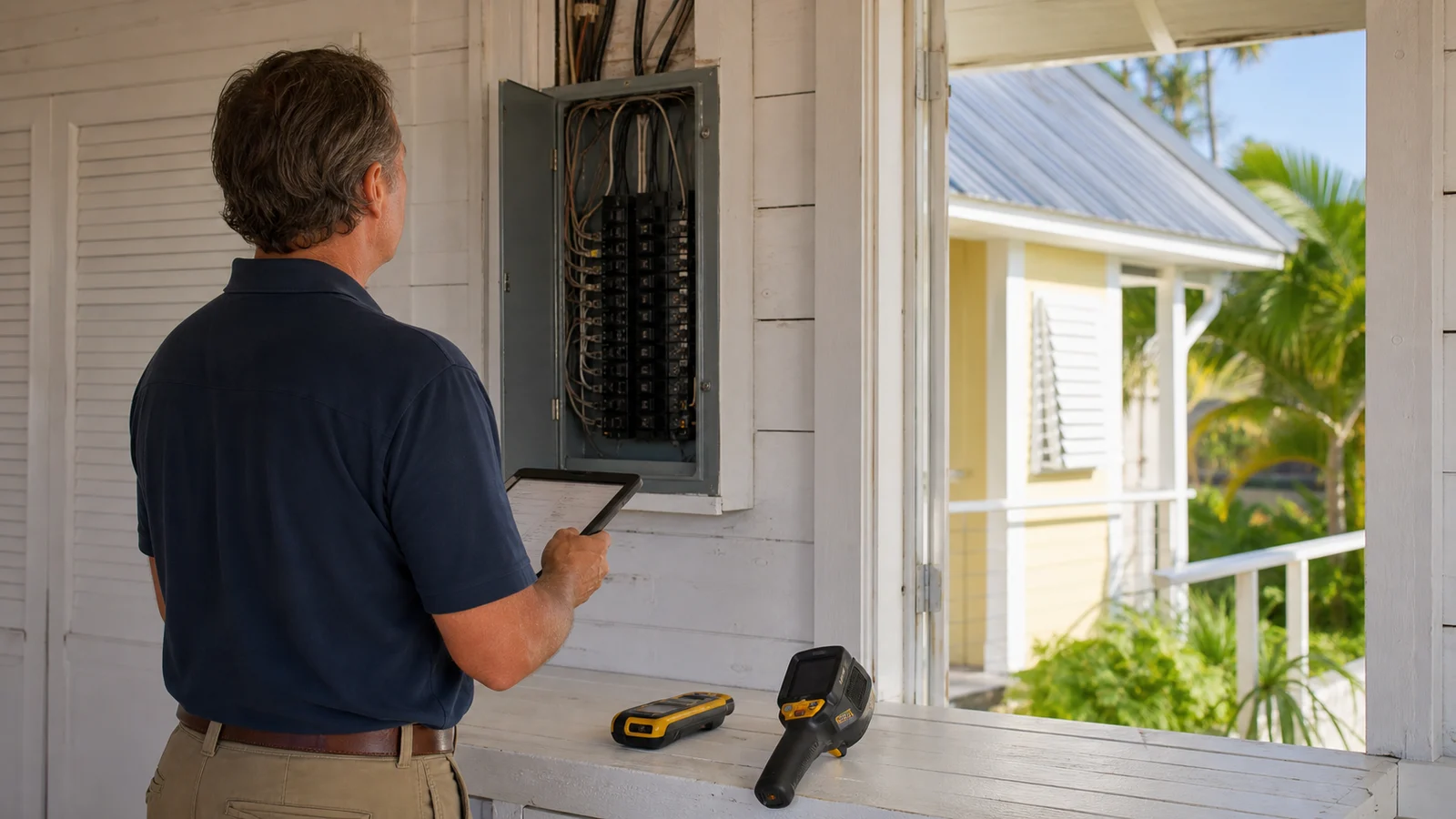
A Key West inspection has to answer more than whether the air conditioner turns on. The useful questions concern the structure and roof, wind-resistance documentation, electrical and plumbing condition, moisture paths, salt exposure, elevated construction, attached exterior components, insurance forms, and what the inspector could not see. A short insurance inspection and a full buyer inspection are different products; ordering one does not quietly include the other.
The five companies below publish a Key West or Florida Keys service connection and enough first-party detail to compare. All Islands and FL Keys Home Inspections identify Key West bases. Waypoint is based in Sugarloaf Shores and explicitly serves Key West. Paw-fect publishes Key West within a wider Central and South Florida territory. Wahoo is based in Key Largo and says it serves all of the Florida Keys. Those distinctions matter for travel, scheduling, local familiarity, and how each profile is described.
Request a comparable inspection proposal
Send the property and deadline once
Include the address, property type, size, age, occupancy, contract deadline, insurance-form needs, special components, access, known limitations, report deadline, and who may authorize add-ons. Do not include entry codes.
Local businesses compared
These are identity-checked local profiles, not paid placements. The fit notes describe differences supported by current official information; ratings shown remain attributed to their outside source.
- Verified base
- 21 Bamboo Terrace, Key West
- Published coverage
- Key West to Big Pine Key
- Service scope
- Residential, condo, commercial, wind mitigation, four-point, roof certificates, drone, and thermal imaging
- Credential evidence
- Official site publishes Florida home-inspector license HI12393; verify current status with DBPR
- Independent signal
- Google Places aggregate snapshot: 5.0 from 35 reviews, captured April 30, 2026; zero review bodies inspected
- Dispatch confirmation
- Confirm property type, deadline, included systems, add-ons, travel, access, report format, and reinspection terms
- Model
- Key West-based inspection company serving Key West through Big Pine Key.
- Best starting fit
- Buyers or owners who want a locally based inspector and may need residential, condo, commercial, wind-mitigation, four-point, roof-certificate, drone, or thermal work.
- Why it is on this list
- The official site identifies Chris Occhiuto, Florida license HI12393, phone 305-240-5641, service from Key West to Big Pine Key, and a Key West address. Its service pages describe residential, condo, commercial, wind-mitigation, four-point, roof-certificate, drone, and thermal-imaging work.
- Confirm before booking
- Confirm the current license directly with Florida DBPR, the exact agreement scope, price, report deadline, roof-access method, and which insurance forms are included. Provider-posted testimonials are not independent RealReviews submissions.
- Verified base
- Key West; Florida corporate record lists 1207 20th Terrace
- Published coverage
- Key West through Marathon
- Service scope
- Residential inspection is published; insurance and specialty work remains a phone confirmation
- Credential evidence
- The site says Florida licensed; the proposal still needs the assigned inspector's name and DBPR number
- Independent signal
- Google Places aggregate snapshot: 5.0 from 61 reviews, captured April 30, 2026; zero review bodies inspected
- Dispatch confirmation
- Before paying: exact scope, signer and license, report deadline, and any locked-room or roof limit
- Model
- Key West office; residential inspections advertised from Key West through Marathon.
- Best starting fit
- Home and vacation-property buyers who want a Key West-based residential inspection and a straightforward electronic-report conversation.
- Why it is on this list
- The official site identifies FL Keys Home Inspections LLC, Bob Guieb, phone 305-434-5369, Key West as its base, and service from Key West to Marathon. Florida corporate records show an active FL Keys Home Inspections LLC at a Key West principal address.
- Confirm before booking
- The reviewed public page does not provide a complete add-on menu, fee table, sample agreement, or license number. Verify the inspector's current DBPR license and ask separately about wind, four-point, pool, dock, WDO, mold, sewer, and reinspection scope.
- Verified base
- Sugarloaf Shores
- Published coverage
- Key West and the Lower and Middle Keys
- Service scope
- Buyer, pre-sale, four-point, wind, roof, mold/IAQ sampling, pool/spa, boatlift, thermal, dock, and seawall
- Credential evidence
- Official site publishes Florida home-inspector license HI14391 and InterNACHI certification; verify both current records
- Independent signal
- Google Places aggregate snapshot: 5.0 from 66 reviews, captured April 30, 2026; zero review bodies inspected
- Dispatch confirmation
- Confirm the exact included and add-on reports, travel, lab charges, above-water limits, delivery time, and reinspections
- Model
- Sugarloaf Shores-based inspector explicitly serving Key West and the Lower and Middle Keys.
- Best starting fit
- Properties needing a full inspection plus clearly advertised Keys-oriented add-ons such as wind, four-point, roof, pool, boatlift, dock, seawall, thermal imaging, or mold and indoor-air-quality sampling.
- Why it is on this list
- Waypoint's site gives 305-741-5312 and Florida license HI14391, places the business in Sugarloaf Shores, and includes Key West in its territory. Buyer and pre-sale inspections appear separately from wind, four-point, and roof reports. The same site offers mold or indoor-air-quality sampling, pool and spa work, boatlift and thermal services, plus an accessible above-water look at docks and seawalls.
- Confirm before booking
- A dock or seawall visual inspection is not an underwater structural or engineering evaluation. Mold sampling is not the same as diagnosing a moisture source or defining remediation. Verify license status, travel, add-on qualifications, laboratory terms, and the precise report boundary.
- Verified base
- Wider Central and South Florida operation; no Key West office verified
- Published coverage
- Central and South Florida, expressly including Key West
- Service scope
- Full residential, four-point, wind mitigation, and mold testing
- Credential evidence
- Verify the assigned inspector and current Florida license directly before booking
- Independent signal
- Google Places aggregate snapshot: 5.0 from 14 reviews, captured April 30, 2026; zero review bodies inspected
- Dispatch confirmation
- Confirm assigned inspector, Key West travel total, date, arrival window, forms, laboratory terms, and report delivery
- Model
- Central and South Florida inspection company that expressly includes Key West in its published service area.
- Best starting fit
- Customers comparing full residential, four-point, wind-mitigation, and mold-testing options who are comfortable confirming a long-distance service-area dispatch.
- Why it is on this list
- The official site lists Key West among its service areas, phone 786-702-9160, and full residential, four-point, wind-mitigation, and mold-testing services. It describes a father-daughter operation and electronic scheduling.
- Confirm before booking
- The evidence supports Key West service, not a Key West office. Confirm which inspector will travel, that person's current license, the complete travel charge, arrival reliability, reschedule terms, lab fees, and report deadline.
- Verified base
- Key Largo
- Published coverage
- All of the Florida Keys
- Service scope
- General home inspections and photo-supported reports; confirm insurance and specialty add-ons
- Credential evidence
- Official site calls the inspector certified; verify the specific current Florida license and any additional credentials
- Independent signal
- Google Places aggregate snapshot: 5.0 from 10 reviews, captured April 30, 2026; zero review bodies inspected
- Dispatch confirmation
- Confirm Key West travel and timing, assigned inspector, current license, full scope, report sample, and add-on availability
- Model
- Key Largo-based home inspector publishing service across all of the Florida Keys.
- Best starting fit
- Buyers who want another Keys-wide comparison and can schedule around a Key Largo dispatch to Key West.
- Why it is on this list
- The official site identifies Aaron Gray, phone 305-240-5627, a Key Largo base, service across all of the Florida Keys, and photo-supported inspection reports. Florida corporate search results identify Wahoo Inspections LLC as active.
- Confirm before booking
- Do not interpret the Key West directory route as a Key West office. The reviewed page does not publish a full service matrix, license number, fixed Key West travel price, or sample report. Verify all four before booking.
Order the inspection product that answers your decision
Florida's statutory definition is narrower than many buyers expect. The job is a limited visual examination of readily accessible structure, electrical, HVAC, roof covering, plumbing, interior, exterior, and site conditions that affect the structure, followed by a written professional opinion. Readily accessible is the important boundary. The opinion records observable conditions on the inspection date; it is not destructive testing, a code certificate, an appraisal, a repair bid, an insurance decision, or a promise that concealed defects do not exist.
A buyer under contract usually needs a full residential inspection. A four-point inspection is built around roof, electrical, plumbing, and HVAC information for an insurer. A wind-mitigation inspection records construction features used in wind-rating decisions. These reports can overlap in what the inspector sees, but they use different forms and serve different recipients. Ask for each deliverable by name. If the quote says only home inspection, do not assume the insurer's forms are included.
Match specialty components to separate scope. A pool and spa, dock, seawall, boatlift, detached structure, guest unit, crawlspace, cistern, generator, solar equipment, sewer lateral, termite or other wood-destroying organisms, mold sampling, and commercial use can require an add-on or another qualified professional. The proposal should say who performs it, the standard used, what is excluded, and whether it arrives in the same report.
- Buying the property? Order the full residential inspection and its written report.
- Sending documents to an insurer? Name the four-point or wind-mitigation form in the order exactly as the carrier names it.
- Pools, docks, seawalls, lifts, and other special components need a written add-on or a separate specialist. Repair prices come from the licensed trade; structural design and capacity questions go to an engineer.
Compare the five companies by location and published scope
All Islands has the strongest documented exact-Key-West identity in this group: its site gives a Key West address, a Key West-to-Big-Pine service area, named inspector, license number, and several local service pages. FL Keys Home Inspections also identifies Key West as its base and limits its public territory to Key West through Marathon, but its inspected page offers less detail about add-ons. For a buyer who prioritizes a locally based operator, those are the first two calls.
Waypoint is not presented as a Key West office. Its site says the company is based in Sugarloaf Shores and serves Key West plus the Lower and Middle Keys. It publishes the broadest specialty menu: wind, four-point, roof, pool, boatlift, dock, seawall, thermal imaging, and mold or indoor-air-quality sampling. That breadth is useful only when each add-on's method and limit fit the property.
Paw-fect covers Key West within a much larger Central and South Florida territory. Wahoo is more geographically focused on the Keys but identifies its base as Key Largo. Both can be valid service-area candidates. The comparison question is not whether either appears on a Key West results page; it is who will arrive, from where, on what date, for what all-in travel and inspection price.
- Exact Key West base: All Islands and FL Keys Home Inspections.
- Lower Keys base with explicit Key West service: Waypoint.
- Wider South Florida service area expressly naming Key West: Paw-fect.
- Key Largo base with Keys-wide service: Wahoo.
- A service-area listing is not evidence of a local storefront.
Build a Key West property brief before asking for price
Send every candidate the same facts: address, property type, approximate year and size, number of structures and units, occupied or vacant status, contract and report deadlines, known access limits, utilities that are off, and every requested insurance form or specialty component. Include whether the property is a single-family home, condo unit, duplex, elevated home, historic property, vacation rental, or commercial building. A low quote based on one unit and no pool is not comparable with a quote that includes a guest structure, pool, wind form, and return trip.
Identify the systems without diagnosing them. Note roof type if known, electrical panels, number of HVAC systems, water heater type, pool or spa, dock, seawall, boatlift, crawlspace or elevated underside, detached buildings, generator, solar, cistern, and visible additions. State whether the seller or association controls access to the roof, attic, crawlspace, utility rooms, common areas, and records.
Consider a quote for Unit 304. ‘Condo inspection’ leaves the boundary unclear; ‘Unit 304 only—the association controls the roof, structure, elevator, and seawall’ prices a defined job. The inspector can still record a stain or crack visible inside the unit. What the order cannot do is turn that observation into an inspection of inaccessible common property, association reserves, or milestone obligations. Those answers live in association records and the applicable engineering reports.
- Write the quote header the way the property will be inspected: address, property type, approximate age and size, unit count, and detached structures.
- The three dates that can change the purchase belong together: appointment, promised report, and contract decision deadline. Wind, four-point, and specialty work should sit beneath them as named deliverables.
- Name the person who can open each restricted area. A locked roof hatch and an association-controlled utility room create different limits; a pool, dock, lift, generator, solar array, guest unit, or addition should not disappear inside the word ‘extras.’
Treat wind mitigation and four-point reports as separate deliverables
If the carrier asks for wind mitigation and a four-point, buy two named reports. The wind report addresses observable construction features such as roof covering and geometry, deck and wall connections, secondary water resistance, and opening protection. A connection hidden by finishes may stay unverified. The completed form supplies evidence; the carrier still makes the underwriting and premium-credit decisions.
The four-point answers a different set of carrier questions about the roof, electrical, plumbing, and HVAC systems. It is not a discount version of a buyer inspection. Send the carrier's current request before scheduling; the proposed signer, form version, photographs, and license type need to fit that request. A completed form still does not compel the carrier to write coverage.
When an electrical photograph creates an underwriting problem, call the carrier and the electrician for different reasons. The carrier can say what paperwork will close its file—a permit, letter, invoice, new photographs, or another inspection. The electrician can say what is actually wrong and what work makes sense. Price a possible return visit at the outset; insurance can run on a shorter clock than closing. If the inspector could not see a wind feature, the form should say exactly that. It did not pass merely because it was hidden.
Make the inspection respond to Keys construction and exposure
‘Corrosion observed’ is almost useless on its own. ‘Ocean-facing side of the outdoor condenser cabinet’ gives the buyer somewhere to look and a contractor something to discuss. Water notes need that same address-level precision: the window, roof penetration, deck connection, flashing joint, or drain shown in the photograph.
An older front room, a later rear enclosure, and the open area beneath a raised house deserve separate report entries. One page may show a stain near the front opening. Another may show different materials and repairs in the enclosure. Beneath the house, the useful photograph identifies the pier, stair, guard, connection, or utility in view. None of those observations dates concealed work or proves code compliance; they tell the buyer where a records search or specialist visit should begin.
Meter and infrared results should be modest. A meter reading belongs to the spot that was tested. A thermal image shows a temperature pattern. Neither establishes the cause or clears the rest of the room. The ordinary photograph, reading or thermal image, and written note should all point to the same location; otherwise the add-on leaves the buyer with an interesting picture and no reliable next question.
Separate mold sampling from moisture investigation
Start with the cabinet, not the lab. If a base cabinet smells musty beneath a window, the first record should show the odor or damage location, the visible window or plumbing path, and any meter reading taken at that spot. Access may end at the finished wall or cabinet back. The resulting note can justify a roofer, plumber, HVAC contractor, or licensed mold assessor, but it cannot describe a concealed cavity or clear the rest of the house.
Sampling makes sense only when its result changes a purchase decision. For example: must the buyer obtain a licensed assessment of this named cabinet area before the inspection period ends? Put the sample locations, collector, laboratory method, price, turnaround, and sample-count limit in the order. The result belongs to those collections on that date; it is not a map of every moisture source. Verify the collector's credential and remember that Florida treats assessment and remediation as separate services.
Waypoint and Paw-fect advertise mold-related testing or sampling, so the comparison may include that published service. It does not prove either company is authorized to remediate. Keep inspection, assessment, laboratory analysis, remediation, and clearance under their proper names. Active leaks, sewage, fire residue, extensive damage, or an occupant-health concern should go to the professional qualified for that problem rather than being folded into an undefined buyer inspection.
Price the complete assignment, not one attractive number
None of the five compared companies published a complete Key West rate card on the pages reviewed. Two outside examples show why a single statewide average is weak. A South Florida company serving Broward, Miami-Dade, and Palm Beach publishes $499 for a house up to 2,000 square feet and $329 for a condo up to 2,000 square feet, including a full inspection, four-point, wind mitigation, and limited repair verification. A separate mainland provider publishes a $375 residential starting price plus $250 to $400 for Key West travel. That second example produces $625 to $775 before size or add-ons, but it is a route-price example from one provider, not the Key West market rate.
Use those figures only as quote-structure evidence. Local inspectors may have little or no travel charge and different inclusions. A seemingly lower total can omit wind or four-point forms, pool, dock, detached structures, older-home surcharge, extra HVAC systems, sampling, laboratory fees, same-day delivery, weekend scheduling, or reinspection. Ask each candidate to return a single all-in proposal with every requested line item.
Remote buyers should ask one blunt scheduling question: what could force a paid second trip? The answer may involve shut-off utilities, a tenant, association-controlled rooms, a locked attic or roof hatch, pets, an alarm, parking, or nobody available onsite. Put the responsible contact and return charge in the quote. The cheapest first appointment is not cheapest if an inaccessible component pushes the complete report past the deadline.
- Line one should price the base inspection against a named property type, size, age, unit count, and structure count. A line that says only ‘inspection’ cannot be compared.
- Below it, mark each wind, four-point, pool, dock, seawall, boatlift, mold, WDO, or sewer item as included, excluded, or separately priced. Travel, parking, after-hours work, rush delivery, laboratory work, and card charges belong there too.
- The bottom of the quote is for contingencies: reinspection eligibility and price, cancellation and rescheduling, inaccessible components, and the cost of a return trip.
Judge the sample report before the appointment
Put two sample reports side by side and open one roof finding in each. The stronger entry names the roof area, states what was observed, pairs it with the right photograph, explains why the condition matters, and points to the appropriate next evaluator. Its summary links back to the detail. A colored badge with no location or a generic command to repair gives a buyer nothing dependable to investigate or price.
Ask what ‘report tonight’ includes. The PDF may arrive before the drone photographs, insurance forms, thermal files, or lab result. Get the later delivery times too, along with a review-call window and a way to correct a wrong address, model number, or room label. Fast is valuable only if the buyer receives the whole usable file before the decision date.
We would keep the sentence ‘East roof slope viewed by drone; not walked.’ It says where the inspector looked, how, and what access was missing. ‘Roof inspected’ says none of that. A blocked wall, sealed attic hatch, dead utility, unreachable pool equipment, or dock viewed only above water should be recorded just as plainly. That unresolved limit may justify another visit.
- Good roof note: ‘East slope, lifted shingle at the second vent,’ beside a photograph of that vent.
- Weak limit: ‘not accessible.’ Better: name the component, attempted viewing method, and question left open.
- After the attachments arrive, download the complete file rather than leaving parts scattered across email links.
Verify the inspector, agreement, and conflicts
DBPR licenses people. That is why the name to search is the inspector assigned to the appointment, not merely the company collecting payment. Match the returned name and status to the proposal, and repeat the search if somebody else is sent. Sunbiz records and association badges answer other questions; they do not replace the Florida occupational-license result.
The agreement should be readable before cancellation becomes costly. Locate the inspection standard, promised scope, exclusions, fee, liability language, dispute route, report-use rights, cancellation terms, and reinspection policy. If the deal calls for liability or errors-and-omissions coverage, ask for the current document. A checked box is not the document.
One disclosure question is worth saving verbatim: ‘Does anyone connected with this company get paid for the repair or referral being recommended?’ A referral may help, but it does not prove a diagnosis. Keep the answer with the signed agreement and add the report, photographs, specialist findings, permits, invoices, repair proof, and replacement insurance forms to the same property file over time.
- Before the appointment, resolve any mismatch among the assigned name, DBPR result, agreement, invoice, and payee.
- Keep the pages that govern exclusions, liability, disputes, report use, and reinspections—not just the signature page.
- File required insurance evidence and any repair, referral, affiliate, or other financial disclosure with the agreement.
Use the report to make decisions before the deadline
Start with the finding, not a generic repair list. For ‘East slope, lifted shingle at the second vent,’ save the matching photograph and write down the missing answer. Is it condition, cost, permit history, timing, or insurer acceptance? Send that question to the person who can answer it—the relevant trade, engineer, records office, or carrier. Active water, electrical danger, structural concern, a failed major system, an insurance obstacle, and an inaccessible high-risk area come before paint and routine upkeep.
What happens next depends on the contract. The record might show that the buyer accepted the issue, requested a document, ordered specialist work, obtained a price, opened a negotiation, or discussed withdrawal. It should not jump automatically to ‘seller must repair.’ Inspectors report observable conditions; trades diagnose and price their work; carriers decide coverage; agents and attorneys explain transaction choices within their own roles.
For a remote purchase, book calls and specialist access while the property is still available. Attach the matching roof permit, electrical or plumbing record, HVAC history, association document, insurance request, flood or elevation information, or seller disclosure to the finding it informs. Decide before seller work begins whether acceptable proof is a receipt, permit, trade letter, photograph, or paid reinspection. A recheck records observable completion of named work; it is not a repair warranty.
- Example row: buyer's agent owns the electrician appointment; written answer due Tuesday at 3 p.m. The responsible person and deadline should be just as explicit for an inspector, engineer, insurer, association, attorney, estimate, or negotiation response.
- Before seller work starts, choose the proof that will close it: receipt, permit, trade letter, photograph, or paid reinspection.
- After closing, store the final report, attachments, decisions, and repair proof with the property's permanent records.
Sources and verification
Rules and public requirements link to the responsible agency. Business-specific service claims are checked against privately retained official material, while public ratings remain attributed to their original source. RealReviews does not turn outside reviews into invented testimonials, blend unrelated platforms into a house score, or sell placement in these comparisons. Recheck licenses, availability, scope, and price before hiring.
Frequently asked questions
How much does a home inspection cost in Key West?
Budget from complete written quotes, not one island-wide average. The five compared firms do not publish full Key West rate cards. One mainland provider currently publishes a $375 residential starting price plus $250 to $400 for Key West travel, or $625 to $775 before size and add-ons; that is one company's route price, not the local market. Request an all-in total covering property size and age, travel, full inspection, wind and four-point forms, pool or dock work, sampling, laboratory fees, expedited delivery, and reinspection.
Is a four-point inspection the same as a full home inspection?
No. A four-point report concentrates on roof, electrical, plumbing, and HVAC information for insurance underwriting. A full buyer inspection covers a broader set of accessible residential systems and produces a professional opinion for the purchase decision. Order both by name when both are needed.
Do I need both a wind-mitigation and four-point inspection?
Yes—order both when the carrier requests both; neither replaces the other. Wind mitigation documents observable construction features used in wind-rating decisions. A four-point reports roof, electrical, plumbing, and HVAC information for underwriting. The buyer inspection remains a separate, broader examination. Even correctly signed forms provide evidence rather than a promise of coverage or a premium credit.
How long should I allow for a Key West inspection and report?
Set the report deadline first: it should fall at least 3 days before the contract decision date so questions, specialist visits, and estimates still fit. Then work backward to the appointment. Ask for the onsite duration and delivery promise in writing. A small condo and an old, elevated, waterfront, or multi-structure property should not be assigned the same field-time assumption.
Does a condo inspection cover the whole building?
No. A Unit 304 inspection covers the boundary written into that order. A stain inside the unit may be reported, but it does not mean the association's roof, structure, elevator, seawall, reserves, or milestone obligations were inspected. Use association records and the applicable engineering reports for those building-level questions, and order separate qualified review when the purchase depends on one.
Will a home inspector check the dock, seawall, pool, or boatlift?
Only when the quote names that component. No dock, seawall, pool, or boatlift line means it is not safe to assume the base inspection includes it. Waypoint publishes those items as add-ons and calls its dock and seawall work an accessible, above-water visual evaluation. Underwater structure, load capacity, marine electrical work, and engineering conclusions remain separate.
Can a home inspection prove there is no mold?
No. A swab taken beneath one stained window describes that collection on that date; it does not clear the wall cavity or the next room. The inspection can still record odor, visible growth, staining, damaged finishes, meter readings, and a possible moisture path. If a sample will change the purchase decision, agree on its location, laboratory, chain of custody, price, and turnaround before collection.
How do I verify a Florida home inspector?
Ask who is actually coming, then search that person's legal name or license number in Florida DBPR. The returned name and status should match the proposal. Search again if the company substitutes another inspector. DBPR confirms the occupational-license record, not workmanship, so still read a sample report and the contract. Confirm the payee too, and obtain current liability or errors-and-omissions evidence when the transaction calls for it.