
Key West minor-repair guide
Key West Handyman Services: What to Hire, What Needs a Licensed Trade
Compare Key West handyman services for minor repairs, maintenance, painting, assembly, storm preparation, remote-owner work, pricing, insurance, permits, and licensed-trade boundaries.
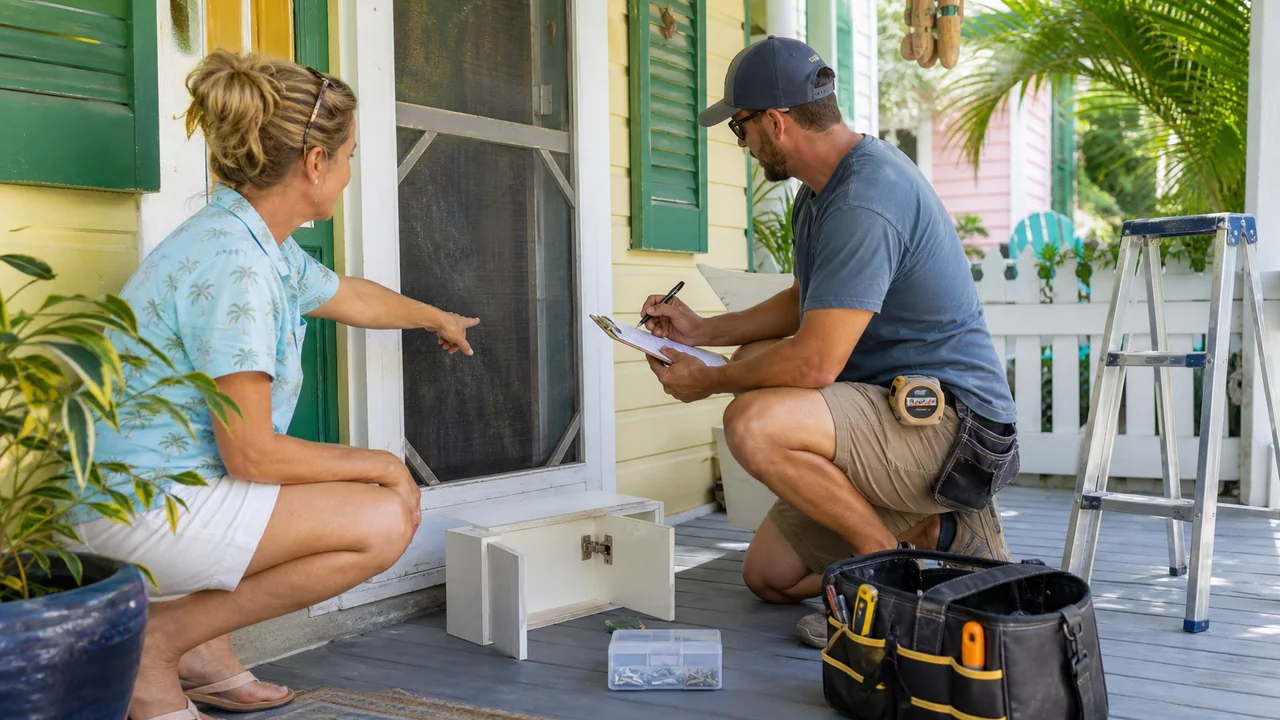
A good handyman closes the small-work gap: doors that drag, hardware that loosens, trim that needs repair, furniture that needs assembly, walls that need patching, and recurring property tasks that are too limited for a renovation contract. The value comes from competent execution, a clear scope, reliable access, and a written closeout.
The handyman label does not authorize every repair. Monroe County says it does not issue a handyman license, while electrical, plumbing, mechanical, roofing, structural, gas, and other regulated work may require the appropriate contractor credential and a permit. In Key West's historic district, exterior work can also require a Certificate of Appropriateness. Classify the job before selecting the person.
For a Key West repair list
Send one scoped task list to local providers
Include photographs, measurements, preferred materials, access, timing, occupancy, and the decision deadline. The intake separates ordinary repairs from work that needs a licensed trade.
Local businesses compared
These are identity-checked local profiles, not paid placements. The fit notes describe differences supported by current official information; ratings shown remain attributed to their outside source.
- Model
- Key West and Florida Keys property-maintenance provider advertising residential, commercial, realtor, preventive-maintenance, and storm support, with direct work limited by its published license-and-permit disclaimer.
- Best starting fit
- A Key West owner with a consolidated list of small non-permit repairs and maintenance items.
- Why it is on this list
- The official homepage describes maintenance, repairs, improvements, and project support, then states that work requiring a specialized contractor license or permit is referred to or coordinated with affiliated contractors.
- Confirm before booking
- The site states that the company is a Florida corporation with general liability insurance, but those first-party statements are not a current certificate or contractor credential. Verify direct scope, insurance evidence, pricing, crew, and every referred entity.
- Model
- Lower Keys service-area provider advertising home maintenance, minor repairs, yard work, hurricane preparation, debris removal, and property care.
- Best starting fit
- An owner from Key West through the Lower Keys who wants recurring minor work and storm-preparation tasks quoted together.
- Why it is on this list
- The current official site identifies a Big Pine Key base and a Key West-to-Marathon service area with maintenance and property-care offerings.
- Confirm before booking
- The site says insured but does not publish a contractor license number. Confirm the responding entity, insurance, travel charges, and scope; move regulated or permit work to the credentialed trade.
Decide who is legally suited to the job before asking for a price
A Key West owner can save a round of useless estimates by classifying the task first. Painting an interior wall, assembling furniture, replacing weatherstripping, hanging a shelf, or adjusting cabinet hardware may belong in the handyman lane. That changes when the job reaches wiring, plumbing, air-conditioning or refrigeration, roofing, gas, a structural member, or another regulated system.
The visible symptom is not always the scope. A loose switch plate is one thing; opening the box and altering a circuit is another. Touching up painted fascia is not the same job as repairing the roof edge behind it. The useful question for a provider is: what will you open, disconnect, alter, or replace?
Put uncertain exterior or regulated work on hold until the City or a properly licensed contractor classifies it. That is especially important inside the historic district. A handyman who refers a task out is showing judgment. If someone dismisses a permit question because the invoice is small, ask for the applicable rule or confirm it directly with Key West.
- A sticking interior door, loose cabinet pull, furniture assembly, or ordinary weatherstripping can stay on the handyman request only while the task remains minor maintenance.
- A switch, pipe, air-conditioning component, roof edge, gas line, pool system, or other regulated assembly stops the handyman quote at the visible symptom. The properly credentialed trade owns the regulated work.
- Send the address, photographs, and proposed change to the City before pricing a structural change, visible exterior alteration, historic-district question, or any job whose permit status remains unresolved.
Write the punch list so two estimates describe the same job
Put this on the first line instead of “fix the bedroom door”: adjust the north-bedroom door until it closes and latches without rubbing; keep the existing hardware; touch up disturbed paint; photograph the final clearance. Now both bidders are pricing the same door and the owner has a completion test.
The next line cannot simply say “patch wall” if the source of a stain is unknown. Resolve the leak or damp material first. A shelf line should identify the wall construction and concealed-utility concern before drilling. An exterior-hardware line should name the compatible fastener and finish; “coastal grade” by itself does not specify a product.
The material entry belongs beside the task, not in a later text message. Name the buyer, model or finish, allowed substitute, return responsibility, and procurement markup. Also mark stocked items separately from special orders: island availability can otherwise convert one booked workday into two visits.
- Door 4A is accepted only after it closes and latches without rubbing. Leave the existing hardware in place, inspect the touched-up paint, and attach the final photograph to that item.
- For shelf 4B, mark the measured wall location on the photograph. Drilling stops if the substrate or concealed-utility check does not match the written assumption.
- The finish has its own purchasing instruction: the provider buys it, handles a return, and messages the owner before any substitute would exceed the approved amount.
- Tuesday's access window belongs on the work order with the parking direction, occupied rooms, noise limit, cleanup expectation, and real deadline.
Verify identity, insurance, and the scope-specific credential
Start with the payee line. If the estimate names one company, the invoice names a second, and the payment app shows an individual, pause the deposit until the provider explains the relationship in writing. Put the resolved legal name beside the website, phone, responsible owner, arriving worker, and W-9 when the property owner needs one. A mobile business may have no storefront; it still has to identify who is contracting for the work.
Next, date the insurance evidence. The file should contain current general liability proof plus workers' compensation coverage or a lawful exemption when that applies. An online “insured” badge is not the certificate, and a certificate can be checked with its listed agent or carrier when the risk warrants it. None of those documents grants permission to perform electrical, plumbing, roofing, mechanical, or other regulated work.
Run the credential search under the contracting name, not a similar trade name. Save the relevant class and status, the qualifier's relationship to the business, and any Key West or Monroe County registration that reaches this job. A promised licensed partner is a second contractor, not an extension of the handyman file: establish that entity's scope, price, credential, insurance, access, and payment recipient before the handoff.
- Payment stop: the contracting name, invoice name, and recipient have not been reconciled.
- Expiration stop: the liability or workers' compensation record is missing, stale, or belongs to somebody else.
- Scope stop: the saved license class does not cover the task being assigned.
- Referral stop: the second company has not yet supplied its own written scope and vendor records.
Check the parcel before ordering an exterior item
An exterior punch-list item can become a Historic Architectural Review Commission question even when the labor is brief. Key West says work in the historic district may need a Certificate of Appropriateness in addition to a building permit. Check the address and proposed change before purchasing a visible door, window, shutter, fence component, railing, light, roof item, equipment screen, or finish.
The estimate should name the person responsible for the application, drawings, product sheets, review appearance, and rejected-material fallback. A handyman can take measurements or perform an installation that is within lawful scope. That does not transfer permit responsibility or a required contractor credential to the handyman.
Salt, sun, wind, and moisture make material compatibility important. Fastener metal, coating system, wood species, sealant, and substrate preparation affect durability. Require the product and preparation in writing; coastal-grade is not a measurable specification.
- Property location and historic-district status.
- Exterior visibility and Certificate of Appropriateness screening.
- Permit, application, drawing, product, and inspection responsibility.
- Named material, fastener, coating, sealant, and preparation.
- Alternative if the proposed product or design is not approved.
Put an hourly bid and a fixed bid on one worksheet
Hourly pricing can be sensible for diagnosis or a mixed list with uncertain quantities. A fixed price is easier to compare when the finished result is already measurable. In either case, write down the crew size. A rate that sounds lower can become the expensive bid if it applies to two workers or carries a long minimum.
Write $505 beside the hourly bid: one worker for four hours at $95 is $380; add $80 of material and $45 for parking or travel. The arithmetic is illustrative, not a Key West market average. Write $575 beside the fixed bid for the same numbered work. The extra $70 buys certainty only if ordinary material and parking are included and disposal, procurement, and a return visit are not waiting outside the total.
Cap the hourly route with a not-to-exceed amount and a stop-for-approval point. On the fixed route, identify a likely concealed condition and add a unit price when one is practical. If the job changes, record the finding while it is visible, the scope difference, price effect, schedule effect, and owner approval before work continues.
- Hourly column — crew count, minimum, estimated hours, $505 worked total, and the not-to-exceed ceiling.
- Fixed column — $575, the numbered scope, its completion test, and every stated exclusion.
- Below both columns — travel, parking, material markup, disposal, equipment, tax, overtime, return visit, deposit, progress trigger, final inspection, and applicable lien documents.
- If the wall, door, or substrate reveals something else — stop, photograph it, price the change, and obtain written authorization.
For an absent owner, treat entry and proof as two separate records
A Tuesday entry record might say: temporary code active from 8:45 a.m. to 1:30 p.m.; alarm contact is the manager; the rear owner closet stays closed; no guest images; street-parking instruction attached. Do not send the property's permanent shared credential.
The work record begins when the provider arrives. Attach the before image to the task number, log any condition that conflicts with the estimate, and obtain approval before improvising. At departure, add the after image, receipts, removed-item disposition, cleanup view, and itemized invoice. Crop photographs so guest or tenant information is not swept into the file.
A local manager may operate the repaired door and confirm that the room was left clean. Label that as a visible closeout, not electrical, structural, mold, or other technical clearance. Any licensed professional's approval belongs in the owner-controlled folder as a separate record.
- 8:45 a.m. — temporary credential activates; manager and alarm instructions are on the entry sheet.
- 8:58 a.m. — task-numbered before images; a differing condition pauses the job for owner approval.
- 1:18 p.m. — after images, receipts, removed items, cleanup, and invoice; technical signoff remains with the qualified trade or inspector.
Do not bury hurricane preparation inside an ordinary punch list
Store storm work as two orders: preparation/installation and later removal. The first may cover fitted shutters, named exterior objects, owner belongings, and a completion report. It does not turn into roof repair, generator wiring, structural alteration, unqualified tree work, or another licensed trade because a storm is near.
Do the physical matching before the season. Mark each panel for its opening, photograph the hardware, test the tools, and list missing parts. The activation sheet then names the trigger and latest safe start. Add Monroe County's loose-object, water, refrigeration, boat, and move-items-up guidance only where it fits this property.
Price installation and removal separately. The provider should disclose how simultaneous client calls are ordered and when evacuation timing or an official order makes a task unsafe or impossible. The owner needs an unfinished-work notice at that point; no service promise overrides those conditions.
- Before the season, make one contact sheet that shows every opening beside its matching panel and hardware; add the tool test and missing-parts order to the same file.
- The activation order is signed later. It states the owner's trigger, the provider's queue rule, the lawful task list, and the latest safe start.
- Removal is a separate authorization. Dated completion images and any unfinished-work notice close the installation order first.
A stain or crack changes the ticket
Suppose trim removal reveals soft material, staining, visible growth, frass, termite tubes, active leakage, corrosion, movement, or a crack that was not in the estimate. Photograph the location and pause that task. Until the source and lawful scope are known, new paint or patching would hide evidence and may enlarge the eventual repair.
Active water needs source control and prompt drying. EPA recommends drying water-damaged materials within 24 to 48 hours when possible. Suspected mold assessment or remediation can require Florida-licensed individuals and role separation. Structural pest treatment is regulated by Florida agriculture authorities. Structural movement may need a licensed contractor or design professional.
Put an escalation allowance in the schedule. The owner should not force the handyman to finish patching a wet wall to preserve a checkout date. Open a separate ticket, assign the proper professional, and return to finish work after the source and material condition are resolved.
- Stop before covering an unexplained wet, damaged, infested, or moving assembly.
- Photograph location and condition without unsupported diagnosis.
- Route water, mold, pest, structural, and trade conditions correctly.
- Resume cosmetic work only after the source and scope are resolved.
Give a new handyman one ordinary workday to prove the process
Use an ordinary Tuesday, not a storm call or the entire backlog. Assign the north-bedroom door, one modest finish repair, and a measured installation. By lunch, the owner should know whether the provider read the task numbers, protected the property, stopped when a condition differed, and kept the estimate's closeout promise.
Inspect the work rather than grading the conversation. Operate the door. Measure the mounted item. Look at the patch in normal daylight. Check the material receipt, removed item, photographs, cleanup, and invoice against the task numbers. A willingness to stop at a licensing boundary counts in the provider's favor.
A clean first job can earn the next ordinary punch list, not every future category of work. Keep a second qualified contact. Revisit insurance and credentials when the scope changes. Familiarity should make the owner file more complete over time; it is not a reason to stop keeping one.
- If all three task records match the finished work, the rooms were protected, and surprises were raised before improvisation, the provider has earned another comparable punch list.
- One repairable finish or paperwork defect calls for a named correction and a second inspection—not an immediate recurring assignment.
- Even a clean Tuesday does not qualify the same company for a new trade. Set any maintenance cadence separately, keep a backup contact, and reopen credentials when the work category changes.
Understand the two current service models on the shortlist
Square Property Maintenance's official homepage advertises broad maintenance and improvement capabilities but places a legal boundary in its footer: direct work is limited to general handyman, maintenance, repair, and improvement services that do not require a specialized contractor license or permit. It says regulated work is referred to or coordinated with affiliated contractors. Verify every referred entity separately.
Florida Keys Home Services publishes a Big Pine Key base and Key West-to-Marathon service range, with home maintenance, minor repairs, yard work, hurricane preparation, debris removal, and property care. Its public site does not prove authority for a regulated trade; classify each task before requesting a quote.
Only these two current RealReviews profiles passed the identity, geography, and present-service-scope checks for this comparison. That is not enough for a credible rank order. Recheck each official domain, phone, service area, legal scope, and insurance when requesting a quote because a directory category or older description can outlive the business's current offering.
- Start with Square Property Maintenance when the request is a consolidated Key West maintenance list, then hold its direct work to the company's published license-and-permit boundary.
- Florida Keys Home Services is the geographically different option: it publishes a Big Pine Key base, service from Key West to Marathon, and a maintenance and property-care menu.
- Either company receives the identical numbered list. Compare the reply for current insurance, an actual date, travel treatment, task-level scope, and the credential or referral assigned to any regulated item.
Sources and verification
Rules and public requirements link to the responsible agency. Business-specific service claims are checked against privately retained official material, while public ratings remain attributed to their original source. RealReviews does not turn outside reviews into invented testimonials, blend unrelated platforms into a house score, or sell placement in these comparisons. Recheck licenses, availability, scope, and price before hiring.
Frequently asked questions
Does Key West or Monroe County issue a handyman license?
No. Monroe County does not offer a catch-all handyman license. It separately warns consumers to check the contractor credential required by the work itself. Electrical, plumbing, mechanical, roofing, structural, gas, and other regulated scopes can still require the proper license, local registration, and permits even when the invoice is small.
Can a Key West handyman do electrical or plumbing work?
No, not merely under the handyman title. Work that alters electrical wiring, circuits, panels, plumbing systems, or another regulated trade belongs with the properly licensed contractor. Describe the exact task and verify the credential and permit requirements before authorizing it.
How much does a Key West handyman cost?
Use a written task-based proposal because no verified Key West market average supports a universal rate. For planning, RealReviews illustrates a four-hour minimum at $95 per hour plus $80 materials and $45 parking or travel: $505 for one worker before tax. Replace those inputs with live quotes and confirm crew count, minimum, markup, disposal, overtime, and change orders.
Does minor exterior work in Old Town need approval?
Yes, it can. Key West says exterior work in the historic district may require a Certificate of Appropriateness in addition to any building permit. Check the property and proposed change with the City before ordering doors, windows, shutters, fencing, lighting, roofing, or other visible materials.
Should a handyman carry insurance?
Yes. Obtain current general liability evidence and workers' compensation coverage or lawful exemption as relevant, match it to the contracting entity, and confirm it when the risk warrants. Insurance does not substitute for a trade license or permit when the work requires one.
Can a handyman prepare my Key West home for a hurricane?
Yes—if the work order was settled before the storm and stays within lawful handyman scope. Fitted shutters and a photographed list of exterior items are reasonable examples. On a RealReviews quote request, spell out the trigger for dispatch, the last safe start, how simultaneous clients are ordered, and how incomplete work will be reported. Roof, electrical, generator, structural, regulated tree, and other trade work still belongs with the appropriately qualified provider.
How should a remote owner verify handyman work?
RealReviews uses a reconstruction test for remote jobs: the owner should be able to account for the visit without relying on the provider's summary. Keep the numbered task list, the individual time-limited access record, arrival and departure notices, before-and-after photographs, approvals for exceptions, receipts, removed-material disposition, the actual completion tests, and the itemized invoice. Store the package—and any credential record—in a folder the owner controls.